ChatGPT Now Connects to Your Bank: OpenAI Personal Finance Launch Sparks Privacy Debate
TL;DR
OpenAI partners with Plaid to let ChatGPT Pro users link 12,000+ financial institutions. Spending analysis, portfolio tracking, financial planning — but users are asking hard privacy questions.
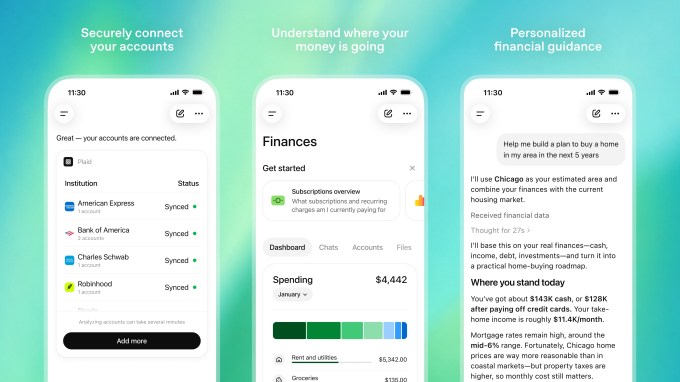
ChatGPT’s personal finance feature launched in preview on May 15, 2026, for U.S. Pro subscribers. OpenAI partnered with Plaid, the financial data infrastructure company, to let users link their bank and investment accounts directly to ChatGPT — then simply ask “Where did my money go this month?”
The move is not entirely surprising. Over 200 million people ask ChatGPT financial questions every month, but without real data, the answers are generic. OpenAI is now trying to fix that.
What You Can Connect — and What ChatGPT Can See
Through Plaid, ChatGPT now connects to more than 12,000 financial institutions, including Chase, Schwab, Fidelity, Robinhood, American Express, and Capital One. Once linked, a dashboard appears showing spending trends, subscription costs, recent transactions, and upcoming payments.
ChatGPT only has read access. It cannot see full account numbers or perform any transactions. According to TechCrunch’s coverage, the kinds of questions users can now ask include:
- “Am I saving enough for retirement?”
- “At my current savings rate, when could I buy a house?”
- “What’s my biggest spending category this month?”
OpenAI also previewed a future Intuit integration for tax impact analysis and credit approval estimates.
The User Reaction: “What Sane Person Would Do This?”
Tom’s Guide captured the internet’s mood in its headline: “What sane individual feels comfortable giving this level of access to OpenAI?”
The Hacker News thread was more specific. Most skepticism was not aimed at Plaid — Plaid has a track record in financial data — but at what OpenAI does with the data once it arrives. OpenAI says users can “control their data,” including a 30-day deletion period after disconnecting and the option to exclude financial conversations from model training. What the company has not spelled out is how the data is stored during those 30 days, or what happens in the event of a breach.
OpenAI faced a class action lawsuit in 2024 over claims it shared ChatGPT user data with Google and Meta. That history makes the current privacy assurances harder to accept at face value.
Why OpenAI Is Doing This
The business logic is clear. Personal finance is a high-retention use case. Once users connect accounts and build a conversation habit, the switching cost rises sharply. This is the same model that kept tools like Mint and YNAB sticky for years.
OpenAI acquired the core team behind personal finance startup Hiro one month ago. This launch is the direct output of that acquisition. CFO Sarah Friar also said on May 15 that the company may raise additional capital within six weeks, despite having closed a $122 billion round just recently.
The feature is currently limited to U.S. Pro subscribers, with a roadmap to expand to Plus after improvements. That framing suggests the product is still being tested, and OpenAI is betting users will accept an imperfect first version.
The Competitive Landscape for AI Financial Tools
Personal finance AI is not OpenAI’s race alone. Intuit is integrating generative AI across TurboTax and Credit Karma. Traditional banks have been rolling out AI financial assistants. The difference is scale: 200 million monthly active ChatGPT users dwarf any dedicated FinTech app.
For OpenAI, the challenge is not technical — it is trust. Financial data is far more sensitive than search history. Whether users hand over salary records, investment details, and loan information to an AI company depends entirely on how much trust that company has earned.
According to Bloomberg’s reporting, the long-term goal is for ChatGPT to function as a “personal financial advisor,” not just a question-answering tool. The direction makes sense. Getting there will take more than a dashboard.
If this was useful, subscribe to the newsletter for weekly AI PM insights and GenAI case studies.
Further reading:
Related Articles
OpenAI Launches Dots: Ongoing Work Should Not Become a Growing Review Queue
OpenAI is rolling out dots to eligible paid users for work that continues between conversations. Read-only background research and limited memory controls make missed commitments and accumulated review work more useful tests than activity alone.
EU Designates ChatGPT as a VLOSE: Four Months After the 45 million User Threshold
The European Commission designated ChatGPT a Very Large Online Search Engine under the DSA, giving OpenAI until January 2027 to address systemic risks including illegal content, minors’ well-being, and public security.