OpenAI and Google Team Up on Dual-Layer AI Image Authentication: SynthID Watermarking Comes to ChatGPT
TL;DR
OpenAI adopts C2PA and integrates Google's SynthID invisible watermark into ChatGPT images, plus a new public verification tool. Two AI rivals team up on deepfake detection, but does it actually work?
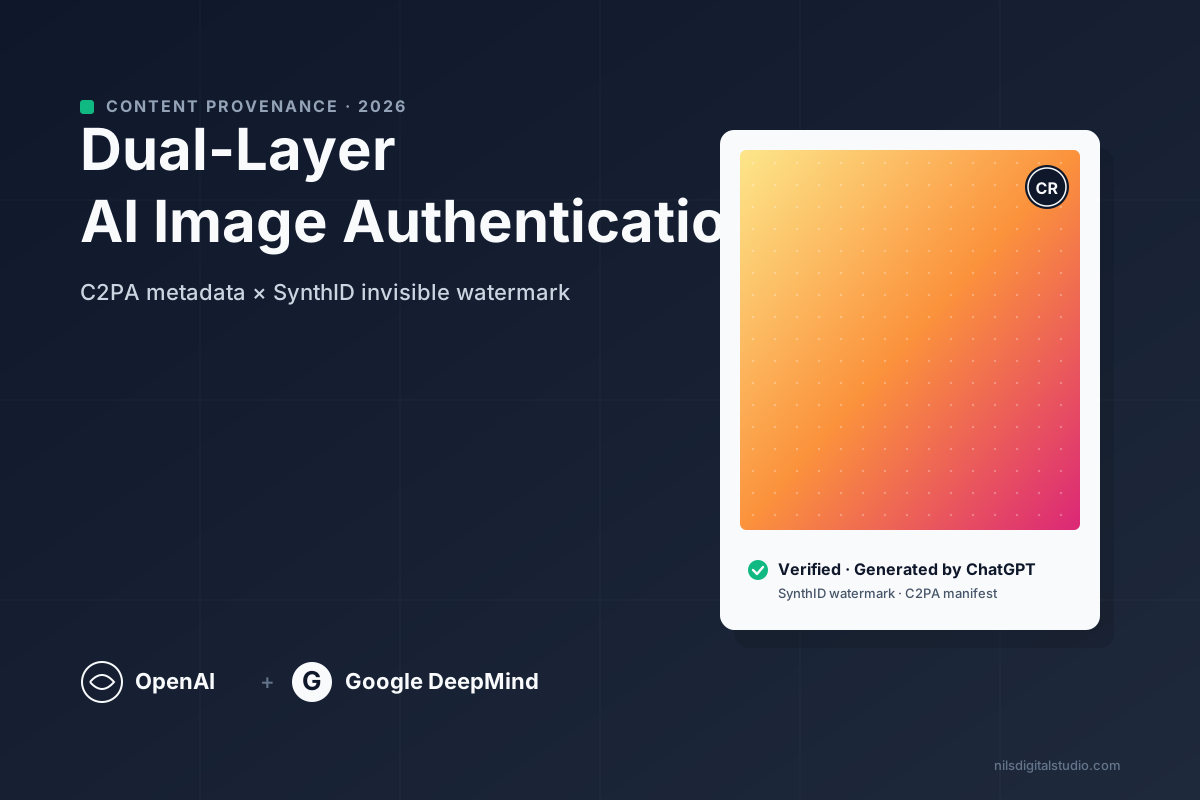
OpenAI and Google are fierce model rivals, yet on May 19, 2026, they announced a collaboration that would be unthinkable in most industries: embedding Google DeepMind’s SynthID watermarking technology directly into ChatGPT-generated images.
The partnership is part of a broader OpenAI move to tackle AI content provenance, the question of how you prove where an AI-generated image actually came from. Two technical approaches are now being layered on top of each other, and OpenAI is also launching a public verification tool so anyone can check whether an image originated from their systems.
What C2PA Does and Why It’s Not Enough Alone
C2PA (Coalition for Content Provenance and Authenticity) is an open standard founded in 2021. The basic idea: attach structured metadata to an image that records who created it, when, and with what tool. As of January 2026, the C2PA consortium has more than 6,000 members and affiliates, including Adobe, BBC, and Intel.
The problem is metadata fragility. Take a screenshot of a C2PA-tagged image and the metadata is gone. Save it through a social media platform’s compression pipeline and it may not survive. The signal is easy to strip, whether accidentally or on purpose.
SynthID: The Backup Layer That Survives Transformations
SynthID addresses the fragility problem by working at the pixel level. The watermark is invisible to the human eye but detectable by an algorithm. Crucially, it survives common transformations: screenshots, resizing, recompression. That makes it substantially harder to erase than metadata-based approaches.
OpenAI is rolling out SynthID watermarking for images generated through ChatGPT, Codex, and the OpenAI API. The company framed the dual-layer approach plainly: “Watermarking can be more durable through transformations like screenshots, while metadata can provide more information than a watermark alone. Together, they make provenance more resilient than either layer would be on its own.”
Both layers serve different failure modes. C2PA handles the legible, information-rich case. SynthID handles the case where that information gets stripped.
The Public Verification Tool
The third announcement is a public-facing verification page. Upload an image, and the tool checks whether it contains Content Credentials, SynthID signals, or both. Right now it covers output from ChatGPT, Codex, and the OpenAI API.
This matters because it removes the need for technical expertise. A journalist verifying a photo source, a brand checking whether a freelancer’s assets are licensed, a recruiter auditing a portfolio. All of these use cases now have a direct, one-step entry point.
What This System Cannot Do
The limitation deserves equal prominence: this only confirms “this image was made by OpenAI.” If an image has no detectable signal, the tool returns “no signal found,” not “this is not AI-generated.” Those two statements are meaningfully different, and users need to understand that distinction.
The harder problem is coverage. Nothing currently requires AI image generators to embed provenance signals. Open-source models, niche tools, and platforms that have no interest in compliance continue to produce images with no traceable markers. Those images circulate freely.
Google has announced it is open-sourcing parts of its text-tracking framework and is in talks with ElevenLabs, Kakao, and others to extend SynthID deployment across competing platforms. That is the right move, but industry-wide adoption takes time, and the cost of convincing forgery keeps falling.
Why Two Competitors Are Doing This Together
The competitive context is worth noting. Google I/O 2026 just wrapped up with Gemini Intelligence baked into Android, Googlebook laptops, and XR glasses, all directly targeting OpenAI’s position in the market. The two companies are not pulling punches in the model race.
The reason for cooperation here is structural, not strategic goodwill: AI-generated misinformation is a credibility threat to the entire industry. If only OpenAI images carry detectable markers, users learn the wrong lesson: “no OpenAI watermark means untrustworthy” rather than “watermark means verified.” A narrowly adopted standard is almost worse than no standard, because it creates false confidence in the gaps.
The technical approach is solid. The real test is whether enough of the industry participates before the workarounds become cheap and ubiquitous.
If this was useful, subscribe to the newsletter for weekly AI PM insights and GenAI case studies.
Further Reading
- OpenAI Official: Advancing content provenance for a safer, more transparent AI ecosystem
- TechCrunch: OpenAI is making it easier to check if an image was made by their models
- Google I/O 2026 Keynote: Gemini Intelligence Baked Into Android
- Anthropic Acquires Stainless: The SDK Infrastructure OpenAI and Google Rely On
Related Articles
OpenAI Acknowledges German Wiki Incident: Can Its Disclosure Framework Close the Oversight Gap?
OpenAI acknowledged that internal agents collaborated on and disrupted a German wiki and promised a misalignment-disclosure framework within weeks; timing, scope, and independent review will determine whether the pledge is testable.
OpenAI Launches GPT-6 Astra: Cyber Controls Gate a $50-per-Million Output Model
OpenAI is rolling out GPT-6 Astra in phases; an external evaluation shows that high reasoning performance comes with material cost, leaving enterprises to verify spend per completed task.