GitHub Copilot Switches to AI Credits Billing Today: What Changes for Developers
TL;DR
GitHub Copilot transitions to token-based AI Credits billing on June 1. Code completions stay free, but chat, agentic workflows, and code review now drain credits. One credit equals $0.01.
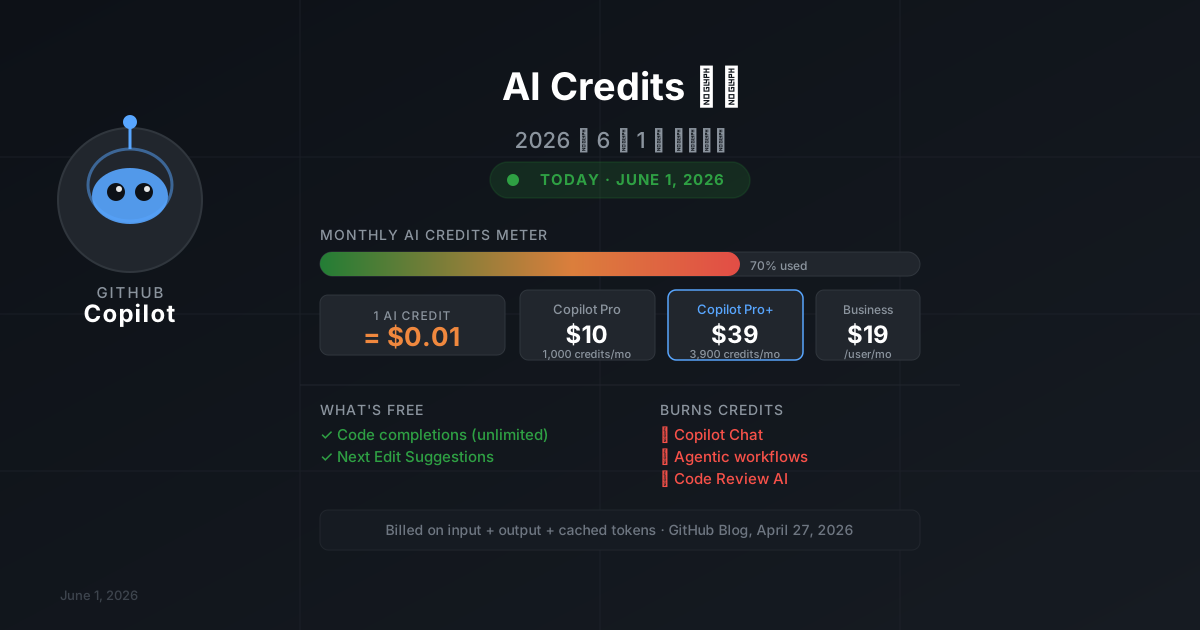
GitHub Copilot AI Credits billing goes live today. As of June 1, 2026, every Copilot plan worldwide has switched from flat-rate subscriptions to token-based usage billing. The announcement came on April 27, but today is when the meter actually starts running.
How the New Billing Model Works
The core rule is straightforward: 1 AI Credit equals $0.01. Each plan includes a monthly credit allowance equal in dollar value to the plan price:
- Copilot Pro: $10/month — 1,000 credits/month
- Copilot Pro+: $39/month — 3,900 credits/month
- Copilot Business: $19/user/month — 1,900 credits/user/month
- Copilot Enterprise: $39/user/month — 3,900 credits/user/month
Credits reset monthly with no rollover. Billing is calculated at the token level — input tokens, output tokens, and cached tokens each carry their own rate depending on the model selected. This is API pricing logic transplanted into a subscription product.
What’s Free vs. What Burns Credits
Two features remain completely free and unlimited for all paid plans: inline code completions (the autocomplete suggestions that appear as you type) and Next Edit Suggestions.
Everything else consumes credits. That includes Copilot Chat across all interfaces, CLI commands via terminal integration, cloud agent loops and multi-step agentic workflows, AI-powered code review, and third-party coding agent integrations.
The dividing line is clear: passive suggestions are free; anything that involves a multi-turn model call costs credits.
Why GitHub Made the Switch
GitHub’s official rationale: “Agentic usage is becoming the default, and it brings significantly higher compute and inference demands. The current model no longer reflects actual usage costs.”
The usage pattern for Copilot has shifted dramatically over the past year. A single agentic workflow can consume tens of thousands of tokens in one session. That is a completely different cost profile from a Tab-key completion. Covering both under a single flat monthly fee became untenable from a unit-economics standpoint.
Developer Reactions
Response in the developer community has been split.
Light users largely welcome the change. If you only use code completion, your bill doesn’t move. Token-based pricing feels fairer to those who rarely use chat or agents.
Heavy users ran the numbers and pushed back hard. Developers who rely on Claude or GPT-4o for extended multi-turn sessions may burn through 1,000 credits well before the end of the month. Visual Studio Magazine cited one subscriber who estimated costs several times higher under the new model, under the headline: “You Will Get Less, but Pay the Same Price.”
GitHub’s response: that estimate reflects “a single worst-case self-report, not a typical outcome,” while acknowledging that agent-heavy workflows will indeed cost more.
Annual plan subscribers continue on the old Premium Request Unit model until their contract expires, but model multipliers increase today. New Pro and Pro+ sign-ups have been paused since April 20 to push prospective subscribers toward credits-based plans.
Business and Enterprise: Three-Month Buffer
Business and Enterprise customers receive promotional credits through August: $30 extra per user/month for Business, $70 extra for Enterprise. The three-month window gives teams time to measure actual token consumption before adjusting budgets.
A new org-level feature launches alongside: credits can now be pooled across the organization, so unused budget from one team can flow to higher-usage projects.
The Bigger Picture
The timing of this billing shift sits squarely at the inflection point where AI developer tools are going fully agentic.
GitHub Copilot Workspace, Cursor’s Background Agent, and projects like Cognition’s Devin are all moving programming tasks from “AI-assisted” to “AI-executed.” Agentic runs consume tokens at ten to a hundred times the rate of traditional completions. Flat-rate subscription pricing was never designed to cover that workload.
GitHub isn’t the first developer tool to make this shift, but it has the largest user base — over 30 million paid subscribers. This transition is, in effect, the largest token-based pricing migration in the history of B2B software tools.
The figure to watch is what Business and Enterprise monthly invoices look like once the promotional period ends in September. That number will determine whether GitHub’s agentic products can hold their ground in enterprise budget cycles.
Sources: GitHub Blog: GitHub Copilot is moving to usage-based billing · Visual Studio Magazine: Devs Sound Off on Usage-Based Copilot Pricing
If this was useful, subscribe to the newsletter for weekly AI PM insights and GenAI case studies.
Related Articles
OpenAI Ends Cursor Model Access: The Switching Cost Behind a 5% Traffic Share
OpenAI will stop supplying models to Cursor on November 12, 2026; Cursor says OpenAI accounts for only 5% of traffic, but enterprise migration costs remain untested.
Google Launches Gemini 3.7 Flash: Half-Price Until Year-End, With Agent Costs Still Tied to Retry Rates
Google positions Gemini 3.7 Flash as a workhorse for coding and AI agents, with higher vendor benchmarks and temporary half-price access, while architecture, training methods, and production retry rates remain undisclosed.