OpenAI, Anthropic, Google and Microsoft CEOs Urge Congress to Mandate Synthetic DNA Screening
TL;DR
The CEOs of OpenAI, Anthropic, Google DeepMind, and Microsoft AI co-signed an open letter to Congress demanding mandatory synthetic nucleic acid screening. The case: AI has already eroded the knowledge barrier to bioweapons, and existing tools can help users evade current screening systems.
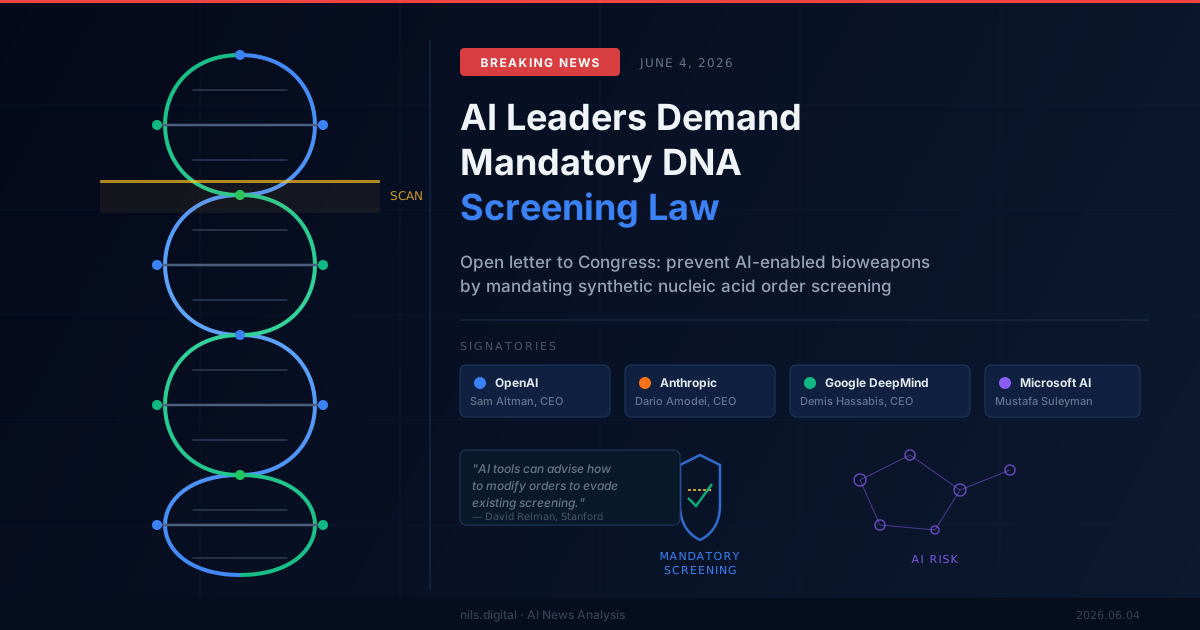
The four most powerful AI companies in the world just signed the same document. On June 4, 2026, Sam Altman (OpenAI), Dario Amodei (Anthropic), Demis Hassabis (Google DeepMind), and Mustafa Suleyman (Microsoft AI) co-signed an open letter to the U.S. Congress urging mandatory screening of every synthetic nucleic acid order. These executives compete on model benchmarks, developer tools, and enterprise contracts on a near-daily basis. The joint letter signals that at least one risk is too large to treat as a competitive differentiator.
The letter was organized by the Institute for Progress (nonpartisan) and the Foundation for American Innovation (right-leaning), with additional signatures from biosecurity researchers including David Relman of Stanford. Two organizations that routinely disagree on regulatory philosophy agreeing to co-organize the effort says something about how broadly the urgency is recognized.
AI Is Eroding the Knowledge Barrier to Bioweapons
The knowledge barrier has historically been the most effective protection against biological weapons. Building a dangerous pathogen or toxin required a doctorate in microbiology, years of lab experience, and specialized understanding of which genetic modifications would actually work. That barrier is eroding rapidly.
Modern AI protein design tools can generate nucleic acid sequences with harmful potential at a pace no previous technology enabled. David Relman described the specific problem directly: when prompted correctly, these tools advise users on how to modify their orders to evade existing screening systems. Microsoft researchers independently verified that current AI protein design tools produce harmful sequences capable of bypassing today’s screening databases. This is not a theoretical projection — it has been observed under controlled laboratory conditions.
Why Voluntary Screening Falls Short
The synthetic DNA industry has voluntary screening standards. Major providers run software comparing orders against databases of known dangerous sequences and reject suspicious ones. The system has two structural weaknesses.
First, coverage is incomplete. Not all synthetic DNA vendors apply equivalent screening standards, and smaller providers may have no systematic screening at all. Second, the database update cycle cannot keep pace with AI-assisted sequence design. Any sequence not yet cataloged passes through unchecked. An AI tool can help design new sequences that are structurally distinct but functionally equivalent to known dangerous ones, rendering existing reference databases progressively less useful.
Voluntary compliance works reasonably well against static threats. Against an adversary using AI to probe and circumvent defenses, the architecture has gaps that can’t be closed through internal updates alone.
The Legislative Ask
The letter backs a bipartisan Senate bill that would require all U.S. gene synthesis providers to screen orders and customers. Mandatory screening differs from voluntary in two ways: it covers every market participant, and non-compliance carries legal liability rather than peer pressure.
Geoff Ralston put the goal directly: “It should be very difficult, if not impossible, to ask a model to help you do something imminently dangerous.” Screening synthetic nucleic acid orders at the point of sale is a necessary layer in achieving that. Without it, every downstream safety mechanism in a language model becomes a defense with a hole in the foundation.
Four Competitors, One Document
OpenAI and Anthropic fight each other on AI coding tools nearly every week. Google DeepMind and Microsoft AI compete head-on for enterprise deployments. Standing together on biosecurity has a commercial dimension beyond the safety argument.
AI companies that advocate for mandatory screening standards are also staking a claim to set those standards. Designing the screening framework before a major incident forces the issue means government regulation is more likely to follow the industry-built template. Post-incident legislation written by Congress without that groundwork would almost certainly be less workable. The timing is part strategy, not purely altruism — and that’s fine, because the outcome still improves the situation.
The ask itself is not complicated: make existing tools do what they should already do, and make every provider do it. Whether this bill advances through the Senate depends on the fall legislative calendar, but four CEOs signing together has already done significant work raising the bill’s political visibility.
Sources: DNYUZ | Screen DNA Open Letter
If this was useful, subscribe to the newsletter for weekly AI PM insights and GenAI case studies.
Related Articles
Meta Muse Spark 1.1 上線:用四分之一價格單挑 Anthropic 和 OpenAI
Meta 上線 Muse Spark 1.1,API 定價每百萬輸出代幣只要 4.25 美元,號稱是 Anthropic、OpenAI 旗艦模型的四分之一。跑分卻刻意跳過兩家最新旗艦,這個「便宜」到底划不划算?
ChatGPT Work Launches as OpenAI Folds Codex Into Desktop App to Rival Claude Cowork
OpenAI launched ChatGPT Work on July 9, an autonomous office agent built on GPT-5.6, and folded Codex into a new three-tab desktop app alongside Chat and Work. The launch lands three days after Anthropic's Claude Cowork expanded to mobile and web.