Great American AI Act: US Congress Unveils Federal AI Governance Framework
TL;DR
Great American AI Act: Congress' 269-page draft freezes state AI laws for 3 years, mandates audits for major AI labs, and sets $1M/day penalties. Opposition was immediate from unions, consumer groups, and Democratic colleagues.
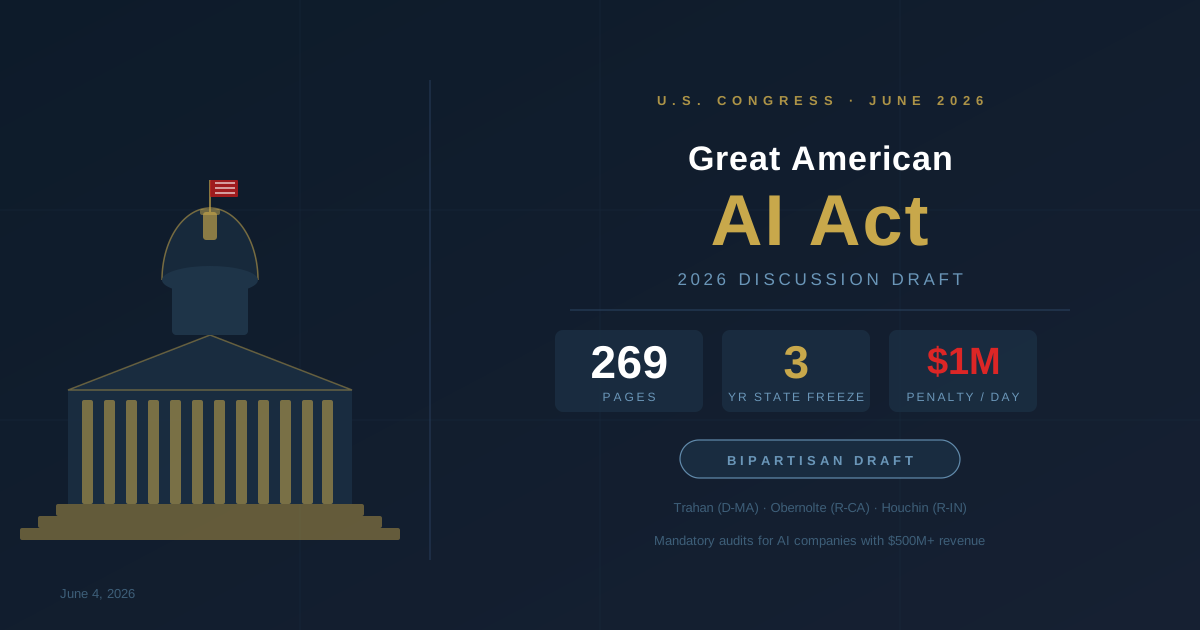
The Great American AI Act landed in Washington on June 4 as a 269-page bipartisan discussion draft — the most substantial federal AI governance proposal the US Congress has produced to date. Two days later, it remained the most-forwarded document in tech policy circles.
Rep. Lori Trahan (D-MA) and Rep. Jay Obernolte (R-CA) co-authored the draft, with Rep. Erin Houchin (R-IN) as co-sponsor. Its central proposition: freeze state-level AI development laws for three years while imposing mandatory semi-annual audits on frontier AI companies with annual revenue above $500 million.
The Three-Tier Framework
State Preemption
Under the draft, states would lose the authority to enact regulations specifically targeting how AI models are developed and trained. States retain oversight of already-deployed systems — hiring algorithms, credit scoring tools, medical diagnostics — but the responsibility architecture during the training phase would be set at the federal level alone.
The three-year sunset provision was designed to allow time for a federal framework to stabilize before the preemption expires.
Mandatory Auditing
AI companies above the $500 million annual revenue threshold must hire a licensed independent auditor every six months. The auditor receives full access to internal records, personnel, and systems. Non-compliance triggers civil penalties of up to $1 million per violation per day.
The revenue threshold draws a fairly precise ring around OpenAI, Anthropic, Google DeepMind, and Meta as primary targets, while early-stage startups are effectively exempt for now.
Institutional Infrastructure
The bill would formally codify the Center for AI Standards and Innovation within the Commerce Department, with $100 million per year authorized for fiscal years 2027–2029. The GAO would evaluate federal AI adoption progress, the Bureau of Labor Statistics would track AI’s employment impact, and a K-12 through university AI scholarship program would receive funding.
Opposition Arrived From Multiple Directions
Within hours of the draft’s release, criticism came from unions, consumer advocates, and Democratic colleagues of Trahan herself.
AFT President Randi Weingarten and AFA President Sara Nelson issued a joint statement calling the bill “a giveaway to the AI industry and a handful of trillion-dollar companies.” Their core concern: the three-year preemption removes states’ ability to protect workers from algorithmic wage manipulation and workplace surveillance before federal protections exist.
Americans for Responsible Innovation’s Brad Carson put it plainly: “This bill takes the current floor on state AI legislation and turns it into a federal ceiling.”
The House Democratic commission on AI issued a statement refusing to support the draft as written — notably fast intra-party resistance given that Trahan is herself a Democrat.
The Case for Federal Consolidation
Houchin’s framing — “America should lead the world in artificial intelligence, not regulate ourselves into falling behind China” — represents the standard Washington argument for federal pre-emption. The underlying problem, though, is real.
Colorado’s first comprehensive state AI law takes effect in roughly 25 days. California, Texas, and more than a dozen other states have active AI legislation at various stages. A company operating nationally faces up to 50 different compliance frameworks simultaneously.
The draft’s supporters argue that one federal standard is more efficient than 50 different answers. What remains undefined in the current text is exactly what that federal standard requires of companies in practice.
Still a Discussion Draft
The bill has not been formally introduced to Congress. Co-authors are soliciting feedback at GAAIA@mail.house.gov before any formal legislative action. The path from a 269-page discussion draft to enacted law is long.
What the draft’s emergence does accomplish is force every corporate legal team, state legislator, and labor union to start staking out a position before a federal framework exists. Colorado’s law arrives in July. If federal preemption advances fast enough, that state law could face a legal challenge shortly after it takes effect. If the federal process stalls, more states will legislate in the interim.
The US ends up with AI governance that fragments further before it consolidates.
If this was useful, subscribe to the newsletter for weekly AI PM insights and GenAI case studies.
Further Reading
- Anthropic Files Confidential IPO at $965B Valuation
- Anthropic’s AI Pause Proposal: Recursive Self-Improvement as the Red Line
Sources
Related Articles
EU AI Act Article 50 Takes Effect: AI Disclosure Failures Can Cost 3% of Global Turnover
The EU began enforcing AI-system transparency rules on 2 August 2026, requiring AI disclosure for chatbots and visible, machine-readable marking of certain synthetic content.
EU AI Act August Countdown: 54 Days Until Enforcement With 7% Global Revenue Fines
The EU AI Act enters full enforcement on August 2, bringing fines up to €35M or 7% of global revenue. The EU just stood up a 60-expert scientific panel to enforce it, and 78% of companies have not taken meaningful compliance steps.