Morgan Stanley: Global AI Debt Issuance to Hit $570 Billion in 2026
TL;DR
Morgan Stanley forecasts AI-related global debt issuance to double to $570 billion in 2026. Through May 31, issuance already reached $236 billion, four times the same period last year. Alphabet issued a 100-year bond. Amazon set the record for the largest-ever euro corporate bond. The AI arms race is now financed with debt.
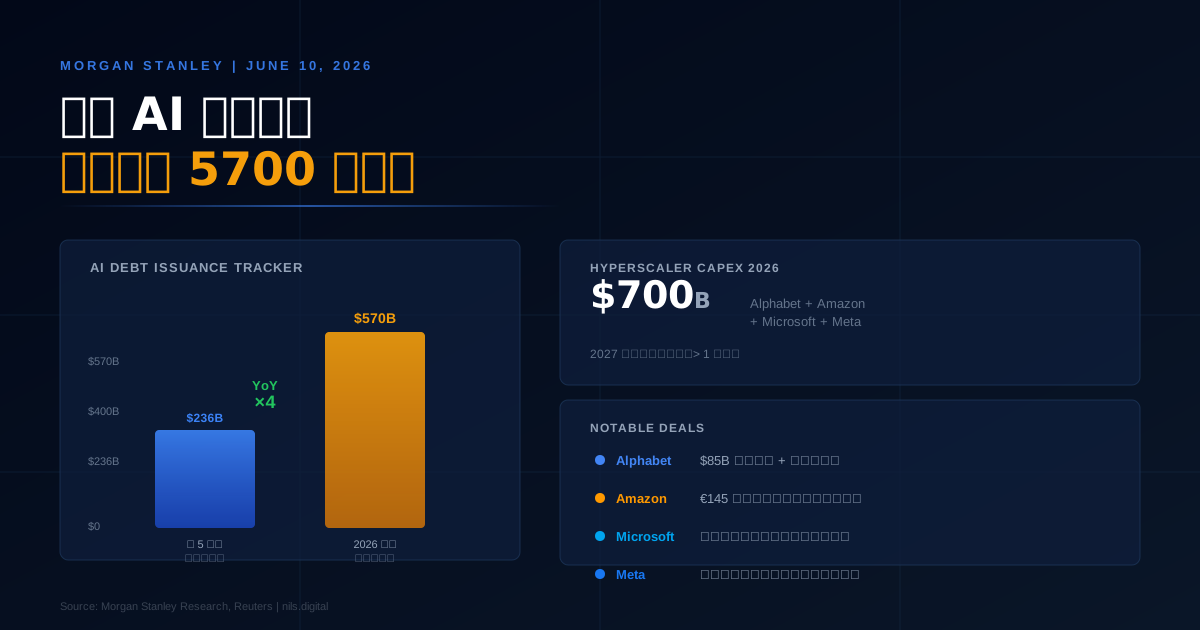
On June 10, Morgan Stanley published a report forecasting that global AI-related debt issuance will reach approximately $570 billion in 2026, more than doubling compared to last year. Through May 31, issuance had already hit $236 billion, a fourfold increase from the same period in 2025.
The implication is straightforward: even the most cash-rich companies in Silicon Valley are now borrowing to fund AI infrastructure.
A 100-Year Bond and the Largest Euro Corporate Deal in History
Several unusual transactions hit capital markets this year.
Alphabet announced an $85 billion fundraising plan, then issued a 100-year bond in February earmarked for AI infrastructure. A century bond signals that investors are willing to lock in for a hundred years, effectively betting that Google will still exist in 2126, and that the computing infrastructure being built today will generate returns well before then.
Amazon went even larger. A C$14 billion ($10 billion USD) Canadian dollar issuance, followed by a single €14.5 billion euro bond, the largest euro corporate bond ever placed in market history.
Morgan Stanley’s report noted directly that hyperscalers “have been broadening their investor base through non-USD issuance,” and that bond market price action is “being mostly driven by supply expectations” rather than macroeconomic fundamentals. The market is already pricing in more debt to come.
$700 Billion in 2026, $1 Trillion by 2027
Alphabet, Amazon, Microsoft, and Meta are projected to spend a combined $700 billion in capital expenditures in 2026. Morgan Stanley expects that figure to surpass $1 trillion in 2027.
The money flows into compute infrastructure. A data center housing 100,000 H100 GPUs costs roughly $2 to $3 billion to construct, before accounting for power and cooling over its operating life. At $1 trillion scale, hundreds of facilities at that magnitude would be simultaneously under construction worldwide.
For most of the past two decades, tech companies ran on strong free cash flow. AI infrastructure demands have now outpaced that model. The bond market is filling the gap.
Chip Manufacturers Follow a Different Path
Morgan Stanley also flagged a divergence: semiconductor manufacturers are shifting toward shorter-term structured repayment arrangements rather than long-duration bonds.
The logic differs by business model. Semiconductor process technology advances roughly every two to three years, making a hundred-year time horizon irrelevant for chipmakers. Shorter-term structured financing preserves flexibility across each technology cycle. Both models operate in the same AI investment wave, but with fundamentally different capital needs.
The Private Market Contrast
The same day, a related story underscored the gap between public and private AI financing. SoftBank’s attempt to raise $6 billion using its 13% OpenAI stake as collateral stalled, because banks cannot price unlisted equity for margin purposes, even at a stated valuation of $852 billion.
Hyperscalers access public debt markets because their balance sheets are transparent and investors can price the risk. Private AI companies currently lack that channel, which explains why Anthropic confidentially filed for an IPO at a $965 billion valuation and OpenAI is reportedly preparing to follow. Once those listings close, the financing architecture for private AI companies will look very different.
If this was useful, subscribe to the newsletter for weekly AI PM insights and GenAI case studies.
Further Reading
- SoftBank’s $6B OpenAI Margin Loan Stalls: Banks Won’t Accept Private AI Valuations
- Anthropic Confidentially Files for IPO at $965 Billion Valuation
- Stargate: The AI Server Center Running 24/7 Shifts
Sources
Related Articles
SpaceX Plans $20 Billion Investment-Grade Bond to Refinance xAI Merger Debt
SpaceX issues a $20B bond to refinance xAI merger debt. Three agencies gave investment-grade ratings on the back of $75B in AI contracts despite a $4.28B Q1 loss.
Google Sends TPUs Into Orbit: A 15-Minute Test Is Not Continuous Compute
Google and Planet launch a Suncatcher prototype to test Gemma on four TPUs. Orbital hardware enables thermal and radiation testing, but cooling intervals, sustained compute and commercial costs remain unresolved.