AI's Dark Output: The Invisible Productivity Explosion That Will Mislead Central Banks
TL;DR
AI is generating enormous real economic value that GDP, CPI, and labor statistics all fail to capture. When the cost of drafting a will collapses from $500 in lawyer fees to $0.50 in token costs, the statistical system reads this as 'declining services output.' If the Fed keeps relying on this broken ruler, monetary policy will navigate in the dark.
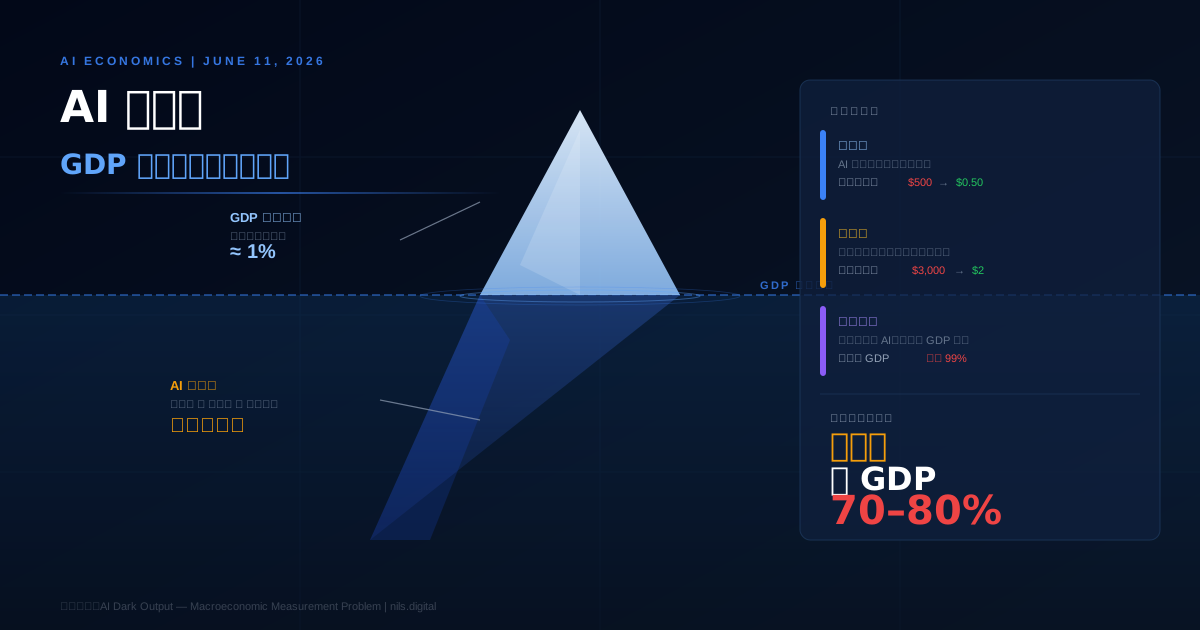
Drafting a will at a law firm costs $500. That transaction enters GDP. The same will, drafted in ChatGPT over 30 minutes, costs $0.50 in tokens. That transaction barely registers in GDP.
The quality of both wills may be comparable. But in the statistical system’s eyes, the second option represents a decline in legal services productivity.
This is the core of the AI dark output problem: a real, large-scale productivity explosion is being systematically misread by every macroeconomic measurement tool we have — and in some cases, being flagged as a contraction signal. The Fed’s current ruler is pointing in the wrong direction.
The Dark Matter Blind Spot
The concept of dark output borrows a physics metaphor. Dark matter in the universe cannot be directly observed, yet it exerts real gravitational effects on surrounding galaxies. The logic of AI dark output follows the same structure: AI work that creates genuine economic value is invisible in national accounts, or severely distorted.
GDP measures activities with market transactions. When you hire a lawyer, money flows from your account to the law firm — that flow is recorded. When AI replaces that flow, transaction volume shrinks by 99%. The statistical system doesn’t ask whether service quality improved. It records only that revenue fell.
The problem isn’t AI. It’s the measurement logic baked into how GDP was designed.
Three Types of Dark Output
Substitution dark output is the most straightforward category. Work previously done by humans at market prices gets done by AI at marginal cost.
Drafting a will is one example. The more pervasive version: entry-level analytical work across corporate legal, finance, marketing, and customer service departments is being displaced at scale. Services GDP is typically estimated by working backward from revenues and costs. When pricing collapses, statistical readings collapse with it — without registering that more work is being completed in the same time.
New creation dark output is harder to see. It refers to work that would never have happened before AI because human labor costs made it economically irrational. A concrete example: a founder runs a full competitive analysis before every important meeting using AI. Before AI, this would have cost thousands in consulting fees — so it simply didn’t happen. Now it takes $2 in tokens and 15 minutes. It creates real decision value. But apart from that $2, there’s no invoice, no contract, no payroll record. In the macro data, this work is invisible.
Captured AI output is the most counterintuitive category. When a company has market pricing power, AI dramatically cuts costs but prices to customers hold. A critical distinction applies here: if the company purchases AI services externally, that outsourcing spend enters GDP, and net output roughly stays flat. But if the company runs the same work through an internal AI workflow — no external transaction — the GDP entry that used to exist simply evaporates.
AI is systematically internalizing market transactions and removing them from GDP’s radar.
Manufacturing Can Be Counted. Services Cannot.
When manufacturing automates — robots replacing workers on an assembly line — GDP captures the productivity gain cleanly. The reason is simple: cars can be counted. A factory that produced 100,000 vehicles last month and 150,000 this month shows a 50% productivity gain in the data.
Knowledge work and services have no countable physical output. A lawyer who reviewed 20 contracts and now reviews 200 with AI assistance — how does traditional statistics measure that tenfold output increase when billing rates are collapsing? It can’t. It only sees revenue fall.
Token counts don’t equal output quality. You can’t measure services productivity growth directly in tokens. This isn’t a technical detail — it’s a structural flaw in the entire measurement framework. Services account for 70–80% of GDP in developed economies. The scale of the gap is not small.
Four Compounding Biases
As these three types of dark output accumulate, macroeconomic statistics develop four systemic biases.
Boundary migration: Market transactions become internal AI workflows. GDP readings drop without any actual reduction in work completed.
Price collapse misread: Service pricing falls due to AI competition while average wages appear to rise as junior positions are eliminated. The statistical picture shows high inflation and low productivity. The reality is ordinary inflation with dramatically improved productivity.
Sector misattribution: AI creates real efficiency gains in healthcare, law, and education, but its economic footprint shows up only in tech companies’ token revenues. Policymakers reading sector-by-sector statistics will badly misjudge real development across industries.
New work invisibility: Massive volumes of new economic activity enabled by AI’s low cost leave no traditional financial trace and can’t be entered into GDP. A startup running three people and AI to do work that previously required thirty — the productivity equivalent of those other twenty-seven people disappears from the data.
These four biases compound each other. The gap between what the statistical system reads and what’s actually happening in the economy only widens over time.
GDP Has Made This Mistake Before
This isn’t the first time GDP has structurally missed large-scale real economic activity.
In 1988, feminist economist Marilyn Waring’s book If Women Counted documented that GDP had always ignored the vast unpaid care and domestic labor performed globally. The estimated value of daily unpaid care work worldwide exceeds $11 trillion — roughly three times the size of the technology sector — yet its contribution to GDP is zero.
The structural flaw in AI dark output is highly similar. GDP’s “production boundary” has always been selective: it measures transactions with market prices and ignores real output without pricing. Women’s domestic labor had no market price, so it was excluded. AI-completed work has an extremely low price, or no external transaction at all, so it’s systematically undervalued.
Every time a structural shift moves the production boundary, GDP starts to malfunction and needs time to recalibrate. The difference this time is that the shift is happening faster than it ever has before.
The Fed Is Reading the Wrong Map
If AI dark output were merely an academic measurement question, the consequences would be limited. But the Fed is currently making interest rate decisions using this broken ruler.
Current data tells the Fed: services productivity growth is limited, inflationary pressures persist, monetary policy should remain restrictive. If the true situation is that productivity is surging but not being measured, the correct policy is completely different from what’s being executed now.
AI skeptics hold exactly these macroeconomic data points: GDP hasn’t risen significantly, therefore the productivity revolution is a bubble. The logic looks rigorous. But the problem is the measurement tool itself. Using a broken ruler to measure a real building and concluding the building doesn’t exist — that conclusion can’t be trusted.
The next number worth watching isn’t the next GDP print. It’s how quickly statistical agencies around the world update their measurement frameworks for AI-driven services. The slower that correction comes, the higher the risk of policy error.
Dark output isn’t a plea to ignore AI’s real costs in electricity, infrastructure, and labor displacement. Those costs exist. The argument is simpler: update the tools, or policymakers, investors, and businesses are all navigating with an outdated map.
The map isn’t wrong. It just describes a landscape that no longer exists.
If this was useful, subscribe to the newsletter for weekly AI industry analysis and macro insights.
Related Articles
Anthropic Watermarks Claude Text, but the EU Compliance Test Still Lacks a Detector
Anthropic is adding text watermarks and C2PA file provenance to new Claude models in the EU, while older-model coverage and third-party detection remain unfinished.
NSF Opens $100 Million Regional AI Infrastructure Program, but Consortia Must Fund the Compute
The U.S. NSF plans to support up to 10 state or multistate AI infrastructure hubs, while regional consortia remain responsible for financing compute, cloud, storage and related systems.