FERC Orders Six Grid Operators to Fast-Track AI Data Centers: What the Mandate Actually Fixes
TL;DR
FERC unanimously issued show-cause orders to the six largest US grid operators, mandating faster grid connections for AI data centers. The regulatory clock can move in weeks. The transformer manufacturing queue runs 160 weeks and counting.
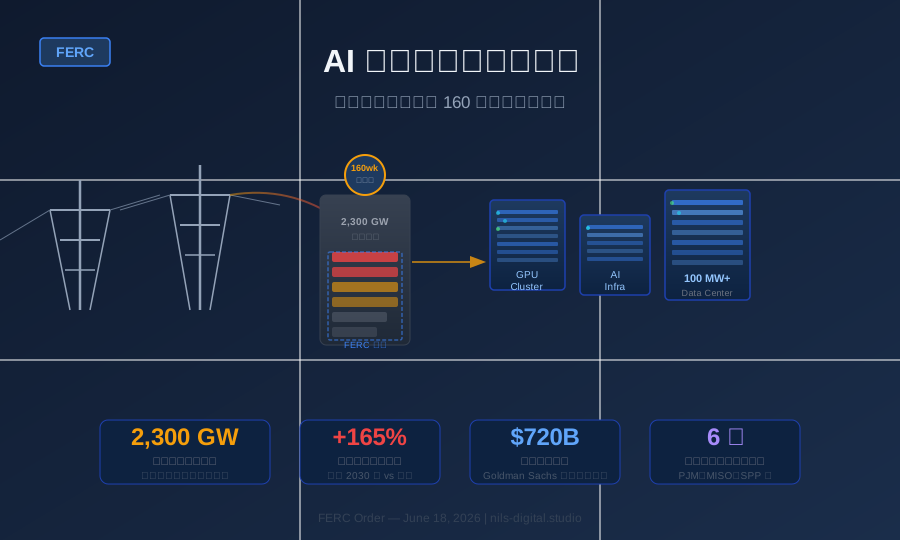
On June 18, 2026, the Federal Energy Regulatory Commission issued unanimous show-cause orders to PJM Interconnection, MISO, Southwest Power Pool, CAISO, ISO-NE, and NYISO — the six grid operators covering roughly 200 million Americans across more than 30 states. Each operator has 30 days to submit resource adequacy reports and 60 days to defend or revise their existing interconnection frameworks.
Texas was left out. ERCOT sits outside federal jurisdiction and is exempt from the order.
Why Six Grid Operators Received Orders Simultaneously
US data center electricity consumption jumped 22% in 2025 alone. Goldman Sachs projects data center power demand will grow another 165% by 2030, requiring roughly $720 billion in grid investment over the decade to keep pace. The FERC order establishes one consistent rule across all six affected markets: data centers must pay the full cost of any grid upgrades required to connect them. Existing ratepayers bear none of the new infrastructure cost.
This “participant funding” model had been inconsistently applied across US grid markets. The show-cause orders are an attempt to standardize it before the demand wave gets harder to manage.
What the Numbers Actually Say
The show-cause orders sound decisive. The underlying numbers are less reassuring.
Roughly 2,300 gigawatts of generation and storage capacity are currently stuck in US interconnection queues — more than the country’s entire installed power capacity. Each application requires an impact study, which takes one to three years. After approval, transmission lines need to be built and substations upgraded, adding another two to four years before power actually flows. FERC’s orders compress the policy review timeline. They have no effect on the engineering timeline.
Transformers are the most concrete bottleneck. Before 2020, a high-power substation transformer had a lead time of roughly 24 to 30 months. In 2026, that figure exceeds 160 weeks — nearly three and a half years. ABB, Siemens Energy, and Hitachi Energy order books are already running into 2028 and beyond. No regulatory order changes that.
A Fermi estimate puts the scale of the problem in perspective. A single NVIDIA H100 GPU draws about 700 watts at peak. An 8-GPU server node runs approximately 5.6 kW. A 100 MW data center can theoretically house around 140,000 H100s. The 165% power demand increase Goldman Sachs projects is roughly equivalent to adding 40 nuclear power plants worth of output capacity to the US grid, at 2.7 GW per plant. The US last brought a new nuclear plant online in 2023, and the pipeline is thin.
Regulatory paperwork moves in weeks. Power infrastructure deploys in years.
Indicators Worth Watching
Texas being carved out of the FERC order is the detail that matters most for near-term siting decisions. ERCOT allows direct negotiation between data center operators and electricity generators, without the layered interconnection queue that characterizes the federally regulated markets. If major cloud providers accelerate Texas data center announcements in the next six months, that signals the market is pricing in this regulatory divergence.
Nuclear co-location deals are the second signal. The participant funding requirement gives data centers strong incentive to pursue on-site power generation and bypass the queue entirely. TerraPower and Kairos Power are actively in conversations with large technology customers. This FERC order increases the urgency of those discussions.
The most important metric is also the hardest to measure: whether the six grid operators’ interconnection queues actually move faster six months from now. FERC issued a 30-to-60-day document deadline, not a construction mandate. If queue wait times remain above five years, the order will have produced compliance filings without producing power.
If this was useful, subscribe to the newsletter for weekly AI PM insights and GenAI case studies.
Sources:
Related Articles
NVIDIA Takes a Stake in Cloverleaf to Tackle AI Data Centers' Power and Site Constraints
NVIDIA made a minority investment in Cloverleaf Infrastructure and will use DSX to coordinate land, power, cooling, and compute design; price, ownership percentage, and added capacity remain undisclosed.
SoftBank's €75 Billion France AI Data Center Bet: Masayoshi Son Goes All-In on European AI Infrastructure
SoftBank commits up to €75 billion to build 5 GW of AI data centers in France. Phase 1 targets 3.1 GW in Hauts-de-France by 2031, with Schneider Electric and EDF as key partners.