Google's AI Brain Drain Accelerates: AlphaFold Researchers Join Anthropic as Alphabet Loses $270B
TL;DR
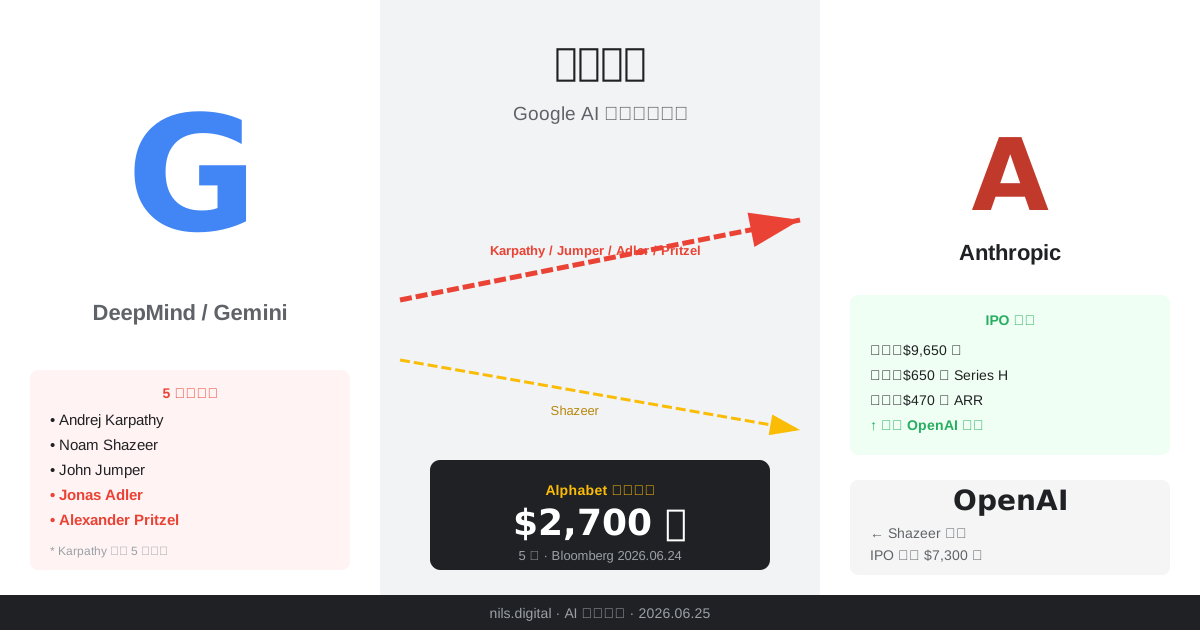
Bloomberg reported June 24 that Jonas Adler and Alexander Pritzel are leaving Google for Anthropic, the fourth wave of departures in five weeks. Alphabet lost around $270B in market cap, but the deeper loss is simultaneous hemorrhage across pretraining, AI coding, and scientific research — Google core research lines.
This analysis covers Silicon Valley headquarters. If you work at an AI lab or research division in Asia — Taiwan, Japan, Korea — a concrete question: does this wave of researchers leaving big tech for AI startups exist at comparable scale in Asian markets? Is the incentive structure (pre-IPO equity, research resources, compute access) meaningfully different? Data points welcome.
On June 24, Bloomberg reported that Google DeepMind is set to lose two more senior researchers: Jonas Adler and Alexander Pritzel, both heading to Anthropic.
Adler led Google’s AI coding research. Pritzel worked on pretraining, the foundational phase where models learn from large-scale data. Both also contributed to AlphaFold, working alongside Nobel Chemistry laureate John Jumper.
This is the fourth departure wave in five weeks. May 19: Andrej Karpathy joined Anthropic. June 18: Noam Shazeer, co-author of “Attention Is All You Need” and a lead on Gemini, announced he was joining OpenAI. June 19: John Jumper left DeepMind for Anthropic. Now Adler and Pritzel.
What Google Is Actually Losing
Headcounts can be refilled. What Adler and Pritzel carry with them is harder to replace.
Adler’s AI coding research at Google represents accumulated knowledge of what failed, what scaled, and what assumptions the team had to discard. That negative knowledge takes years to rebuild at a competitor starting from scratch. Pritzel’s pretraining expertise is foundational, shaping the base capability of whatever models Anthropic trains next. His presence won’t affect Fable 5, which was already in training before his departure. The generation after that is a different story.
Stack the departures side by side: Shazeer took architectural intuition from the Transformer paper; Jumper brought DeepMind’s scientific research methodology; Karpathy contributed large-scale pretraining engineering depth; Adler brings AI coding; Pritzel brings pretraining judgment. Five people, five different research functions, concentrated into roughly thirty-five days. That is not normal attrition.
TechCrunch notes the financial pull is real: with both Anthropic and OpenAI approaching IPO, researchers joining now hold pre-IPO equity with a visible liquidity window. Bloomberg adds an internal push factor: compute resource disputes inside Google, where competing research teams fight for limited GPU allocation, and researchers getting the shorter end move slower, which directly affects career output and recognition.
The Numbers, Properly Sized
Alphabet’s market cap dropped roughly $270 billion over this period. That number needs context before it becomes an argument.
Stock prices reflect market sentiment about future earnings, not a clean accounting of researcher value. The DOJ antitrust uncertainty and AI advertising competition were both factors in Alphabet’s price pressure. Crediting the entire $270B drop to five researcher departures is analytically imprecise.
What the number does reflect is a credible read: markets are pricing in structural concern about Google’s AI research competitiveness, not just five open headcounts.
On a Fermi basis: GPT-4-scale training costs upward of $100M in compute. A senior pretraining researcher’s architectural judgment, applied correctly, can improve training efficiency by 10-15%, saving $10-15M per training run. Four senior researchers joining Anthropic creates a potential $50-150M advantage per model generation in compute efficiency alone, before accounting for research direction and insight. That math makes the recruiting packages rational for Anthropic even at aggressive RSU levels.
The timing reality: this cohort’s influence on Anthropic products begins in late 2026 to early 2027. What you see from Anthropic today was shaped before these hires. The effect appears in the generation after Fable 5.
What to Watch in the Next Three to Six Months
Gemini 3.5 Pro’s GA timeline is the nearest signal. The same day Bloomberg broke this story, June 24, came separate reporting that Gemini 3.5 Pro’s general availability slipped by six weeks. Correlation is not causation here, but if Gemini 3.5 continues slipping into Q4, it becomes harder to attribute the delays entirely to unrelated engineering factors.
Google’s retention response is the second observable. Large organizations facing talent pressure of this scale typically respond with either RSU refreshes or resource reallocation (more compute to core research teams). If Google announces a DeepMind retention program within ninety days, management has concluded the root cause is compensation and resource access. No visible response suggests they view these departures as within acceptable bounds, which is itself a strategic signal about how Google categorizes this generation of researchers relative to its broader workforce.
Anthropic’s next base model quality is the long-run indicator. Pritzel’s pretraining expertise and Adler’s AI coding knowledge are directionally relevant to future Claude generations’ foundation capability. If Anthropic’s 2027 model shows significant improvement on foundational benchmarks (MMLU-class evaluations, not just reasoning or tool use), the causal chain from this talent cohort becomes testable.
If this was useful, subscribe to the newsletter for weekly AI PM insights and GenAI case studies.
Related Reading
Related Articles
Nobel Laureate John Jumper Leaves Google DeepMind for Anthropic
John Jumper, co-creator of AlphaFold and 2024 Nobel Chemistry Prize winner, is leaving Google DeepMind after nine years to join Anthropic. The move follows Noam Shazeer's departure to OpenAI and signals where serious AI safety research may concentrate in the next decade.
G7 Summit 2026: Altman, Amodei, and Hassabis Meet World Leaders Together for the First Time
For the first time in G7 history, the CEOs of OpenAI, Anthropic, and Google DeepMind will attend the same summit in Évian, France (June 15-17). Behind the gathering: US resistance to multilateral AI agreements, Europe's fight for AI sovereignty, and two AI companies approaching IPOs who need political credibility before listing.