The End of Tokenmaxxing: How Enterprise AI Overspending Created Its Own Crisis
TL;DR
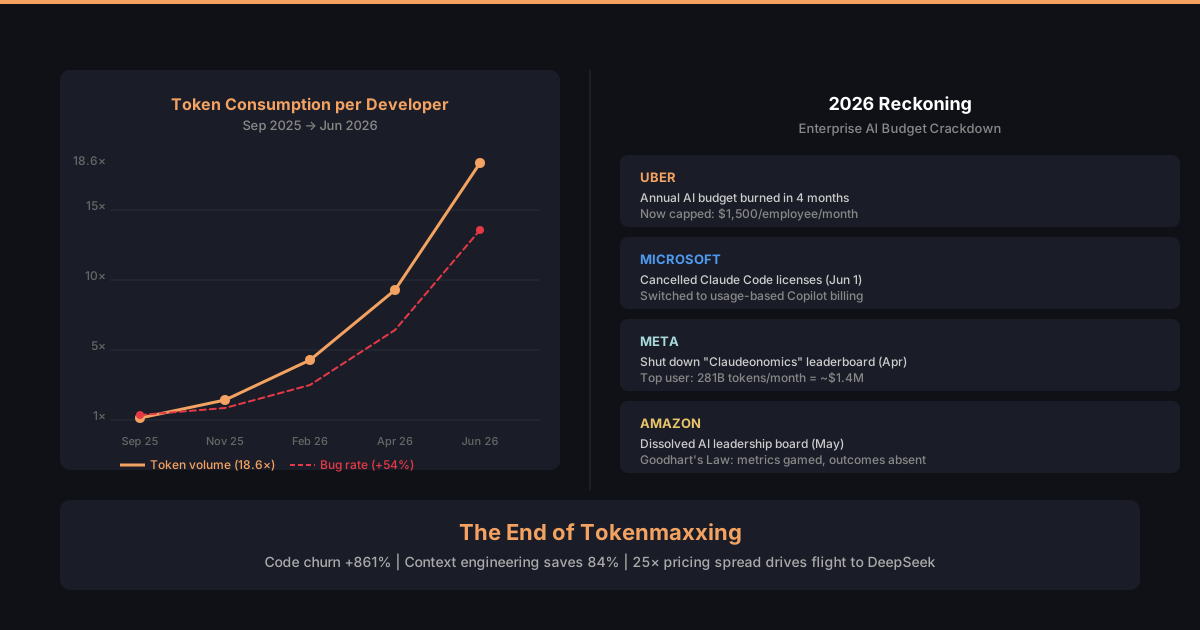
Token consumption per developer surged 18.6× in nine months, bug rates climbed 54%, code churn hit 861%. Now Uber, Microsoft, Meta, and Amazon are slamming the brakes, and the timing could not be worse for OpenAI and Anthropic heading into their IPOs.
Here’s the specific question driving this article: will the tokenmaxxing correction show up as a structural slowdown in OpenAI and Anthropic’s Q3 2026 token revenue, or just a one-quarter blip? My bet is structural, because the pricing model shift toward outcome-based billing removes the incentive to maximize tokens at the application layer. If you’re tracking enterprise AI spend and have data on whether token consumption growth has already flattened in your organization, those numbers are more useful than anything modeled from the outside.
The Numbers First
Token consumption per developer rose 18.6× in nine months, spanning late 2025 through mid-2026. Before Meta shut down its internal “Claudeonomics” leaderboard in April, the top user was consuming 281 billion tokens per month. At Anthropic Opus 4.8 pricing of roughly $5/MTok, that’s approximately $1.4 million in monthly API costs for a single engineer. Salesforce’s annual Anthropic bill reached approximately $300 million.
The productivity paradox: in high-AI-adoption engineering environments, bugs increased 54% and code churn rose 861%. More tokens, more rework.
This has a name: tokenmaxxing. Treating AI token consumption as a productivity proxy.
Why It Happened
Goodhart’s Law, applied to enterprise software. Once “AI usage” became a performance metric, employees optimized the metric rather than the outcome. Amazon dissolved its AI leadership board in May after discovering members were generating meaningless AI workloads to improve their consumption statistics. Meta’s leaderboard created the same dynamic: the engineer with the highest token count was not necessarily producing the most business value.
The correction arrived fast, across multiple companies almost simultaneously:
- Uber burned its entire 2026 AI budget by April, after just four months, then capped per-employee AI tool spend at $1,500/month
- Microsoft cancelled Claude Code subscriptions across divisions on June 1, reverting to usage-based GitHub Copilot billing
- Meta shut down its token consumption leaderboard in April
- Amazon dissolved its AI leadership board in May
Lindy’s CEO moved 100% of traffic from Claude to DeepSeek, citing cost alone.
What the Numbers Actually Mean
Microsoft’s decision carries the strongest signal. Claude Code Enterprise costs roughly $75–100/user/month. At 100,000 engineer seats, that’s up to $1 billion annually. Switching to usage-based Copilot billing cuts that substantially. The signal goes beyond dollars: Microsoft builds GitHub Copilot. Choosing its own product over Claude Code is a product-quality judgment, recorded in enterprise procurement history. No analyst report carries that weight.
The Lindy case illustrates the structural economics: a 25× price gap exists between frontier models. Anthropic Opus 4.8 runs ~$5/MTok; GPT-5.4-nano is ~$0.20/MTok. In many workflows, the quality gap is far smaller than that pricing gap. The math finally matters when CFOs are looking at the bills.
The technical fix has existed for a while. Context engineering, which means optimizing what goes into each prompt rather than dumping everything, reduces token consumption by 84% in Anthropic’s own evaluations with no meaningful quality loss. RouteLLM, a routing system that sends queries to cheaper models when capable, cuts costs by more than 85% while preserving ~95% quality. Teams applying these techniques are cutting costs 60–90%. The problem was never model capability. It was the complete absence of any incentive to optimize.
Indicators Worth Watching
Both OpenAI and Anthropic filed IPO paperwork in early June. Q3 2026 earnings will be the first public data point on whether enterprise token consumption growth has structurally decelerated. If top-tier model consumption growth falls below 15% quarter-over-quarter, current valuation models need significant revision.
The pricing model shift is the longer-duration structural signal. Futurum’s 2026 enterprise survey found outcome-based pricing adoption nearly doubled year-over-year: Intercom charges $0.99 per resolved conversation, HubSpot $0.50, Zendesk ~$1.50. When application-layer companies absorb pricing risk and have commercial incentives to minimize token use, upstream pressure on premium model revenue compounds over time.
Gary Marcus put it directly: “Most of the companies that invested massively in LLMs will struggle to make back their investments.” A testable hypothesis. By September, there will be more data.
Sources: CNBC enterprise AI spending analysis, Corti Token Discipline report
If this was useful, subscribe to the newsletter for weekly AI PM insights and GenAI case studies.
Related Articles
Claude Tops OpenAI in Enterprise AI for the First Time: What the Ramp Billing Data Shows
For the first time, Anthropic's Claude holds more US enterprise AI spend than OpenAI — 34.4% vs 32.3%, per the May 2026 Ramp AI Index tracking 50,000+ companies. Claude Code is the main driver behind Anthropic's 4x year-over-year enterprise growth.
Anthropic Proposes Embedded Reviewers: Customers Need to Know What Remains Untested
Dario Amodei proposes three AI safety measures. Whether external assessment helps customers choose suppliers depends on what reviewers can access and publish.