AI Safety Index Summer 2026: Anthropic Tops the Field With Just a C+
TL;DR
The Future of Life Institute released its Summer 2026 AI Safety Index. Anthropic scored the highest grade among nine companies, a C+. Half the evidence comes from a company self-report survey. Here is how much that should discount the headline number.
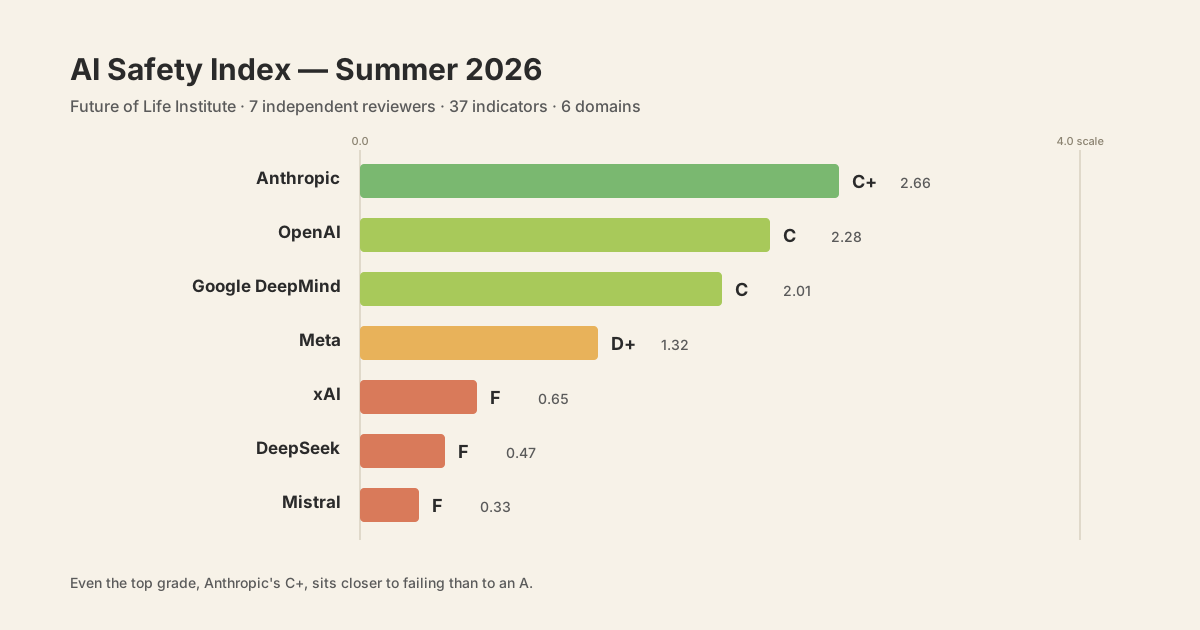
The Future of Life Institute released its Summer 2026 AI Safety Index yesterday. Among nine major AI companies, Anthropic scored highest with a C+. The part worth questioning isn’t who came in first. A large chunk of the scoring rests on a survey the companies filled out about themselves. If you have worked in audit or compliance, I’d like to hear how much discount you’d apply to that kind of self-reported evidence.
What Happened: Nine Report Cards
Seven independent reviewers scored the index across 37 indicators grouped into six domains: risk assessment, current harms, safety frameworks, existential safety, governance and accountability, and information sharing. Evidence was collected through June 3, drawn from public model cards, research papers, benchmark results, and a dedicated survey the Institute sent to each company.
The spread is wide. Anthropic scored 2.66, translating to a C+, the highest of the nine. OpenAI came in at 2.28 and Google DeepMind at 2.01, both landing on a C. Below that the drop is steep: Meta scored 1.32, a D+. xAI scored 0.65, DeepSeek 0.47, and Mistral 0.33, all three failing outright. UC Berkeley professor Stuart Russell’s comment in the report was blunt: “While there is good work being done on AI safety in the industry, the capabilities race has become more extreme.”
More notable than the scores themselves is a pattern the reviewers flagged directly. Anthropic, OpenAI, Google DeepMind and Meta had all previously committed to pausing development if their systems approached specific danger thresholds. The report describes their conduct over the past six months as “moving goalposts,” language the reviewers say has undermined safety frameworks across the entire industry. This isn’t a question of whether safety research is happening. It’s that the red lines these companies agreed to earlier are now getting redrawn.
What the Numbers Actually Mean
Start with the scale itself. This isn’t an absolute measurement, it’s a relative ranking calibrated across seven reviewers, closer to how college recommendation letters get read than to a lab test result: the same word “excellent” carries different weight depending on who wrote it. More importantly, a meaningful share of the 37 indicators draws on company-submitted survey answers rather than third-party audits, with no audit trail attached. That means the score partly reflects who writes better compliance documentation, not strictly who runs the safer system.
Even after discounting for that, the fact that Anthropic’s C+ is the best grade in the field is itself the headline. Map it onto a standard US 4.0 GPA scale and a C+ sits around 2.3, barely a passing grade, nowhere near honors territory. The company widely regarded as the industry’s most safety-conscious still ends up with a report card that reads “barely passing.” What does that say about the other eight?
Run the Fermi estimate on scale: 37 indicators times 7 reviewers works out to roughly 259 individual assessment points per company, close to 2,300 total data points across nine companies, all compressed into one public report. That’s real volume, but it also means any single indicator’s error gets averaged and diluted into the total. The C+ or F a reader sees on the page is hiding a fairly coarse grain size underneath.
Then there’s the “moving goalposts” framing itself. Safety-pause commitments were never legally binding to begin with. No outside party can enforce them, and no independent audit team gets standing access to check compliance. So describing this as companies “breaking their word” somewhat misses the point. These commitments were soft PR language from the start, without an enforcement mechanism attached. The real question isn’t why these companies abandoned their pledges. It’s whether a pause mechanism built entirely on self-restraint was ever going to survive a release cadence where GPT-5.6, Claude Sonnet 5 and Gemini 3.5 all ship within weeks of each other. The gap between that shipping speed and the time a proper safety red-team cycle actually needs is structural, not a case of any one company cutting corners on purpose.
Metrics Worth Tracking Next
First: the implementing rules for the EU AI Act. If this report gets cited as legislative evidence that voluntary pledges don’t hold, expect regulators to start pushing for mandatory third-party audit clauses in the next few months, rather than continuing to accept self-reported company surveys.
Second: whether the self-reported share shrinks in the next index. If the Future of Life Institute takes the self-reporting critique seriously, the winter edition’s methodology should shift toward more third-party-verifiable sources and less company-submitted survey weight. That ratio will tell you more about whether the report is improving than the letter grades will.
Third: whether the three failing companies, xAI, DeepSeek and Mistral, publish any safety framework updates over the next six months. If the scores stay flat with zero policy response, it means these three simply don’t treat this index as something they’re accountable to, and whatever “industry pressure” exists only applies to the top players, not the rest of the field.
I don’t have answers on any of these three yet, and I’ll be tracking them over the coming months. If you’ve done third-party audit or red-team work and have a view on whether this index’s grain size is fine enough to be meaningful, I’d like to hear it.
If this was useful, subscribe to the newsletter for weekly AI PM insights and GenAI case studies.
Further reading: UN Opens First-Ever AI Governance Dialogue, Anthropic’s Claude Sonnet 5 Becomes the Default Model
Sources:
Related Articles
G7 Summit 2026: Altman, Amodei, and Hassabis Meet World Leaders Together for the First Time
For the first time in G7 history, the CEOs of OpenAI, Anthropic, and Google DeepMind will attend the same summit in Évian, France (June 15-17). Behind the gathering: US resistance to multilateral AI agreements, Europe's fight for AI sovereignty, and two AI companies approaching IPOs who need political credibility before listing.
Court Upholds Anthropic Exclusion: Making Safety Restrictions Predictable
A US appeals court backs excluding Claude from the defense supply chain in a 2-1 decision. The ruling addresses purchasing authority, not whether removing safeguards improves reliability. Product teams still need to distinguish intended refusals from mistakenly blocked tasks.