Grok 4.5 Undercuts Opus 4.8 by 4x: Who Blinks First in This Price War
TL;DR
SpaceXAI's Grok 4.5 launched at $6 per million output tokens, a quarter of Opus 4.8's price, with a claimed 4.2x token efficiency edge. The benchmarks are mixed, but the pricing math behind this war is the real story.
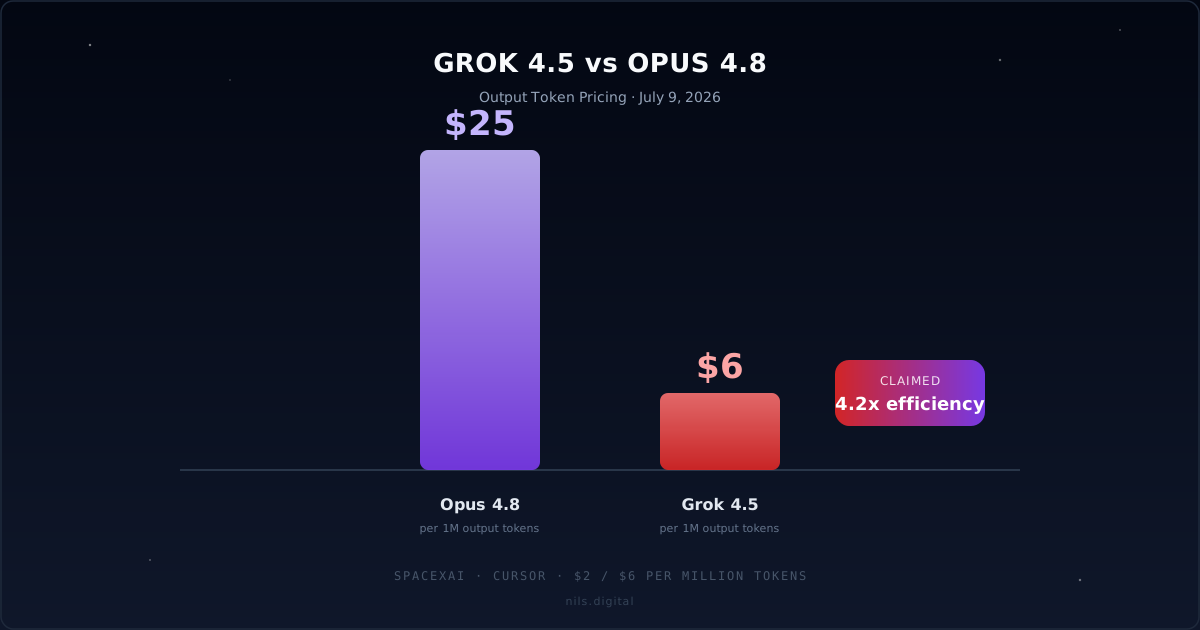
Grok 4.5 went fully public today at $6 per million output tokens, less than a quarter of what Anthropic charges for Opus 4.8 at $25. Elon Musk called it “an Opus-class model, but faster, more token-efficient and lower cost,” and threw in a claimed 4.2x token efficiency number for good measure. The benchmarks are a mixed bag. What actually matters here is the math behind the pricing strategy, and where to go looking in three months to check whether it holds up.
Here’s my read, and I’d genuinely like to be proven wrong: this price cut won’t push Anthropic into an immediate counter-cut. Instead it shifts the real battleground from “dollars per million tokens” to “dollars per completed task.” If you’re already running coding agent workloads and have real billing data, run the same batch of tasks through Grok 4.5 and Opus 4.8 side by side. Does your per-task cost match the estimate below?
What Happened
SpaceXAI, the company formerly known as xAI before a July 6 rebrand, opened Grok 4.5 to everyone today. It’s the first model to ship under the new name, arriving after SpaceX’s February merger with xAI and its June acquisition of coding tool Cursor for $60 billion. Pricing is straightforward: $2 per million input tokens, $6 per million output tokens, available on grok.com, the X app, every Cursor plan, and SpaceXAI’s own API. It runs at roughly 80 tokens per second, squarely in fast-model territory.
On benchmarks, xAI published four head-to-head comparisons against Opus 4.8 and split them evenly. Grok 4.5 leads on Terminal-Bench 2.1 at 83.3% versus 78.9%. It trails on SWE-Bench Pro, 64.7% versus 69.2%, and loses by 6 points on DeepSWE 1.1. The real pitch sits elsewhere: xAI says Grok 4.5 completes the same SWE-Bench Pro tasks using an average of 15,954 output tokens, against 67,020 for Opus 4.8, a 4.2x gap. Independent community scoring places Grok 4.5 at 1462 Elo on LMSYS Chat Arena, in the same band as Opus 4.6. No third party has yet reproduced the efficiency numbers.
Grok 4.5 was trained on Cursor’s live developer session data, debugging traces and real code edits, rather than static public repositories. That explains why it does well on Terminal-Bench, which leans toward engineering workflow tasks, while lagging on SWE-Bench Pro, which demands broader reasoning.
What the Numbers Actually Mean
Start by unpacking the 4.2x efficiency claim. If it holds, a task that would cost 4.2x more output tokens on Opus 4.8 ends up costing the same dollar amount on Grok 4.5, because Grok’s per-token price is already a quarter of Opus’s. Stack the two multipliers and the theoretical per-task cost drops to roughly a seventeenth of what Opus charges. That’s an attractive number, and it comes entirely from xAI’s own internal testing. No independent lab has re-run the same task batch to verify actual token consumption. Benchmark organizations typically validate accuracy, not token spend, and that gap remains unfilled today.
Run the Fermi estimate to get a sense of scale. A mid-size software company running 5,000 AI coding agent tasks a month, at Opus 4.8’s average of 67,000 output tokens per task and $25 per million, spends roughly $8,375. Swap in Grok 4.5’s claimed efficiency at the same task volume: 5,000 times 15,954 times $6 divided by a million comes out to about $479, a gap of nearly 17x. That math assumes identical task difficulty, agent framework, and retry counts, conditions that almost never hold exactly in practice. But the order of magnitude is large enough that any CFO would take a second look.
There’s an engineering reality beyond the benchmarks too. Grok 4.5 trained on Cursor’s internal debugging sessions, and Cursor itself is the company SpaceX is acquiring and folding in as a subsidiary. Competitors like Anthropic’s Claude Code and OpenAI’s Codex have no access to that kind of private development workflow data, so xAI is sitting on a data moat rivals can’t replicate, one that deepens as Cursor’s user base grows. Whoever holds training data closest to real development work picks up an edge that has nothing to do with model architecture.
On deployment reality: 80 tokens per second lands in fast-model range, which matters for interactive coding assistance. But what actually slows down multi-turn agent tasks is usually the back-and-forth of planning and tool calls, not raw token throughput, and that’s a dimension none of the published benchmarks touch.
Metrics Worth Watching Next
Three things should give an answer within one to three months. First, whether independent benchmark groups like the SWE-Bench maintainers or Artificial Analysis re-measure Grok 4.5’s actual token consumption on matched tasks and confirm or debunk the 4.2x figure. Second, whether Anthropic ships a price cut or efficiency-focused variant of Opus. If nothing moves within three months, that tells you Anthropic believes its moat sits in accuracy rather than price. Third, whether Cursor’s paying users shift their default model selection after Grok 4.5’s launch, a number that will say more about real developer judgment than any benchmark table.
Grok 4.5 isn’t available in the EU yet. Whether that regulatory lag leaves European developers sitting out a full quarter of this price war is also worth tracking.
If this was useful, subscribe to the newsletter for weekly AI PM insights and GenAI case studies.
Sources: TechCrunch, Axios
Related reading:
Related Articles
Meta Muse Spark 1.1 上線:用四分之一價格單挑 Anthropic 和 OpenAI
Meta 上線 Muse Spark 1.1,API 定價每百萬輸出代幣只要 4.25 美元,號稱是 Anthropic、OpenAI 旗艦模型的四分之一。跑分卻刻意跳過兩家最新旗艦,這個「便宜」到底划不划算?
OpenAI Eyes Major Price Cuts as Claude Code Forces an AI Token War
The Wall Street Journal reported June 11 that OpenAI is weighing significant API token price cuts. The trigger: Anthropic's Claude Code drove explosive growth and the company's first profitable quarter. As AI pricing enters a competitive phase, enterprise buyers are gaining leverage.