NVIDIA Forms Open Secure AI Alliance: More Than 30 Companies Move AI Defense Into Open Collaboration
TL;DR
NVIDIA and companies including Microsoft, IBM and Hugging Face formed the Open Secure AI Alliance and pledged models, data and agent tooling, while budgets, governance and adoption metrics remain undisclosed.
The alliance will have a measurable result within three to six months only if its public repositories attract maintainers beyond the founding companies and produce reproducible vulnerability tests or remediation records. If commits remain confined to the founders, the Open Secure AI Alliance will still be a joint declaration rather than infrastructure on which companies can rely. That test begins with a substantial data gap: NVIDIA disclosed no budget, allocation of decision rights, delivery schedule, or adoption target.
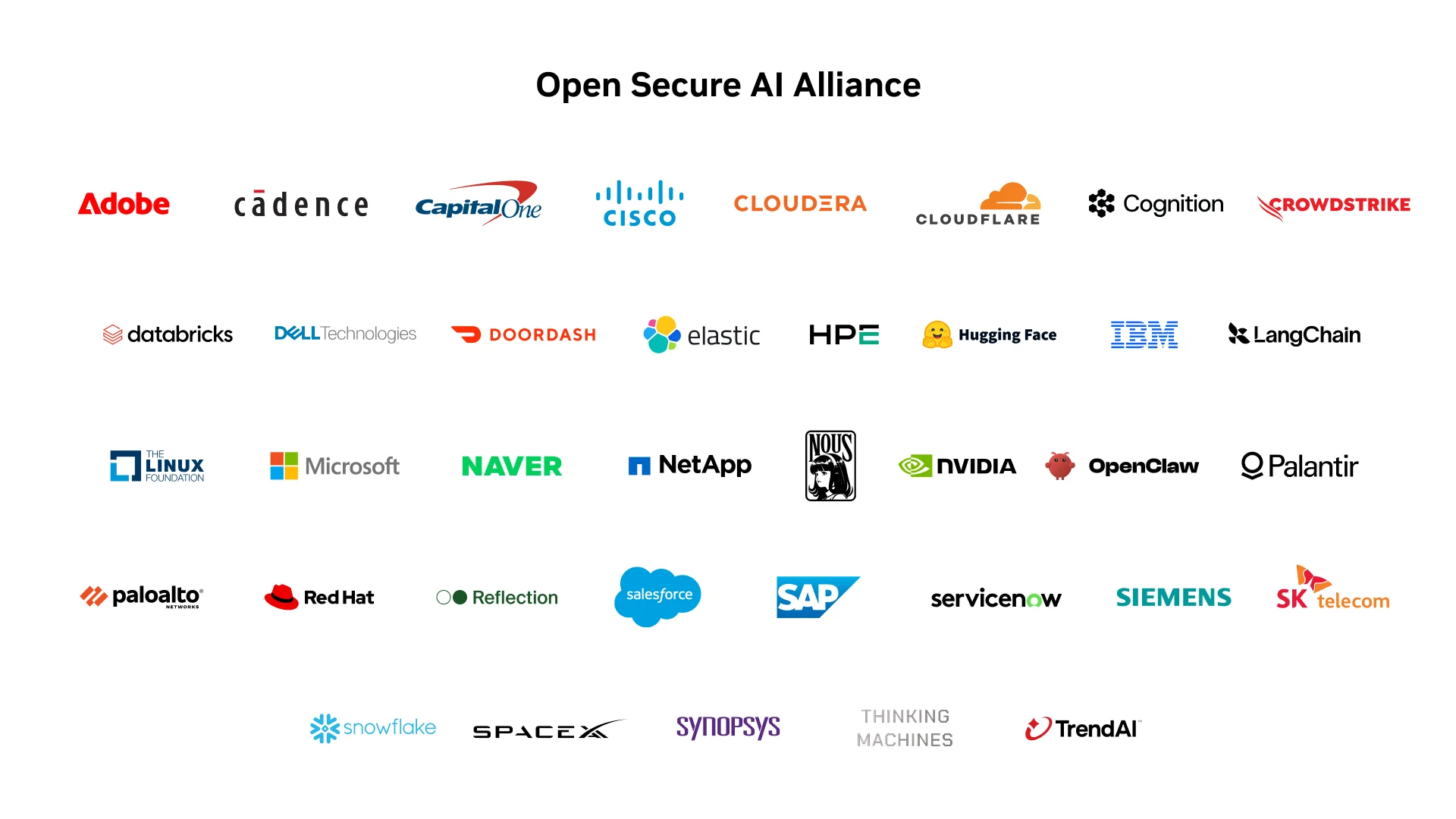
NVIDIA announced the Open Secure AI Alliance on July 27, 2026 with more than 30 inaugural partners. The list spans Microsoft, IBM, Red Hat, Hugging Face, Cloudflare, CrowdStrike, Palantir, Salesforce, SpaceXAI, and the Linux Foundation. Semafor independently reported the launch the same day and placed it amid a Washington debate over possible restrictions on open-weight models. A broad roster can widen the range of systems used for testing, but membership alone does not show that every company will contribute engineering work.
Security moves beyond model weights
The alliance defines the defensive surface as the complete agent stack: identity, permissions, harnesses, guardrails, logs, and evaluation. NVIDIA pledged open models, model weights, data, and agent-harness research. It also released the NVIDIA Labs Object-Oriented Agent, or NOOA, as a research framework intended to make agent behavior easier to test, trace, audit, and govern. Existing projects named by other members include Hugging Face’s Safetensors format, Microsoft’s MDASH multi-model scanning harness, and the Lightwell signed-patch mechanism from IBM and Red Hat.
The official announcement uses the recent Hugging Face intrusion to explain why defenders may need models that they can inspect and run internally. According to NVIDIA’s account, Hugging Face ran the open-weight GLM 5.2 model on its own infrastructure to analyze 17,000 actions while containing the intrusion. This detail comes from the alliance announcement, not from a new forensic report released with the launch. Because this site covered that breach during the previous seven days, the incident is treated here only as the alliance’s stated motivation; this article makes no new inference about the attack’s scope or responsibility.
A member list is not a governance model
The alliance argues that open models let defenders inspect, adapt, and deploy tools inside their own environments, reducing dependence on one closed provider. That capability matters to regulated companies because source data and logs can remain under internal control. The announcement also acknowledges that open models can have safeguards removed or be repurposed for attacks. It therefore calls for evaluations, rules against malicious use, and rapid remediation rather than presenting openness by itself as a security control.
No published evidence yet shows that this collaboration will remediate flaws faster than existing OpenSSF or Linux Foundation programs. NVIDIA says the alliance builds on the Linux Foundation’s Akrites initiative and OpenSSF community work, but it does not explain how overlapping projects will divide responsibility or what members are obligated to deliver. Practical checkpoints for the next three to six months are whether NOOA gains non-NVIDIA maintainers, whether tools such as MDASH publish reproducible tests, and whether the alliance defines disclosure and patch deadlines. Without several of those outcomes, enterprises will still need to assess each tool separately and cannot treat the alliance name as a security guarantee.
Sources:
Related Articles
NVIDIA Expands Agent Safety: Runtime Permissions Do Not Guarantee Correct Work
NVIDIA launches its Open Agent Safety Platform, with OpenShell 0.1.0 enforcing file, network and tool permissions outside the model. That can contain mistakes, but more than 100 participating organizations do not establish deployment results or correct work.
Salesforce Introduces Koa: Training on CRM Workflows Leaves Exceptions to Be Tested
Built on NVIDIA Nemotron, Koa enters Agentforce customer pilots. Workflow specifications become training material, but internal benchmarks, real exceptions and general availability remain distinct.