Microsoft Launches Project Perception: Can a 96% Cyber Benchmark Score Shorten Remediation?
TL;DR
Microsoft launched Project Perception and MAI-Cyber-1-Flash on July 27, 2026, claiming 96% on CyberGym and nearly 50% lower cost than its current MDASH configuration.
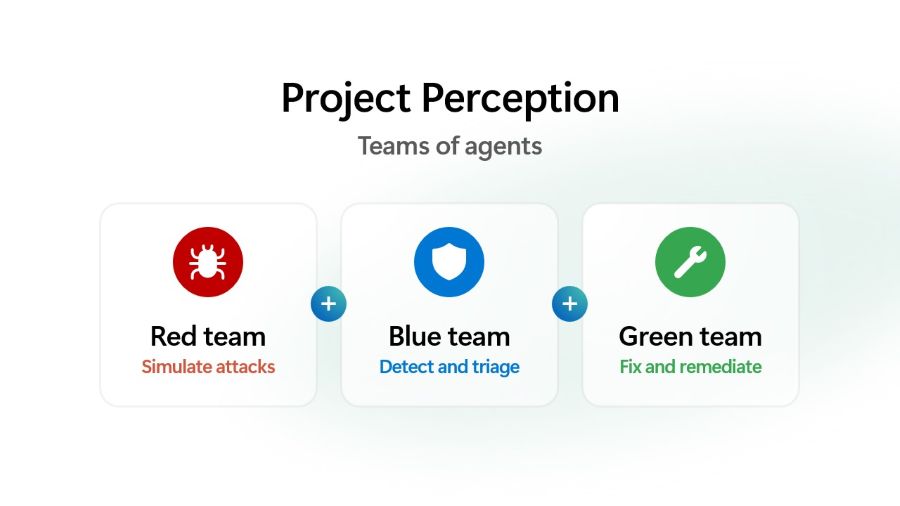
The testable claim behind Project Perception is whether it can reduce the average time needed to remediate an enterprise vulnerability without increasing bad fixes or human review. If customers see only a CyberGym score over the next three to six months while false-positive rates, remediation time, and human intervention remain unchanged, the reported 96% will still be a controlled-test result rather than evidence of better production defense.
Microsoft announced Project Perception and its first cybersecurity-specialized model, MAI-Cyber-1-Flash, on 2026-07-27. Project Perception puts red-team, blue-team, and green-team agents into one closed loop. Red agents search for possible paths to compromise, blue agents investigate context and assess risk, and green agents carry out corrective work. The system draws signals from endpoints, identities, applications, data, clouds, and AI workloads. It is scheduled to enter public preview on August 3, with Microsoft saying that human defenders remain in control.
MAI-Cyber-1-Flash starts with software vulnerabilities
The first deployment scenario is MDASH, Microsoft’s multi-model agent harness for software vulnerability discovery and remediation. MAI-Cyber-1-Flash searches complex codebases for difficult flaws, while the harness routes analysis and remediation work to suitable models and agents. Microsoft says this configuration scored 96% on CyberGym, 12 percentage points above Mythos, while costing nearly 50% less than the MDASH configuration currently on the market. TechCrunch reported from the San Francisco launch that Microsoft AI CEO Mustafa Suleyman described the tested MDASH setup as also combining GPT 5.4 and said it was moving into production immediately.
Those comparisons come from Microsoft. The company did not publish the complete inference settings for every model, token use per vulnerability, failed examples, or the cost of human review. CyberGym tests vulnerability capabilities under specified conditions, whereas an enterprise codebase also carries permissions, package dependencies, internal policies, and controlled change windows. If a model identifies a flaw but proposes a patch that cannot be merged, or makes engineers spend more time rejecting false positives, lower inference expense will not automatically reduce the cost of an incident.
Six layers connect a judgment to a corrective action
Project Perception is organized into six layers: signals and sensors, security context, models, a harness, agents, and actuators. Microsoft’s design turns attack graphs, identity relationships, process trees, and other telemetry into context that agents can consume. The harness then selects models according to quality, reliability, latency, and cost. Actuators connect the resulting decisions back to existing Microsoft security products so that an agent can do more than generate another alert.
This integration may reduce the tokens that agents spend reconstructing context for each task, but it creates deployment constraints. The available visibility depends in part on whether an enterprise already uses Microsoft’s endpoint, identity, cloud, and data tools. The useful automation boundary also depends on how much remediation authority the organization is willing to grant an agent. A system that can recommend a patch but cannot act has a different cost profile from one allowed to change production controls.
A closed loop can also propagate an error from one stage to the next. If a red-team agent labels normal behavior as an attack path, a blue-team agent may raise its risk score and a green-team agent may then alter a healthy configuration. Conversely, an identity relationship missed at the beginning will not be addressed downstream. Enterprises therefore need records of the evidence, model version, approver, and rollback attached to every decision. Those records are necessary to assign responsibility after a bad change and to compare the loss produced by automatic action with the cost of a recommendation-only mode.
There is not yet independent production evidence showing that this closed-loop approach is faster or safer than existing security automation. After the public preview begins, four measurements should be compared: false positives per 100 valid vulnerabilities, median time from discovery to a merged patch, the share of agent actions reversed by people, and model cost per completed remediation. If those measures do not improve together, Project Perception will have demonstrated integration among Microsoft’s models, agents, and security products, but not a reduction in operational security risk.
Sources:
Related Articles
Copilot Unites Office and Persistent Agents: Can Work Continue Without Reconciliation?
Microsoft announces Home, Code and Autopilot, connecting shared Office files with Copilot. Integration could reduce version reconciliation, while persistent agents must recognize obsolete goals. Access remains phased rather than universal.
Salesforce Introduces Koa: Training on CRM Workflows Leaves Exceptions to Be Tested
Built on NVIDIA Nemotron, Koa enters Agentforce customer pilots. Workflow specifications become training material, but internal benchmarks, real exceptions and general availability remain distinct.