Anthropic's $1.5B Settlement Hits Allocation Disputes Among Authors, Publishers, and Agents
TL;DR
As claims in Anthropic's copyright settlement are reconciled, some authors found conflicting publisher or agent allocations; disputed payments are held and unresolved cases may go to a special master.
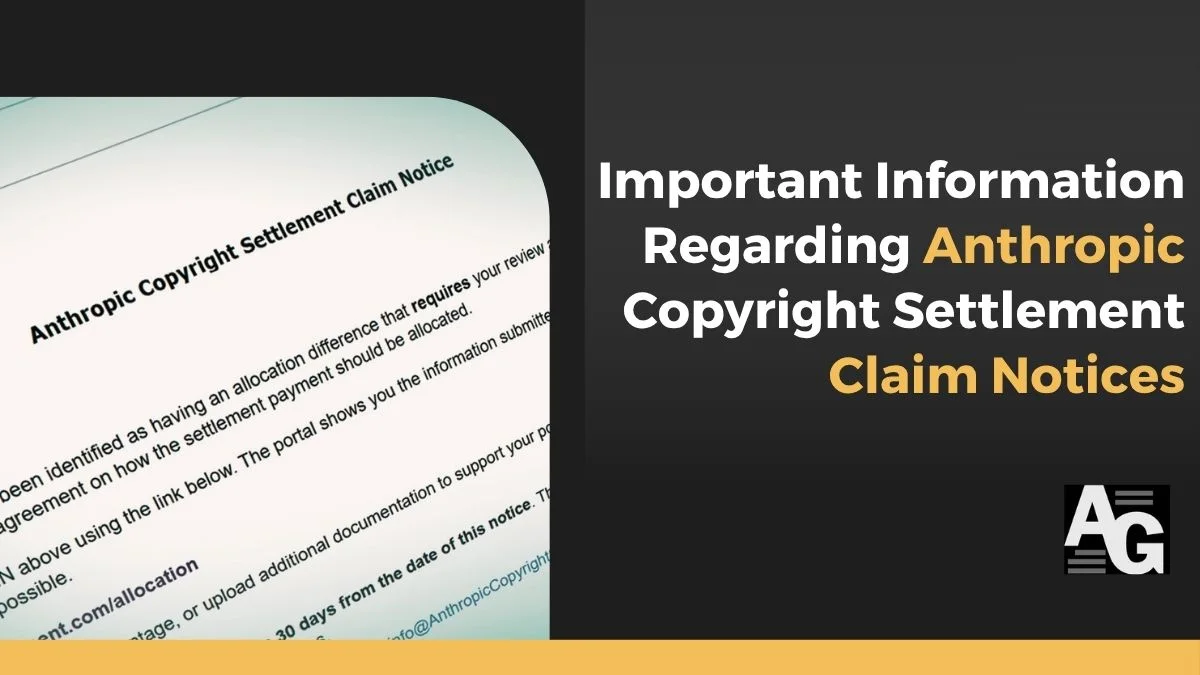
One missing number now determines how quickly this settlement turns into cash: what share of nearly 500,000 covered titles has conflicting ownership allocations? If the dispute rate remains high over the next three months, Anthropic’s $1.5 billion payment will not translate proportionally into money received by authors. If most erroneous 100 percent claims disappear after the administrator updates its system, delays may remain limited to works with complicated contracts. The Authors Guild says all claimants should have received reconciliation notices by September 4, 2026. Each eligible pirated work is scheduled for a $3,000 payment.
The Authors Guild says each notice identifies other claimants for a title and the percentage each one requested. For a conventional trade book that remains in print, the default is a 50-50 split between author and publisher. A self-published author, or an author whose rights reverted before the August 10, 2022 download date, may claim 100 percent depending on the contract. Educational publishing agreements can assign the full copyright to the publisher and have no standard allocation. A discrepancy therefore does not automatically prove that someone filed an improper claim.
Mistaken selections meet old contract records
Some publishers told the settlement administrator that they selected a 100 percent allocation by mistake instead of the default split. The administrator is correcting those percentages, and the Authors Guild advises affected writers to log in again the following week. Writer Beware collected additional reports of publishers claiming rights-reverted books and literary agencies requesting 15 to 25 percent. It also quoted an agent who said a publisher may have mistaken an agency payment clause for an ownership claim. The current evidence consists of author reports, advocacy organizations, and statements from a small number of businesses. There is no complete denominator with which to measure the frequency or cause of the errors.
Anthropic agreed last year to a $1.5 billion class-action settlement covering nearly 500,000 titles. TechCrunch reports that the plan pays $3,000 for each pirated work and generally divides an in-print trade title 50-50 between its author and publisher. A self-published work, or one whose rights had reverted by the relevant date, can qualify for a full author allocation. The operational question has therefore moved from the headline amount per book to who owned the relevant rights on the download date, how a publishing contract allocates infringement recoveries, and whether the claims system confused payment instructions with ownership.
Claimants who see conflicting allocations have a 30-day period to negotiate and upload evidence such as a rights-reversion letter or publishing contract. Money for a disputed work is withheld while the disagreement continues. If the parties do not resolve it themselves, the administrator will try to facilitate an agreement, and a court-appointed special master can ultimately decide the allocation. The delay is thus concentrated in disputed titles rather than automatically stopping every payment. Claimants must also watch for impersonation attempts; the Authors Guild says legitimate notices use the administrator’s listed address and direct recipients to the official settlement site.
Three figures will make the next stage measurable: the number of 100 percent conflicts remaining after corrections, the share resolved within 30 days, and the number sent to the special master. Together they will show whether batch-filing mistakes caused most of the problem or whether poorly maintained publishing contracts created a deeper rights dispute. Anthropic’s total settlement amount is fixed, but when an individual author receives $3,000 still depends on that reconciliation process.
Sources:
Related Articles
White House Demands Zero Jailbreaks for Fable 5: Security Experts Say It's Impossible
Day 7 of the Fable 5 ban: the White House demands the model be completely jailbreak-proof before it relaunches. Security experts are unanimous: that's technically impossible for any frontier LLM, and Dario Amodei has already refused both of the government's proposed fixes.
US Orders Anthropic to Pull Fable 5 and Mythos 5: A Narrow Jailbreak That Took Down Its Most Powerful Models
The US Commerce Department ordered Anthropic to suspend its two most capable models, Fable 5 and Mythos 5, citing a narrow jailbreak tied to cybersecurity capabilities. Anthropic complied. Then it pushed back.