Google Sends TPUs Into Orbit: A 15-Minute Test Is Not Continuous Compute
TL;DR
Google and Planet launch a Suncatcher prototype to test Gemma on four TPUs. Orbital hardware enables thermal and radiation testing, but cooling intervals, sustained compute and commercial costs remain unresolved.
Google and Planet have sent the Suncatcher prototype into orbit to test Gemma on four TPUs. One limitation remains unspecified: thermal constraints restrict planned runs to 15 minutes, but the reporting does not give the interval between runs. Without that interval, a single test cannot establish round-the-clock usable compute.Mission and test conditions
SpaceX scheduled the Transporter-18 launch window to open at 11:18 PDT on 2026-10-01, or 02:18 in Taipei on 2026-10-02. NPR’s report, published at 14:41 EDT on October 1, already confirmed the launch; that is 02:41 on October 2 in Taipei. This article uses the Taipei publication date of October 2 and a 09:02 cutoff. The window opening, publication and actual ignition are distinct times.Launch window Reporting timestamp
Planet subsequently announced initial contact with the prototype and the start of commissioning. That gives researchers an opportunity to test hardware in space, not a compute service customers can buy. Contact with a satellite does not establish sustained TPU operation and should not be counted as additional data-center capacity.Launch and contact confirmation
Google’s September 24 explanation describes heat pipes combined with radiators. Without airflow in space, cold surroundings alone cannot remove heat from a chip. Cooling equipment therefore remains part of the computing system; launching it does not eliminate that expense.Thermal design
Count computing time and cooling time together
I support using a prototype to obtain these measurements. A measurable workload can narrow engineering uncertainty more usefully than immediately debating how much terrestrial capacity orbital data centers might replace. Suppose the chips complete the assigned task every time but must then wait a long time before repeating it. Completion would still be a valuable research result. Deliverable service volume, however, would have to include that waiting time.
Following this constraint, larger radiator panels might enable more sustained operation, while also requiring more equipment to be launched. The comparison should concern work completed by the whole system rather than the chips’ peak performance alone. There is not enough information here to estimate which design would be cheaper. Publishing cooling intervals and repeated-run results would provide a stronger basis for the next capacity decision than one successful run.
Google’s 2025 research already included high-bandwidth optical links between satellites. That earlier proposal is not a capability introduced today.Research history The September explanation still places a two-satellite connectivity test in 2027. Launching this single prototype does not validate the complete distributed-computing architecture.Future testing
This is why I currently treat Suncatcher as a hardware-research investment. If future workloads need several satellites, demonstrating that one chip operates answers only part of the question. Transferring data and waiting for other nodes will also affect completion time. Connectivity that remains to be demonstrated cannot be included in a present-day service promise.
The industrial significance of this launch is the opportunity to test thermal and radiation assumptions in orbit. Teams needing additional AI capacity still lack a service price or sustained-operation results on which to base a choice. Cooling intervals, repeated execution and later connectivity tests would help translate the achievement of sending chips into space into a defensible estimate of deliverable work.
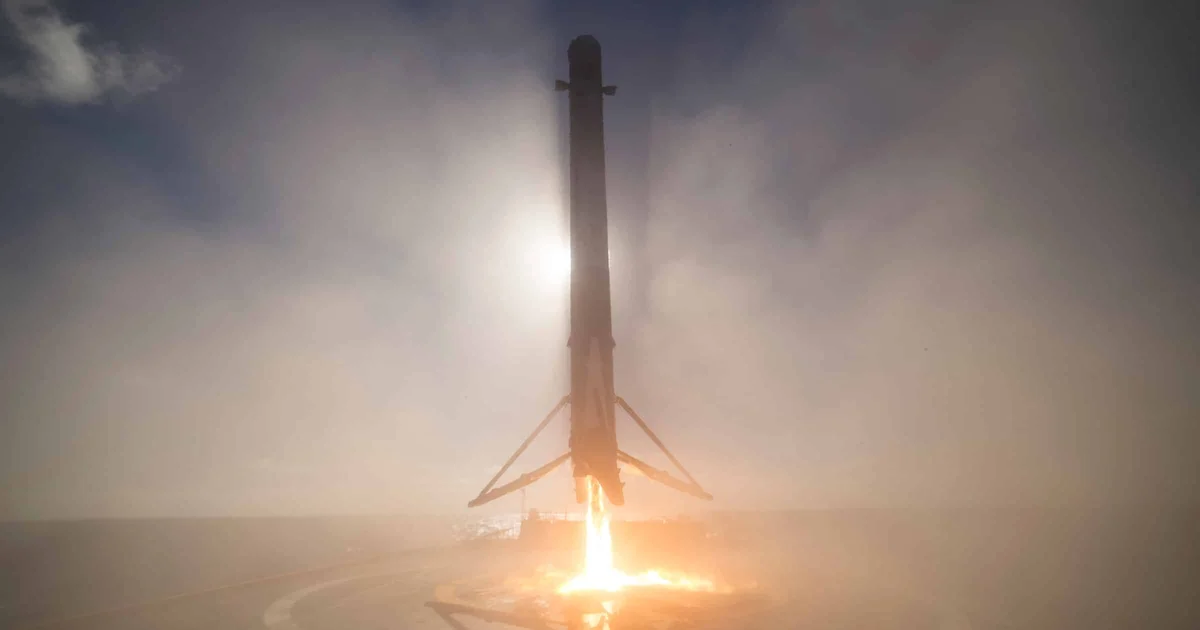
The cover reuses an archival SpaceX rocket-landing photograph from this site, not an image of this Suncatcher launch or satellite. The event-image download failed because DNS resolution was unavailable.
Sources:
Related Articles
Google Unveils Gemini 4 Argon: Code Modernization Needs the Right Baseline
Gemini 4 Argon raises the output limit to 1M tokens, initially for trusted cyber defenders. Its libgav1 example shows iterative improvement of a Rust port, but the 2.7-fold speedup is not measured against the optimized C++ original.
Akamai Wins Anthropic Cloud Deal: CPU Capacity Requires Spending First
Anthropic commits to $11.6 billion of cloud services over seven years, with Akamai estimating $5.5 billion in capital spending. CPU demand has a named buyer, but delivery and revenue still lie ahead.