Agent Harness Deep Dive: The Architectural Core for Production-Grade AI Agents
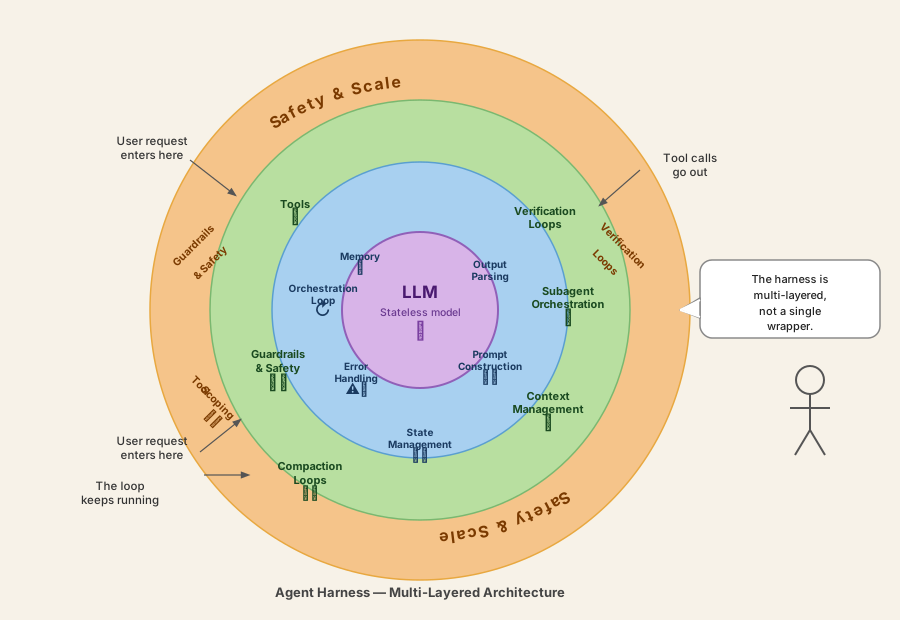
As AI architects, we must acknowledge a harsh reality: in 2026, AI competition is no longer about parameter count — it’s about Agent Harness architecture.
Many agents perform flawlessly in demos, only to collapse in complex production environments. The “success rate chasm” has a clear cause: the model itself is rarely the problem. The scaffolding around it is.
LangChain ran a landmark experiment: without changing any model weights or algorithms, optimizing the Harness architecture alone pushed an agent from outside the top 30 to 5th place on TerminalBench 2.0. LLM-optimized Harness systems achieve task pass rates of 76.4% — far exceeding hand-crafted traditional systems.
Chasing a stronger model won’t patch production failures. The shift from “AI toy” to “production tool” requires engineers to move their focus from model fine-tuning to precise Harness construction.
1. Core Definition: What Is an Agent Harness?
An Agent Harness is the OS-level software infrastructure wrapped around a large language model. It transforms a stateless, error-prone, text-only model into a reliable agent with clear goals, external tool access, self-correction capabilities, and persistent execution.
The Von Neumann Analogy
As Beren Millidge noted in his 2023 essay AI Scaffolding, the Harness is a natural abstraction in the evolution of computing systems. The mapping is precise:
| Traditional Computing | Agent Equivalent | Role |
|---|---|---|
| CPU | Raw LLM | Core computation and reasoning |
| RAM | Context Window | Fast access, but limited and volatile |
| Storage | Vector DB + Long-term memory | Persistent large-scale data |
| Device Drivers | Tool Integration | Interface with external environments |
| Operating System | Agent Harness | Coordinates all resources and flows |
The Three Engineering Layers
| Layer | Focus |
|---|---|
| Prompt Engineering | Refining instructions for model comprehension |
| Context Engineering | Dynamically managing what the model sees at each step |
| Harness Engineering | Tool orchestration, state persistence, error recovery, verification, safety, lifecycle management |
As LangChain’s Vivek Trivedy put it: “If you’re not the model, you’re the Harness.” Building agents means building a precise Harness and connecting a model to it.
2. The 12 Core Modules of a Production-Grade Agent Harness
A stable, deployable production Harness consists of twelve interlocking modules. Miss any one of them and the system will struggle to survive real-world complexity.
1. Orchestration Loop
The agent’s heartbeat. Whether ReAct or TAO (Think-Act-Observe), the loop defines how prompts are assembled, requests sent, outputs parsed, tools called, and results returned.
Anthropic advocates the “Dumb Loop” philosophy: the Harness handles only stable transition logic and scheduling; all reasoning is delegated to the model, reducing coupling.
2. Tools
Tools are the agent’s hands. Through standardized Schema definitions (name, description, parameters, return format), the Harness converts reasoning into action — handling tool registration, argument extraction, sandboxed execution, and result capture.
Claude Code now provides six tool categories covering code intelligence, web access, and subagent spawning.
3. Memory
Memory ensures task continuity across time scales. Claude Code’s three-tier memory design has become an industry benchmark:
- Tier 1: Lightweight index always in memory (~150 chars each) for instant retrieval
- Tier 2: Detailed topic files loaded on demand, balancing capacity and speed
- Tier 3: Raw interaction logs accessible only via search, for full traceability
4. Context Management
To counter “Context Rot” — Stanford’s “Lost in the Middle” study found model performance drops over 30% when critical information is buried in the middle of context — the Harness must implement four dynamic strategies:
- Compaction: Summarize conversation history
- Observation Masking: Hide redundant tool execution details
- JIT Retrieval: Use grep/glob to extract precisely what’s needed
- Subagent Delegation: Offload subtasks to simplify the primary context
5. Prompt Assembly
A structured stacking process. OpenAI uses a strict priority stack:
System Message
    ↓ Tool Definitions
    ↓ Memory Files
    ↓ Conversation History
    ↓ User Message
This ensures core rules always take priority over lengthy conversation history.
6. Tool Calling & Structured Output
The communication protocol between model and Harness. Frameworks like Pydantic enforce Schema constraints so the model returns standardized tool_calls objects instead of free text, eliminating parse failures at the source.
7. State & Checkpointing
For long-running tasks, the Harness must support resume-from-checkpoint. LangGraph uses reducers to manage state updates. Claude Code takes an elegant approach: using Git commits as checkpoints, enabling precise rollback and version management of task progress.
8. Error Handling
Production systems require a classified error taxonomy:
| Error Type | Strategy |
|---|---|
| Transient error | Retry with backoff |
| Model-recoverable error | Return error context for self-correction |
| User-fixable error | Interrupt and request human intervention |
| Unexpected error | Raise exception |
Stripe recommends capping retries at two attempts to prevent resource exhaustion.
9. Guardrails
Safety spans three layers: input, output, and tools. Claude Code decouples permission enforcement from reasoning, independently controlling ~40 discrete tool capabilities across three stages: trust the system, pre-call check, and high-risk confirmation.
10. Verification & Feedback
The dividing line between toy and production-grade. Claude Code’s founder Boris Cherny noted that adding verification improves quality 2–3x. Verification methods:
- Computed: Linter / test suites
- Visual: Playwright screenshot comparison
- Model-judged: Independent subagent evaluation
11. Subagent Orchestration
The “collective intelligence” solution for complex tasks. OpenAI supports Agents-as-tools and Handoffs. Claude Code offers three modes:
- Fork: Isolated copy execution
- Teammate: Terminal-based inter-agent communication
- Worktree: Parallel development in separate Git worktrees
12. Initialization & Standard Execution Cycle
A complete SOP:
1. Assemble  → Combine system prompt, tools, memory, history
2. Reason    → Model generates text or tool calls
3. Classify  → Execute tool, hand off, or terminate
4. Execute   → Verify permissions and run in sandbox
5. Package   → Format results as model-readable messages
6. Update    → Append to history, trigger context compaction
7. Loop      → Repeat until termination condition met
Termination conditions: task complete, token budget exhausted, guardrail triggered.
3. Framework Design Philosophies Compared
| Framework | Core Philosophy | Best For |
|---|---|---|
| Anthropic Claude Agent SDK | Ultra-thin Harness, maximum trust in model reasoning | General production agents |
| OpenAI Agents SDK | Code-first, developer-friendly Runner class | Rapid production deployment |
| LangGraph | Explicit state graph with nodes and edges | Complex flow control and debugging |
| CrewAI | Role-based, decoupled tasks/roles/teams | Multi-role collaboration |
| AutoGen (Microsoft) | Conversation-driven orchestration, 5 modes | Conversational multi-agent systems |
AutoGen’s five orchestration modes deserve special attention: Sequential, Concurrent, Group Chat, Handoffs, and Magentic — treating conversation as the core collaboration protocol.
4. Co-evolution: The Scaffolding Metaphor
The Harness plays the role of construction scaffolding in AI architecture. As model capabilities grow, the Harness should progressively do less.
The Manus project is a compelling case: over six months it refactored five times, each iteration simplifying — reducing complex wrappers to generic shell execution — with performance improving each time. The trend is clear:
As models internalize more Harness capabilities during post-training, architectures should trend toward thinner, more modular designs.
A well-designed Harness must pass the “future-proof test”: when the underlying model upgrades, agent performance should naturally improve — not be constrained by a rigid architecture.
5. Seven Architectural Decisions for AI Engineers
Before building your production agent, answer these seven questions:
1. Single agent vs. multi-agent Exhaust single-agent performance first. Only split when tool count exceeds 10 or domains are clearly separated.
2. ReAct vs. Plan-and-Execute Plan-and-Execute wins on complex tasks. LLMCompiler data shows it’s 3.6× faster than sequential ReAct.
3. Context management strategy Choose among temporal pruning, summarization, masking, note-taking, and delegation — based on token cost vs. reasoning accuracy.
4. Verification loop design Combine computed verification (linter/tests) with reasoning-based verification (model judge). Neither alone is sufficient.
5. Permissions and safety Balance efficiency (permissive) vs. safety (strict). Tune guardrail strength dynamically based on deployment environment.
6. Tool scope Follow the minimal tool set principle. Vercel cut 80% of redundant tools and saw significant agent performance gains.
7. Harness thickness As underlying model capabilities grow, evolve toward a thinner Harness — reduce hard-coded control logic.
Conclusion
The 2026 AI competition is fundamentally a contest of Harness engineering. Next time your agent breaks down, don’t rush to swap the model — audit its Harness architecture first.
Master the Harness, and you master the path to production-grade AI.
Part of the “GenAI in Production” article series.
Further reading:
Harness Engineering: Building the Execution Layer for Your AI Agent
Harness Engineering is the execution layer in AI Agent architecture. This post introduces the core design of a Harness: execution control, observability, hooks, tool sandboxing, and state management.
5 Product Design Traps When Building AI Agents
AI Agents sound cool, but building Agent products in enterprise is full of pitfalls. Here are five design traps I've experienced firsthand.
Harness Engineering: Building the Execution Layer for Your AI Agent
Harness Engineering is the execution layer in AI Agent architecture. This post introduces the core design of a Harness: execution control, observability, hooks, tool sandboxing, and state management.
5 Product Design Traps When Building AI Agents
AI Agents sound cool, but building Agent products in enterprise is full of pitfalls. Here are five design traps I've experienced firsthand.