Why AI Personas Are Compressible — A Bridge from Polynomial-Growth Monoids to PPV Methodology
TL;DR
Ilya says compression is learning. Freedman finds only polynomial-growth monoids are compressible. If Persona can be projected onto a nilpotent substructure, PPV is not just a statistical fit — it's algebraically grounded personality compression.
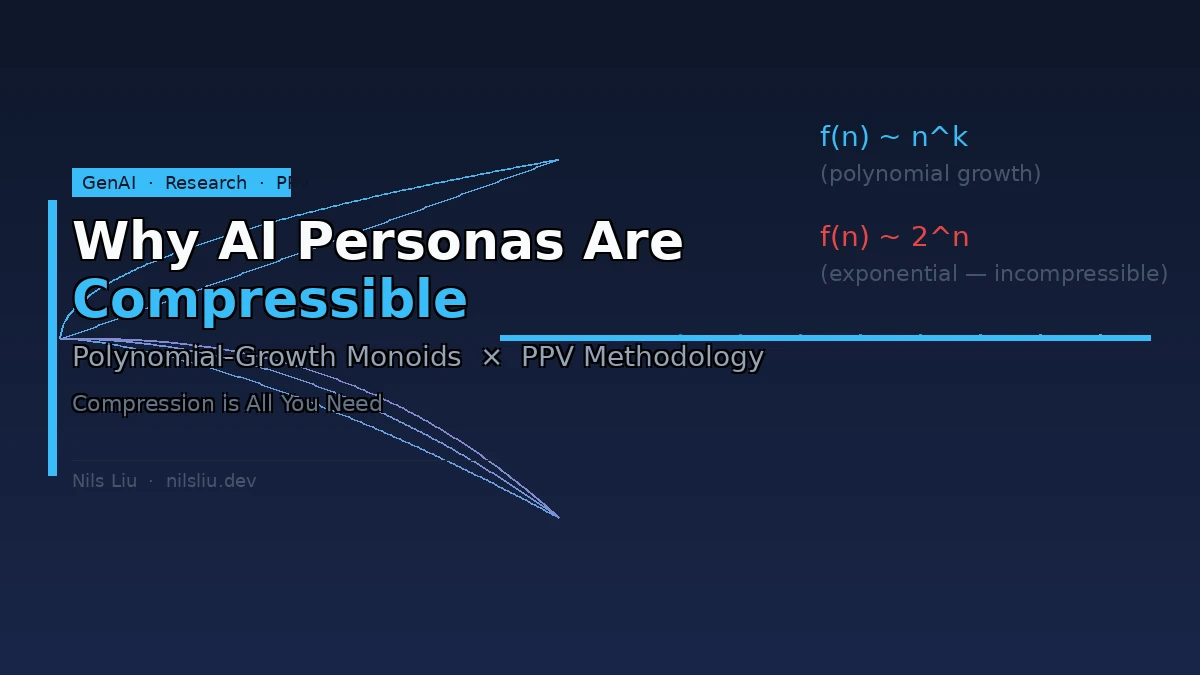
If Personality Can Be Compressed, Can AI Truly Understand You?
Ilya Sutskever has repeatedly proposed a striking thesis: compression is learning, and decompression is reasoning. His intuition: if a model can compress vast data into a compact representation, it isn’t merely memorizing — it’s understanding.
Fields Medalist Michael Freedman recently extended this thesis in a widely circulated video, Compression is All You Need. Freedman’s research team found a mathematically precise boundary: only structures with polynomial growth can be effectively compressed; exponentially growing structures are essentially incompressible.
This result triggered a bold question: Is human personality compressible?
If yes, AI persona simulation gains a far more solid mathematical foundation. If not, every Persona AI is engaged in a fundamentally futile endeavor.
What Is “Polynomial Growth”? An Intuitive Boundary for Compression
You don’t need group theory to grasp the core intuition.
Imagine a system whose complexity grows as it scales. Polynomial growth means the complexity expands like n² or n³ — growing, but predictably and boundedly. Think of a city’s road network: doubling the population doesn’t cause the number of roads to explode exponentially.
Exponential growth, by contrast, expands like 2ⁿ. Every new dimension doubles the possible combinations. Think of an unconstrained social network where everyone can freely connect with everyone else — the number of possible relationships quickly surpasses any comprehensible boundary.
Freedman’s key insight: only polynomial-growth structures can be “compressed” without catastrophic loss of essential information. For exponentially growing structures, any compression will inevitably be a severe distortion.
Is Persona Growth Polynomial?
This is the central claim of the PPV (Psychometric Persona Vectors) methodology.
PPV’s design logic: decompose personality into dimensional vectors from several major psychological frameworks — Big Five, MBTI, DISC, Enneagram — and combine them into a unified “persona projection.”
From an algebraic perspective, this projection process resembles Malcev completion in mathematics: embedding discrete, complex personality data into a “nearly nilpotent” subspace.
Nilpotent structures have a critical property: their growth is polynomial. This is why PPV is theoretically compressible — it projects persona vectors onto a substructure with bounded growth rate, making the “conversation → PPV value” transformation not merely a statistical fit, but a meaningful compression supported by algebraic structure.
This also explains an observed phenomenon in PPV practice: why only 10–15 conversational turns suffice to establish an effective Persona vector. Because the target space of PPV projection is bounded — it’s a polynomial-growth subspace that doesn’t require infinite data points to be accurately estimated.
Compression Is Necessarily Lossy — That’s a Feature, Not a Bug
Any honest Persona research must acknowledge: human personality is not fully polynomial in its growth.
Real human character includes interactions between personality traits, cultural backgrounds, episodic memories, context dependencies… the combinatorial explosion of these dimensions undeniably approaches exponential growth. Compressing such complexity into a fixed-dimensional vector inevitably loses information.
But this is the core philosophical insight of PPV’s design: lossy compression isn’t failure — it’s a deliberate design decision.
A JPEG image achieves dramatic file size reduction by discarding high-frequency visual detail that the human eye barely notices. PPV operates on similar logic: personality’s “high-frequency detail” — those idiosyncratic traits that only surface in extreme situations — isn’t critical for most AI interaction scenarios. What we compress away is “edge-case detail”; what we preserve is the “psychological skeleton.”
Interpretability requires compression. A fully uncompressed persona model becomes too unwieldy for any human to understand or tune. PPV’s lossy compression is a deliberate choice to keep persona simulation transparent and interpretable.
What This Means for AI Practitioners
For AI Researchers
This provides a new formal lens for persona representation learning: what algebraic structures should we target so that Persona embeddings have good compressibility? Nilpotent Lie algebras are a promising candidate space worth exploring.
For AI Product Managers
PPV’s compressibility explains why RAG-free persona design is viable: a compressed persona vector needs no external knowledge base because it already serves as a “pre-compressed” inferential foundation.
For ML Engineers
Polynomial growth properties provide a theoretically grounded upper bound on persona vector dimensionality. This means: when designing Persona embeddings, we have principled reasons to constrain vector dimensionality rather than expanding it indefinitely.
For LLM Designers
Compression theory explains why Persona fine-tuning tends to generalize well: a well-defined polynomial-growth subspace is itself a regularizer — it forces the model to learn “essential personality” rather than “noise detail.”
Looking Ahead: Using Growth Bounds to Constrain Persona Space
This article presents an emerging inspirational framework, not a completed theory.
The next research direction is to use formal tools from polynomial growth theory to provide computable upper bounds on PPV vector space growth behavior — turning “persona compression” from an intuitive analogy into a verifiable mathematical proposition.
If you’re interested in persona simulation, representation learning, or algebraic structures in AI, I’d love to connect. This is a rarely explored intersection — and in my view, one of the most fertile grounds for future work.
→ Read the full PPV methodology: Digital Twin, Persona Bot & PPV
Related Articles
ChatGPT's Cultural Bias Revealed: Harvard Study Maps GPT's Global Identity
When AI researchers say LLMs are 'human-like,' which humans do they mean? A 2023 Harvard study used 262 cross-cultural survey variables and 94,278 respondents to show ChatGPT's cultural psychology aligns most closely with WEIRD Western democracies (r = -.70).
Digital Twin, Persona Bot & PPV: Three Paths to Next-Gen AI Persona Simulation
Can LLMs truly simulate 'you'? From Generative Agents to BehaviorChain and the RAG-Free PPV framework, this in-depth analysis reveals why individual-level fidelity remains AI's hardest unsolved problem.