TSMC Stock Up 137% in a Year: How AI Chip Demand Drove the Surge
TL;DR
TSMC's stock surged 137% from ~$164 in April 2025 to $387 in April 2026. This post breaks down how AI chip demand, CoWoS bottlenecks, and NVIDIA dethroning Apple as top customer drove the run.
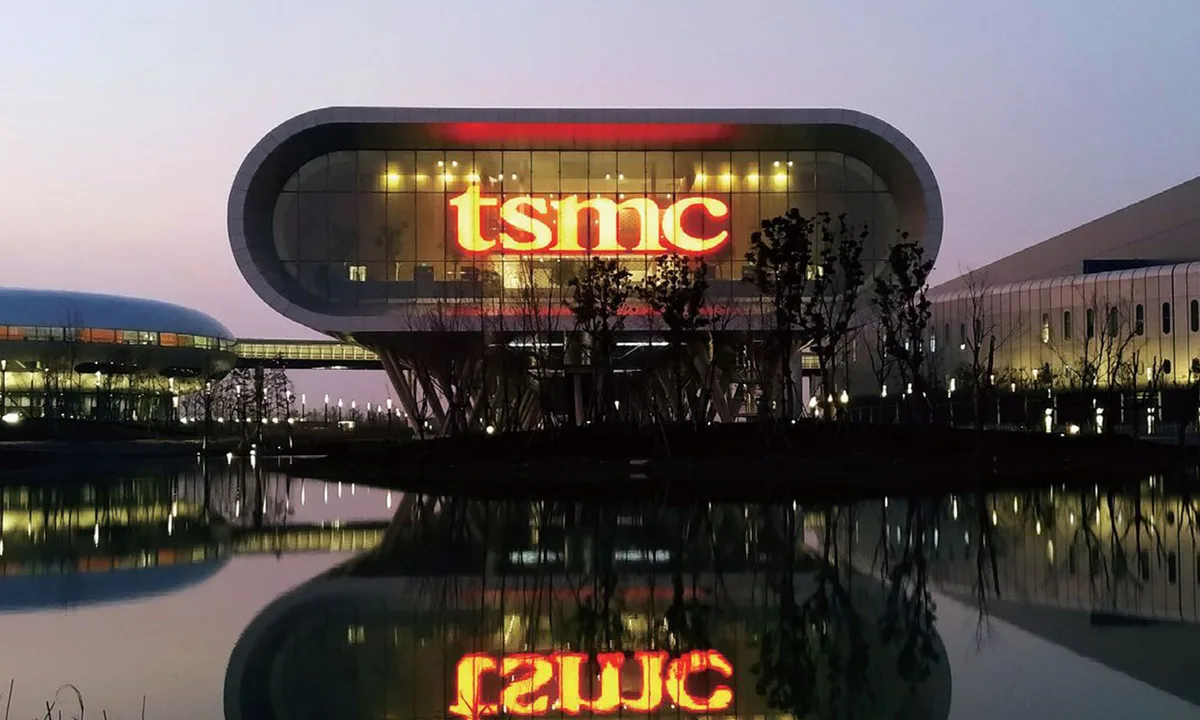
TSMC (TSM) was trading around $164 in April 2025.
On April 24, 2026, it hit an intraday record of $402, closing at $387. That’s a 137% gain in one year.
Several forces converged to drive this: AI chip demand restructured TSMC’s customer base, advanced packaging became the tightest constraint in the entire AI supply chain, and the US fab expansion shifted from geopolitical pressure to financial milestone. Here’s how each piece played out.
NVIDIA Dethroned Apple as TSMC’s Largest Customer
In 2023, TSMC’s customer rankings looked like this: Apple (25%), NVIDIA (11%), AMD (7%).
In 2026, that order has flipped. NVIDIA is projected to generate approximately $33 billion in annual revenue for TSMC — 22% of total — officially surpassing Apple ($27 billion, 18%) as the top customer.
This position swap captures how powerfully AI has reshaped TSMC’s business. NVIDIA’s H100 and H200 use TSMC’s N4 process. The Blackwell GB200 runs on TSMC’s custom 4NP process — a chip spanning ~1,600mm² with 208 billion transistors. A single GB200 NVL72 rack pushes both TSMC’s advanced packaging and logic wafer lines simultaneously to their limits.
TSMC CEO C.C. Wei’s characterization of AI chip demand: “insane.”
AI Chips as Share of TSMC Revenue
High-Performance Computing (HPC) — the category that includes AI chips — as a portion of TSMC revenue has climbed steadily:
- Q3 2025: 57%
- Q4 2025: 55%
- Full-Year 2025: 58%
- Q1 2026: 61% (highest recorded)
Full-year 2025 revenue was $122.4 billion (+35.9% YoY). Q1 2026 delivered a record single quarter: $35.9 billion revenue (+40.6% YoY), profit up 58% YoY — the fourth consecutive quarter of record results.
TSMC’s 2026 full-year guidance: revenue growth above 30% in USD terms. Capital expenditure raised to $52–56 billion, up from $40.5 billion in 2025. That scale of spending signals one thing: TSMC doesn’t think AI demand has peaked.
CoWoS Packaging: The Tightest Bottleneck in AI Infrastructure
Advanced packaging (CoWoS) is the step that determines whether an AI chip can actually be produced at scale. NVIDIA’s HBM memory stacking and multi-die interconnects all depend on this process.
The current situation: TSMC plans to expand CoWoS capacity to 130,000 wafers per month by end of 2026 — double the 2024 level. Even at that rate, estimated supply falls about 20% short of NVIDIA’s projected needs.
Until new facilities come online, CoWoS throughput is the speed limit for the entire AI server supply chain. This constraint applies to every customer requiring advanced packaging: NVIDIA, AMD, Google TPUs, Amazon custom silicon.
US Fabs: From Geopolitical Pressure to Financial Milestone
In March 2025, TSMC expanded its planned US investment from $65 billion to $165 billion, with plans for up to 12 fabs in Arizona. Fab 1 is already in high-volume 3nm production. Fab 2 targets 3nm high-volume production in H2 2027.
In March 2026, the Arizona operation reached its profitability milestone. That result signaled that TSMC’s learning curve in the US, while slower than Taiwan, has stabilized.
N2 (2nm) entered high-volume manufacturing in Q4 2025, with Apple, AMD, NVIDIA, and MediaTek as first customers. Yield performance has been on track, and capacity is ramping at both Hsinchu and Kaohsiung sites, with slots booked through the end of 2026.
C.C. Wei Said He’s “Very Nervous”
On the sustainability of AI demand, TSMC CEO C.C. Wei offered a candid remark: “I’m also very nervous about it. We’re investing $52 billion to $56 billion in capex. If we don’t do it carefully, that’d be a big disaster for TSMC.”
That caution is consistent with TSMC’s historical discipline. But the actual capital commitment tells a clearer story: Wei forecasts AI-related chip revenue growing 45%+ annually through 2029. Advanced-node capacity currently falls roughly three times short of what major customers plan to consume.
On April 24, Taiwan’s FSC formally announced it would relax single-stock holding limits for equity funds and active ETFs. Taiwan-listed TSMC shares hit an intraday record of NT$2,190, closing at NT$2,185. The TAIEX index surged 1,218 points that session — the fifth-largest single-day gain in Taiwan market history — closing at 38,932 points.
JPMorgan estimated the policy shift could attract $6+ billion in inflows. Fubon Securities chairman Chen Yi-guang suggested the index could challenge the 40,000-point level.
Chen also flagged near-term risks: the index’s deviation from its annual moving average has exceeded 40%, potential hawkish signals from the incoming Fed chair in May, and foreign investors still holding 40,000+ short contracts on Taiwan futures. The momentum is real, but the positioning picture is not without friction.
TSMC as the Foundation of AI Infrastructure
From an AI systems perspective, TSMC occupies a unique position.
NVIDIA designs GPUs but depends on TSMC to manufacture them. Apple designs M-series chips but builds them at TSMC. AMD, Qualcomm, Google TPUs, Amazon Trainium — almost every frontier AI chip runs through TSMC’s fabs. TSMC isn’t an AI company. It’s the manufacturing foundation that makes all AI companies possible.
In posts on Harness Engineering and GPT-5.5, I covered software and model-layer AI progress. TSMC is a reminder that all of it eventually runs on silicon wafers. No advanced process and packaging capacity, no frontier model — regardless of how elegant the architecture.
TSMC’s current market cap sits around $2 trillion. Analyst consensus puts a $3 trillion valuation achievable before 2030. That expectation is built on one assumption: AI compute demand keeps growing.
Part of the “GenAI in Practice” series.
💬 Further reading:
Related Articles
GPT-5.5 Is Here: Tops 14 Benchmarks, and Jensen Huang Is Betting $100B on the Infrastructure
GPT-5.5 launched April 23, topping 14 benchmarks and cutting token usage 40%. Behind the scenes, Jensen Huang and NVIDIA are betting up to $100B on the compute infrastructure that makes it run.
Hermes Agent: The Open-Source AI Agent Framework That Gets Smarter Over Time
Most AI Agents forget everything after each session. Hermes Agent is different — it remembers what you teach it and gets better over time. Here's what makes this open-source framework from NousResearch stand out.