OpenAI Files Confidential IPO with SEC, Targeting $1 Trillion Valuation
TL;DR
OpenAI filed a confidential S-1 with the SEC on May 22, targeting a $1 trillion valuation with Goldman Sachs and Morgan Stanley underwriting. With $2B monthly revenue and 900M+ weekly users, this could be tech's largest-ever IPO.
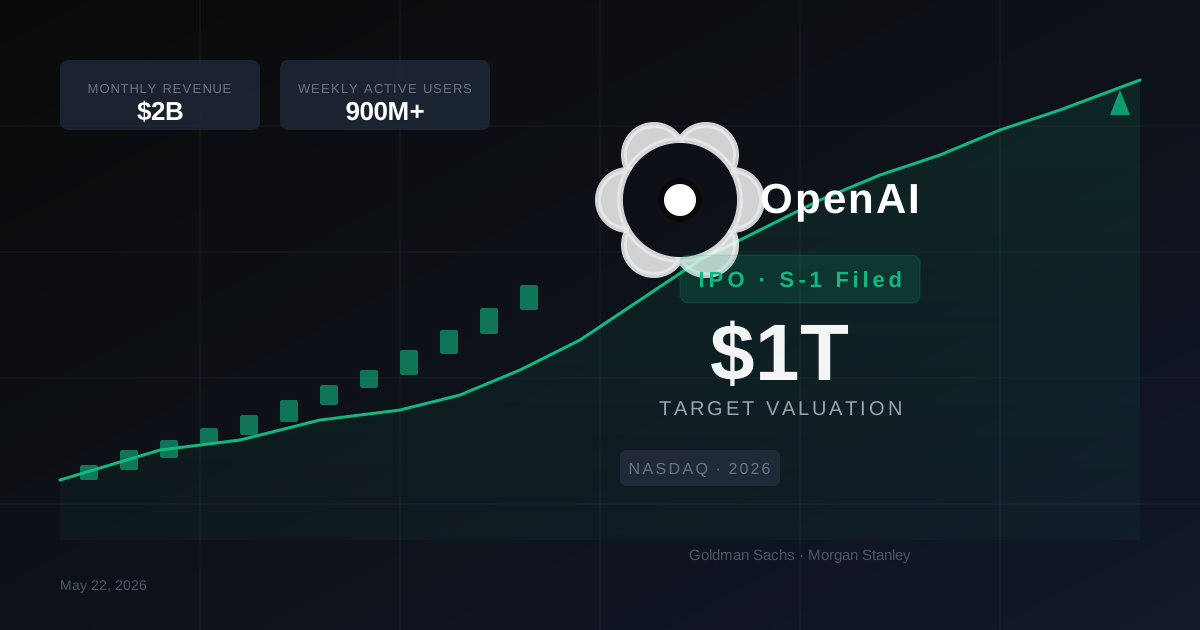
OpenAI’s IPO moved from speculation to reality on May 22, 2026. The company filed a confidential S-1 registration statement with the Securities and Exchange Commission, kicking off the formal process toward a public listing. Goldman Sachs and Morgan Stanley are leading the underwriting. The target: a fall 2026 debut at a valuation north of $1 trillion.
If that valuation holds, this would be the largest tech IPO in history — dwarfing Facebook’s $16 billion raise in 2012 and Saudi Aramco’s $29.4 billion in 2019.
The Numbers Behind the Story
A few figures sketch the scale. OpenAI generates roughly $2 billion per month in revenue, annualizing above $25 billion. ChatGPT counts more than 900 million weekly active users and over 50 million paying subscribers. Enterprise revenue now accounts for more than 40% of the total. A March 2026 funding round of $122 billion set the private market valuation at $852 billion.
The IPO targets $1 trillion-plus. The gap between $852 billion and that figure depends on how aggressively the public market prices the growth story Goldman and Morgan Stanley will roadshow over the coming months.
Legal Clearance Opened the Window
On May 18, a federal jury in Oakland rejected all of Elon Musk’s claims against OpenAI and Sam Altman. Reuters described the verdict as “removing a major legal obstacle ahead of a potential IPO.” Musk said he plans to appeal, but the practical overhang has largely cleared.
OpenAI’s decision to move immediately after that ruling is not a coincidence. The company spent years navigating legal uncertainty. The S-1 filing timing reflects a deliberate response to that clearance.
Corporate Structure Meets Public Markets
OpenAI spent much of the past year restructuring around a public benefit corporation — OpenAI Group PBC — governed by the nonprofit OpenAI Foundation. The Foundation holds approximately 26% equity, valued at roughly $130 billion at the target price. Microsoft holds about 27%, worth around $135 billion, along with an IP license extended through 2032 that is now non-exclusive.
What public investors still cannot see: gross margins, compute cost trajectory, the mechanics of the Microsoft partnership on a competitive level, and how the governance structure translates into voting rights. Those details wait for the public version of the S-1.
The confidential filing process, available under the JOBS Act to emerging growth companies, lets OpenAI work through SEC review before exposing its financials to competitors.
Racing Anthropic and SpaceX to the Market
Timing matters here. Anthropic is projecting Q2 annualized revenue close to $44 billion, its first operating profit, and has signaled IPO ambitions of its own. SpaceX filed its S-1 earlier this week, with that document revealing Anthropic’s $1.25 billion per month compute contract with SpaceX’s Colossus infrastructure.
Three of the most valuable private companies in tech may end up competing for the same pool of public market capital within the same window. OpenAI’s first-mover logic: land the narrative before rivals can. Sam Altman has said publicly that getting to public markets first is “very important.” This filing executes that thinking.
What a $1 Trillion Multiple Requires
At $1 trillion and $25 billion in annualized revenue, OpenAI would be priced at roughly 40x revenue. That multiple is defensible for a high-growth company, but sustaining it requires the market to believe three things: revenue growth continues, compute costs compress over time, and the model moat is real.
Cerebras’s 68% debut surge in mid-May gave the market a warm-up. That deal raised $5.5 billion. OpenAI’s raise will be multiples larger, testing liquidity demand at a completely different scale.
The S-1 going public will be the first real look at whether those growth assumptions hold up to scrutiny.
If this was useful, subscribe to the newsletter for weekly AI PM insights and GenAI case studies.
Sources:
- OpenAI to confidentially file for IPO as soon as Friday — CNBC
- OpenAI Preparing to File for an IPO in the Coming Weeks — Bloomberg
- OpenAI IPO: Valuation, Timeline, Risks — TECHi
Related Reading:
Related Articles
OpenAI IPO Prospectus Reveals Q1 2026: Revenue Tripled, Losses Widened
OpenAI's S-1 IPO financials are public: Q1 revenue tripled to $5.7 billion, but non-GAAP operating margin hit -122%. ChatGPT weekly users stalled near 905 million, Anthropic is only $900 million behind, and the IPO target remains $1 trillion.
OpenAI Faces 42-State Probe Over ChatGPT Sycophancy
A coalition of 42 US state attorneys general has subpoenaed OpenAI over ChatGPT's sycophancy, child safety failures, and health data handling, just three weeks after its confidential IPO filing. Can a trillion-dollar listing survive a multistate probe?