CNN Sues Perplexity for Copyright Infringement: Who Wins the Fight Over 17,000 Scraped Stories?
TL;DR
CNN filed its first AI copyright lawsuit against Perplexity, alleging the search startup scraped 17,000+ stories without authorization. The case could reshape how AI companies license news content.
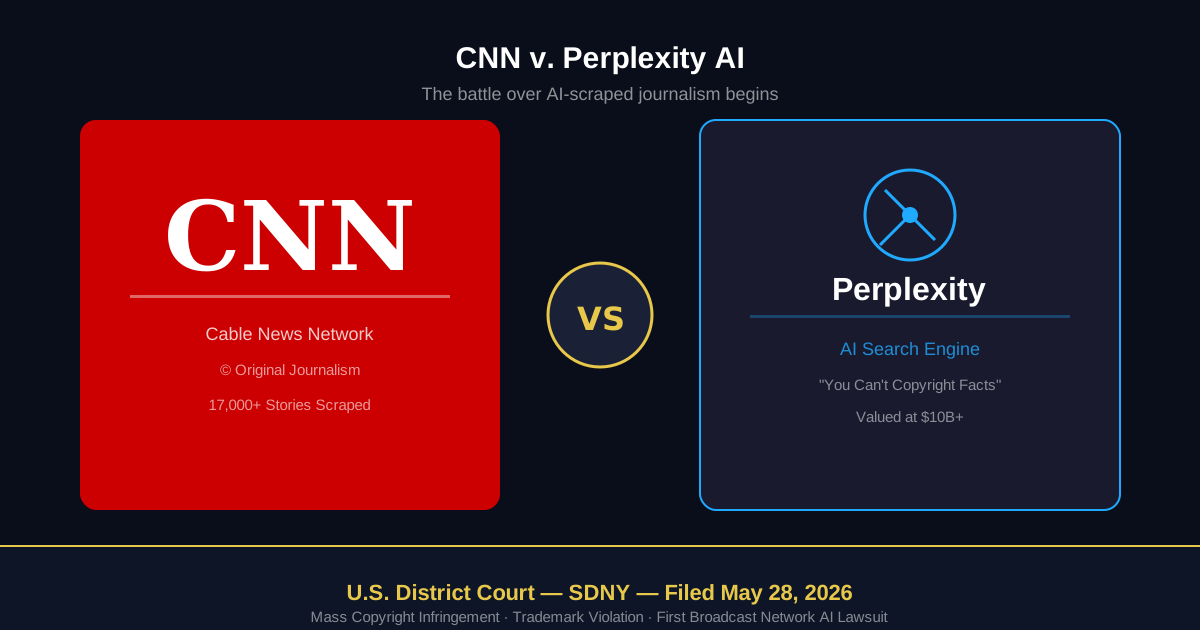
CNN filed a lawsuit on Thursday against AI search startup Perplexity in the U.S. District Court for the Southern District of New York, alleging massive copyright infringement involving more than 17,000 CNN news stories, photos, and videos. The filing seeks statutory damages and a permanent injunction. It marks the first AI copyright lawsuit filed by a broadcast television network and adds a significant new front to the industry-wide legal battle over AI content scraping, according to Variety’s coverage.
The dispute traces back to failed licensing negotiations in 2024. CNN approached Perplexity to discuss a paid content agreement, but the two sides could not agree on terms. CNN then blocked Perplexity’s scraping bot. According to the complaint, Perplexity subsequently continued harvesting CNN content via third-party platforms, making the block largely ineffective.
Perplexity’s One-Line Defense
Perplexity’s spokesperson gave a single response: “You can’t copyright facts.”
That argument has partial grounding in U.S. copyright law, which does not protect facts themselves. The lawsuit, however, targets something more specific: Perplexity allegedly reproduced CNN articles paragraph-by-paragraph, repackaged them as AI-generated answers, and served them directly to users. That sits in a materially different legal category than citing a few news facts.
CNN’s complaint also includes trademark infringement. Perplexity’s “Comet Plus” subscription tier reportedly advertised access to CNN premium content, despite no licensing agreement existing between the two companies. CNN argues this falsely leverages CNN’s brand credibility.
Why Licensing Talks Collapsed
Licensing negotiations between media companies and AI platforms typically stall on the same issue: AI companies value their use of content far below what publishers consider fair, often framing themselves as a “search tool” rather than a content distributor. CNN and Perplexity could not bridge that gap in 2024.
Notably, NPR and the Associated Press have signed licensing deals with Perplexity, which means the company does not oppose paying outright. Its willingness varies by publisher. CNN’s decision to litigate is, in part, a test of whether the courts can force Perplexity back to the table.
The Business Model Collision
Perplexity’s design keeps users on-platform, delivering complete answers without a click to the original source. Ad revenue and user attention stay with Perplexity; reporting costs stay with the newsroom. CNN’s spokesperson was direct about the network’s stance: “Commercial operators can and must pay to make use of it. There is no free option.”
Al Jazeera reported that The New York Times, Dow Jones, the New York Post, and Reddit have already filed similar suits against Perplexity. With CNN’s entry, broadcast television networks are now part of the fight. Broadcast content carries broader copyright protections than text alone, covering audio and video, which could widen the scope of liability.
What the Court Needs to Decide
Two questions will determine the outcome: whether Perplexity’s AI outputs constitute verbatim reproduction under copyright law, and whether the “Comet Plus” misrepresentation creates independent liability. Neither question has settled precedent in a generative AI context, meaning the court will need to examine Perplexity’s technical architecture directly.
A ruling in CNN’s favor could force a fundamental restructuring of licensing costs across the AI search industry. With multiple major publishers pressing cases simultaneously, Perplexity’s legal exposure is rising sharply heading into the second half of 2026.
If this was useful, subscribe to the newsletter for weekly AI PM insights and GenAI case studies.
Related reading:
Related Articles
Google Sends TPUs Into Orbit: A 15-Minute Test Is Not Continuous Compute
Google and Planet launch a Suncatcher prototype to test Gemma on four TPUs. Orbital hardware enables thermal and radiation testing, but cooling intervals, sustained compute and commercial costs remain unresolved.
Google Unveils Gemini 4 Argon: Code Modernization Needs the Right Baseline
Gemini 4 Argon raises the output limit to 1M tokens, initially for trusted cyber defenders. Its libgav1 example shows iterative improvement of a Rust port, but the 2.7-fold speedup is not measured against the optimized C++ original.