Databricks Raises $5 Billion at a $190 Billion Valuation to Fund Enterprise AI Agents
TL;DR
Databricks closed a $5 billion round at a $190 billion valuation to fund Lakebase, Genie, and Unity AI Gateway, while its operating figures remain company-reported.
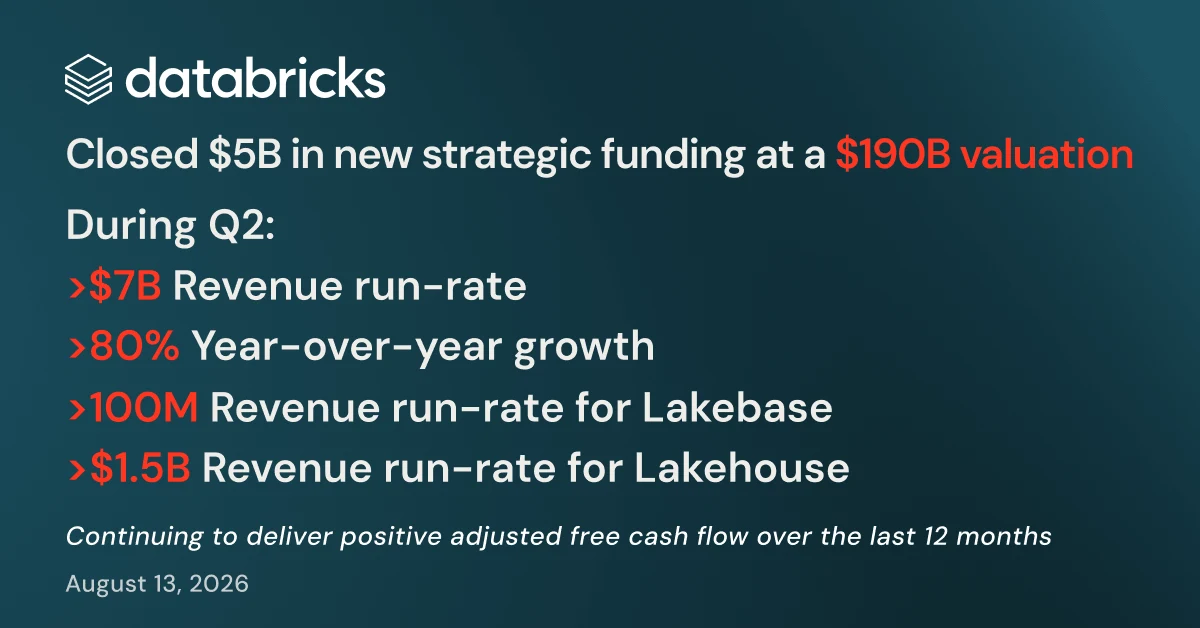
One test can show whether this financing supports a $190 billion valuation: over the next three to six months, Lakebase’s revenue run-rate and enterprise AI-agent usage should rise as Databricks invests the new capital. If product revenue does not accelerate, the round will have extended the company’s time in the private market without validating the growth embedded in the valuation.
Databricks announced on August 13, 2026 that it had closed a $5 billion strategic funding round at a $190 billion valuation. Coatue led the round, with participation from Blackstone, MGX, accounts managed by T. Rowe Price, Sixth Street Growth, and other investors. Databricks says the capital will support Lakebase, Genie, and Unity AI Gateway. Those products address databases for AI agents, access to enterprise data, and governance across multiple AI models. CNBC interviewed chief executive Ali Ghodsi that day and independently reported the amount, valuation, and principal investors.
Capital for data, business queries, and model costs
Lakebase is a serverless Postgres database designed for AI agents. Genie allows employees to query company data in natural language and take actions from the results. Unity AI Gateway manages model access, traffic, and costs across providers. Together, the products address practical constraints in enterprise agent deployments: an agent must work with continuously updated internal data, users need answers that can be traced to governed sources, and administrators must control model choice and inference spending.
The announcement does not allocate the $5 billion among those products or say how long the capital is expected to last. The size of the round therefore cannot be converted directly into a development schedule. Databricks did provide operating figures for its second quarter. It says revenue run-rate exceeded $7 billion and grew more than 80% year over year, while adjusted free cash flow remained positive over the past 12 months.
The mature Lakehouse data-warehousing product passed a $1.5 billion revenue run-rate and grew more than 100% year over year. Lakebase exceeded a $100 million revenue run-rate. That figure indicates paying demand for the newer database, but it also shows that Lakebase remains much smaller than Lakehouse. The next disclosure will need to distinguish rapid growth from a small base from material contribution to total company revenue.
Databricks says more than 20,000 organizations worldwide use its platform, but the announcement does not separate paying customers, trial accounts, or adoption by product. The customer total therefore measures platform reach rather than proving that each organization has deployed AI agents. It also cannot establish the average contract value for Lakebase or Unity AI Gateway.
A private valuation without public-company accounts
CNBC reports that only six months earlier Databricks had raised $5 billion in equity and added $2 billion in debt capacity at a $134 billion valuation. The new financing lets the company postpone an initial public offering. Ghodsi told CNBC that Databricks wants to become a public company, but that entering public markets now would create too much distraction.
Remaining private gives management more room to invest without quarterly public-market pressure. It also means outside investors cannot check revenue recognition, net losses, cash consumption, or customer concentration in regular public filings. The $7 billion figure is an annualized revenue pace, not completed annual revenue. Positive “adjusted free cash flow” is not the same measure as net income under generally accepted accounting principles.
The $190 billion headline is the valuation accepted by investors in this private round, not a price continuously formed by public trading. Databricks did not disclose the price per share, liquidation preferences, or other financing terms in its announcement. Without those details, the rights obtained by new investors cannot be compared fully with those held by existing shareholders.
Over the next three to six months, measurable evidence would include Lakebase moving materially above its $100 million run-rate, Lakehouse sustaining growth above 100%, and Unity AI Gateway producing quantified reductions in model costs. If Databricks updates only its valuation and aggregate revenue while withholding product revenue and usage measures, the conversion of this financing into an AI-agent business will remain unverified.
Sources:
Related Articles
OpenAI Launches Dots: Ongoing Work Should Not Become a Growing Review Queue
OpenAI is rolling out dots to eligible paid users for work that continues between conversations. Read-only background research and limited memory controls make missed commitments and accumulated review work more useful tests than activity alone.
NVIDIA Expands Agent Safety: Runtime Permissions Do Not Guarantee Correct Work
NVIDIA launches its Open Agent Safety Platform, with OpenShell 0.1.0 enforcing file, network and tool permissions outside the model. That can contain mistakes, but more than 100 participating organizations do not establish deployment results or correct work.