KotoCare: A Care Center Operations System That Actually Runs
TL;DR
Long-term care centers in Taiwan still rely on paper forms, Excel sheets, and LINE groups to handle daily operations. KotoCare is an MVP that actually runs — case management, AI query, CSV reports, electronic whiteboard, all backed by a real database.
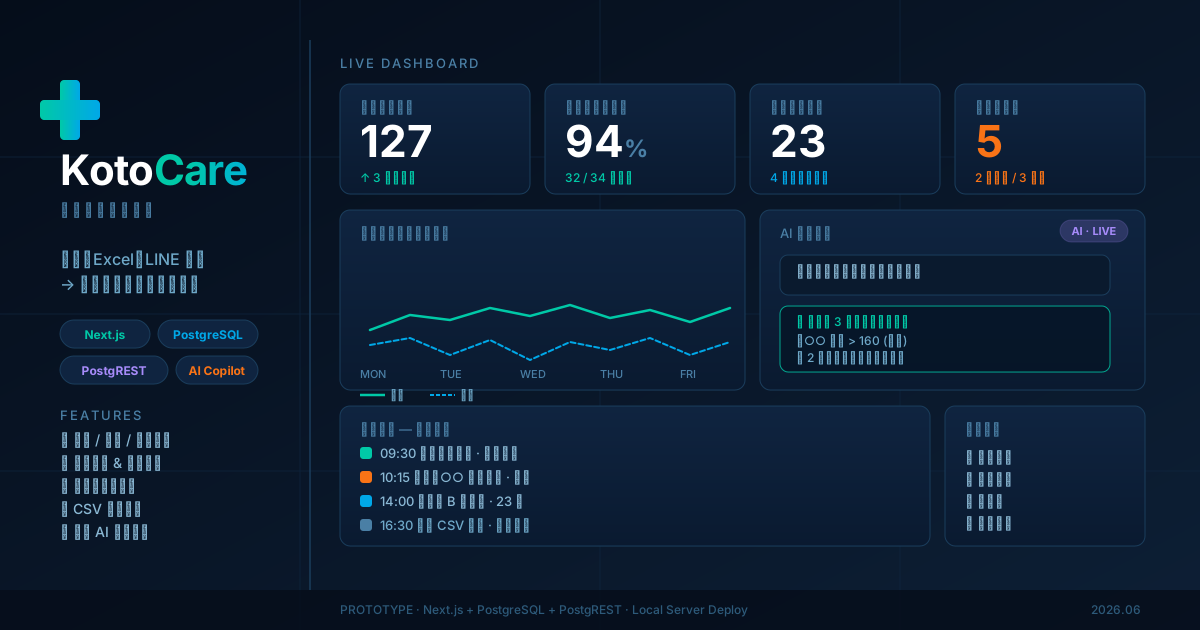
Taiwan has over a thousand day care centers. Most of them run their daily operations on three things: paper forms, Excel files, and LINE group chats. Attendance is tracked in hand-drawn tables. Vital signs get written down first, then typed into a computer. Transportation pickup status comes from a driver’s text message. At month-end reconciliation, everyone is hunting for records.
This is not because the people running these centers lack competence. The software available is either too expensive, too complicated, or simply not built for how care operations actually work.
KotoCare is a prototype I built with one goal: give long-term care centers a real place to put their daily workflows.
Demo Video
▶ Watch the KotoCare System Demo
Not Just a UI
Anyone who has built software knows the difference. A UI demo is easy — buttons respond, data is hardcoded, everything looks clean. A system that actually works means: click submit and a row appears in the database; export a report and it pulls real data; ask the AI assistant and it queries real tables.
KotoCare runs locally on Next.js, PostgreSQL, and PostgREST. The database ships with seed data, but the data flow, API layer, permissions, and export pipeline are production-grade. Deploy it on a care center’s own machine and the real workflows can start running.
What It Does
Operations Backend
Case records, staff profiles, attendance check-in, and vital signs tracking in one interface. A nurse logs blood pressure and heart rate — data goes to the database directly, no Excel copy step required.
Electronic Whiteboard
Real-time display of care scene events, tasks, and status. Morning shift handoffs, urgent care incidents, referral reminders — all recorded, tracked, and flagged in one place.
Case Journals
Care records, notes, status management, and follow-up assignments. Tasks can be assigned to a responsible person. Nothing falls through the gap between memory and a chat message.
Transportation Management
Routes, stops, vehicles, passengers, and pickup status all in the system. When a driver marks arrival, the system updates. Family members don’t need to call to find out where the van is.
Report Center
Attendance, vital signs, transportation, reimbursement, and care logs all export to CSV. Month-end reconciliation that used to take an afternoon now takes minutes.
AI Query Assistant
Ask operational questions in plain Chinese. “Which cases had elevated blood pressure this week?” “Who had the most attendance last month?” The system constrains queries to safe table ranges and returns structured answers.
HIS AI Copilot
AI helps summarize vital sign trends and flags transition care reminders, but human review stays in the loop. Automation is not a substitute for clinical judgment — this was a deliberate design decision.
Why Local Deployment
Long-term care centers are not tech companies. They have no IT department, no cloud budget, and real concerns about sending resident data to external servers. Local deployment means the center uses its own computer as the server. Data stays on-premises. Maintenance overhead is low.
This is a different choice than putting the same product on SaaS. It serves a different operational context.
What This Prototype Represents
KotoCare already covers the core daily workflows of a care center. It is a prototype, which means no electronic signature integration, no NHI card reader, no multi-tenant architecture — yet.
But it also means this: these workflows can be digitized without expensive commercial software or waiting for a government system. A small or mid-sized care center can run a trackable, exportable, AI-queryable operations system on their own hardware.
For long-term care, healthcare, social services, and internal operations teams, that is a direction worth building toward.
Related: #AI #HealthTech #LongTermCare #FullStack #MVP #OperationsSystems
Related Articles
Google Sends TPUs Into Orbit: A 15-Minute Test Is Not Continuous Compute
Google and Planet launch a Suncatcher prototype to test Gemma on four TPUs. Orbital hardware enables thermal and radiation testing, but cooling intervals, sustained compute and commercial costs remain unresolved.
Google Unveils Gemini 4 Argon: Code Modernization Needs the Right Baseline
Gemini 4 Argon raises the output limit to 1M tokens, initially for trusted cyber defenders. Its libgav1 example shows iterative improvement of a Rust port, but the 2.7-fold speedup is not measured against the optimized C++ original.