Google Is Paying SpaceX $920M a Month for AI Compute
TL;DR
Google's Gemini Enterprise hit demand it couldn't handle in-house, forcing a near-$1B-per-month deal with SpaceX's xAI-absorbed infrastructure. What this reveals about the true severity of AI compute scarcity.
Google operates one of the largest private data center networks on the planet. Gemini Enterprise’s usage still outpaced it.
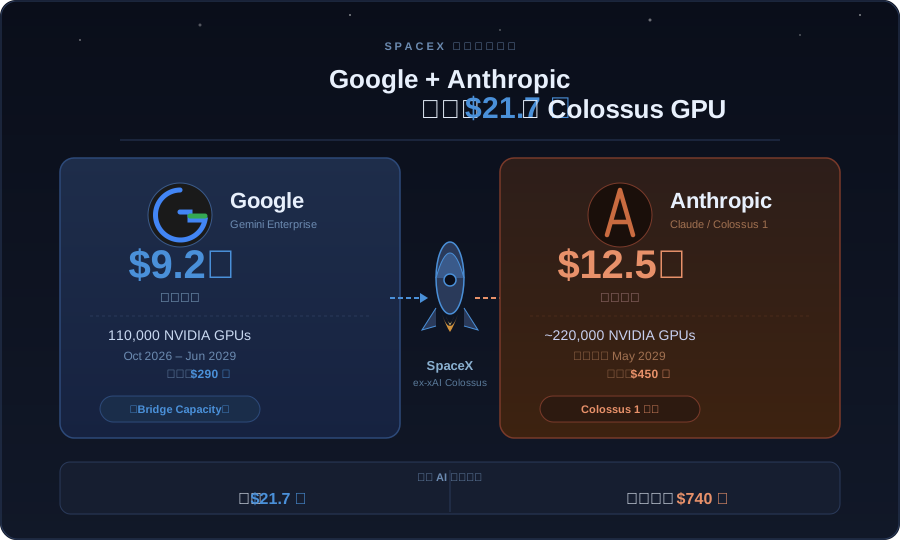
On June 5, TechCrunch reported that Google signed a major compute-leasing agreement with SpaceX: starting October 2026, Google will pay approximately $920 million per month for access to roughly 110,000 NVIDIA GPUs, with the contract running through June 2029 and totaling nearly $29 billion.
Google described the arrangement as “bridge capacity” for “unexpected demand” for its Gemini Enterprise platform. That framing sounds temporary. Nearly $1 billion a month, three years running, points to something more structural.
How SpaceX Became the AI Compute Landlord
The other party to this contract is SpaceX, though these GPUs were never part of the rocket business.
In February 2026, SpaceX completed its absorption of xAI. Elon Musk’s AI company had built the Colossus supercomputer cluster in Memphis, Tennessee, and those assets now sit on SpaceX’s balance sheet. Colossus has deployed more than 500,000 GPUs, making it the world’s largest single AI training cluster.
After the merger, SpaceX started leasing spare capacity to outside customers. The first major tenant was Anthropic, which signed a deal last month worth $1.25 billion per month for roughly 220,000 GPUs through May 2029. Google’s 110,000 GPUs are the second tranche.
Between the two, SpaceX is now collecting roughly $2.17 billion per month from its AI compute tenants.
Why Google Ran Out of Compute
Google is not short on money or on data center construction capability. The constraint is lead time.
Gemini Enterprise launched late last year, and adoption ran ahead of internal forecasts. Compute doesn’t get provisioned overnight. Building data center capacity, connecting power infrastructure, and deploying GPU racks each require months of preparation. Renting an existing cluster was the only way to close the gap quickly enough.
Google did build in exit options. If SpaceX fails to deliver the committed GPUs by September 30, 2026, Google can terminate or renegotiate. After December 31, either side can exit with 90 days’ notice. The structure suggests Google treats this as a bridge, not a permanent arrangement, and may not renew once its own capacity catches up.
What a $29 Billion Compute Deal Actually Signals
This contract makes one thing clear: compute scarcity is now severe enough that even Google cannot self-supply on the timeline its products require.
SpaceX’s timing works out well. The company is preparing for an IPO before year-end, with market estimates around a $1.75 trillion valuation. Two compute-leasing contracts adding up to $2.17 billion in monthly recurring revenue give the IPO narrative a straightforward case for predictable income.
For AI startups and enterprise teams modeling compute budgets, this is a cost warning. When the largest, best-resourced companies in the market are all competing for the same GPU clusters, market pricing only moves in one direction. Cost assumptions from three or four years ago no longer serve as reliable baselines.
If this was useful, subscribe to the newsletter for weekly AI PM insights and GenAI case studies.
Related reading:
Related Articles
SpaceX IPO Oversubscribed: Wall Street Pays $1.75T to Own AI Compute
SpaceX's $75B IPO oversubscribed within 24 hours of roadshow launch. Goldman Sachs projects AI compute will generate $322B of $474B in revenue by 2030. The market is pricing this as an AI infrastructure company, not a rocket maker.
Google Sends TPUs Into Orbit: A 15-Minute Test Is Not Continuous Compute
Google and Planet launch a Suncatcher prototype to test Gemma on four TPUs. Orbital hardware enables thermal and radiation testing, but cooling intervals, sustained compute and commercial costs remain unresolved.