SpaceX IPO Oversubscribed: Wall Street Pays $1.75T to Own AI Compute
TL;DR
SpaceX's $75B IPO oversubscribed within 24 hours of roadshow launch. Goldman Sachs projects AI compute will generate $322B of $474B in revenue by 2030. The market is pricing this as an AI infrastructure company, not a rocket maker.
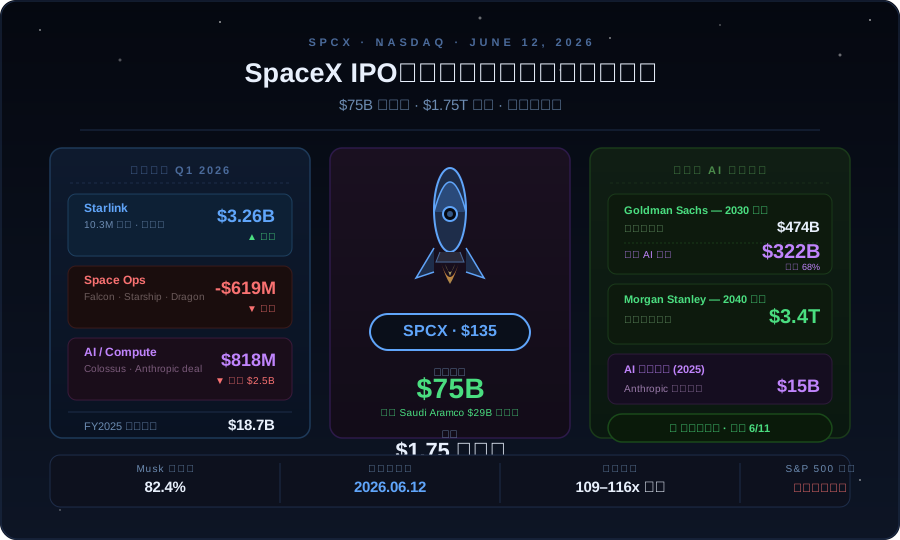
Page 73 of the SpaceX prospectus contains one sentence worth more than every paragraph about Falcon 9 combined: “Anthropic has agreed to pay $1.25 billion per month.”
That line explains the $1.75 trillion valuation better than anything else in the filing.
SpaceX launched its IPO roadshow on June 4, targeting a $135 per-share pricing on June 11 and a June 12 Nasdaq debut under the ticker SPCX. Within 24 hours, Bloomberg reported the offering was already oversubscribed. At $75 billion, this eclipses Saudi Aramco’s 2019 record of $29 billion, making it the largest IPO in market history.
Three Business Lines, One That Makes Money
The Q1 2026 financials draw clear boundaries between SpaceX’s three divisions.
Starlink generated $3.26 billion in revenue with $1.19 billion in operating profit. 10.3 million subscribers, concentrated in remote regions, maritime routes, and in-flight connectivity. It is currently the only SpaceX business that can claim profitability.
Space Operations posted a $619 million operating loss. Falcon 9 is mature but competitive pressure is mounting, and Starship development costs run every quarter regardless of launch cadence.
The AI compute unit generated $818 million in Q1 revenue against $2.5 billion in losses. The Colossus cluster, absorbed from xAI last year, now runs over 500,000 GPUs, making it the largest single AI training cluster in the world.
Full-year FY2025: $18.7 billion in revenue, $4.9 billion net loss.
Why the Losing Division Is the Valuation Story
Anthropic is paying $1.25 billion per month through May 2029, annualizing to $15 billion per year. Google signed an additional $920 million per month through June 2029. Together, these two contracts bring in more than $2.1 billion per month in compute rent, before any new clients are added.
Goldman Sachs projects $474 billion in SpaceX revenue by 2030, with $322 billion, roughly 68%, coming from AI and compute-related businesses. Morgan Stanley extends the runway to 2040 and sets a $3.4 trillion target.
Both forecasts hinge on a single assumption: AI infrastructure demand grows fast enough to convert today’s loss-making cluster into a cash machine. The Anthropic and Google contracts are the opening argument. The rest of the thesis is still being written.
What 109x Revenue Multiple Actually Means
A $1.75 trillion valuation on $18.7 billion in 2025 revenue puts the price-to-sales ratio between 109 and 116 times. For context, Nvidia trades around 25x, Amazon around 4x, and Palantir around 80x. SpaceX is priced higher than the most expensive AI stocks on the market today.
Jim Cramer said on CNBC that SpaceX could double to $4 trillion after listing, driven by Starlink subscriber growth and AI compute pricing power. Cramer’s track record on specific price targets is mixed. But institutional oversubscription speaks more clearly: the buyers who secured allocations have decided this multiple is worth taking.
S&P 500 Will Not Fast-Track SPCX
One frequently cited catalyst for post-IPO buying pressure has been cut off.
S&P Dow Jones Indices announced on June 4 that it will not modify existing profitability and liquidity thresholds to accommodate large IPOs. Under current rules, companies need four consecutive quarters of GAAP profit to apply for S&P 500 inclusion. With a $4.9 billion net loss in 2025, SpaceX is not close.
This matters for retail investors. The roughly 60% of Americans holding 401(k) retirement accounts would have been forced buyers if passive index funds were required to hold SPCX. A Harvard Law professor quoted in Fortune described any future rule change as making her “uneasy,” given the precedent it sets for tailoring index rules around high-profile issuers.
The Pipeline Behind the IPO
The SpaceX prospectus notes that OpenAI and Anthropic are both expected to file after Labor Day 2026. Three companies with a combined implied valuation exceeding $4 trillion, all seeking institutional capital within the same calendar year, will create real competition for allocations.
SpaceX is going first. Elon Musk retains 82.4% of voting power post-listing. Pricing is June 11, first trading day is June 12 on Nasdaq under SPCX.
If this was useful, subscribe to the newsletter for weekly AI PM insights and GenAI case studies.
Related reading:
Related Articles
Google Is Paying SpaceX $920M a Month for AI Compute
Google's Gemini Enterprise hit demand it couldn't handle in-house, forcing a near-$1B-per-month deal with SpaceX's xAI-absorbed infrastructure. What this reveals about the true severity of AI compute scarcity.
SK Hynix Surges 13% on Nasdaq Debut: Inside the $26.5B AI Memory Bet
SK Hynix debuted on Nasdaq July 10, raising $26.5B in the largest-ever foreign ADR offering and popping 13% to a $1.2 trillion market cap. Leveraged ETFs tracking the stock launch today. Structural shift, or cycle-top euphoria?