HarmonyOS 7 at HDC 2026: Huawei Turns the Mobile OS Into an AI Agent Runtime
TL;DR
At HDC 2026, Huawei debuted HarmonyOS 7 with Agent Framework 2.0, promoting Xiaoyi to a system-level AI agent with 2,100+ system capabilities and a 90%+ task completion rate, signaling the shift to intent-driven mobile computing.
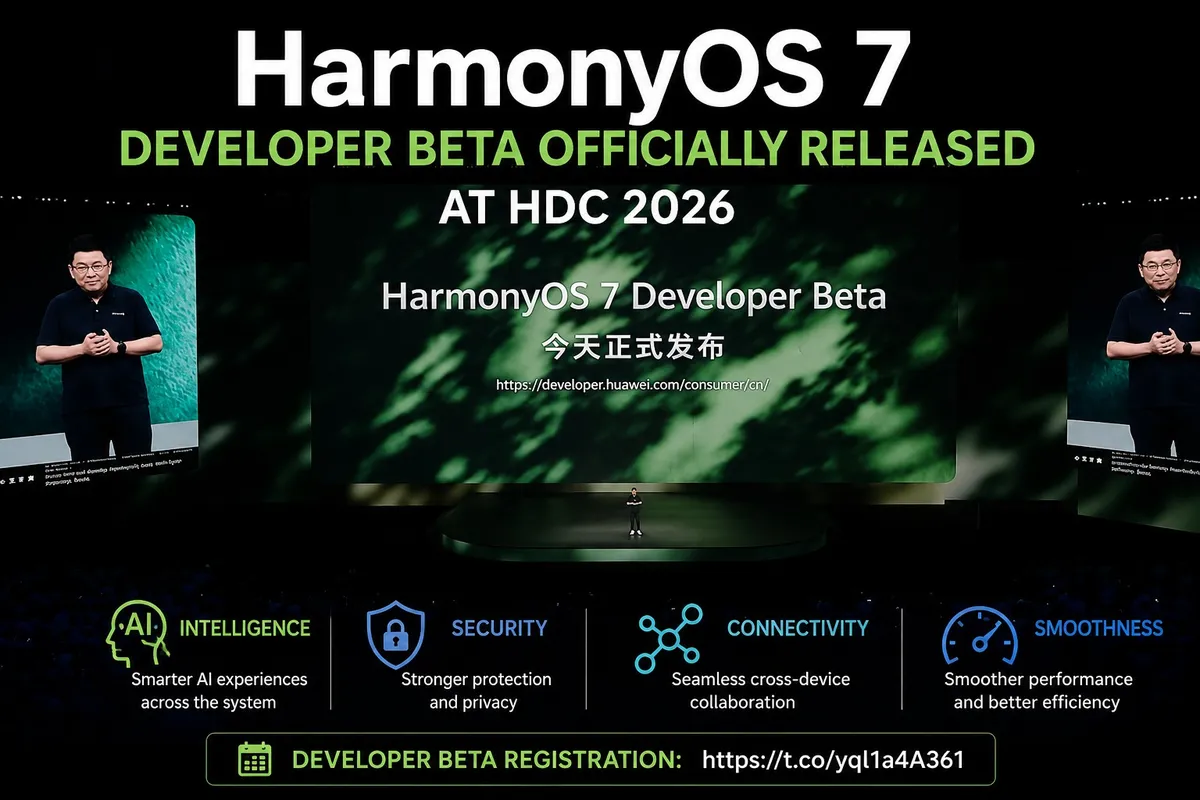
Huawei’s annual developer conference, HDC 2026, runs June 12–14 in Shenzhen. Today is the final day, and the headline announcement is HarmonyOS 7.
The central update is a complete rearchitecting of Xiaoyi, Huawei’s built-in AI assistant. Previous versions handled voice search and basic reminders. HarmonyOS 7 promotes Xiaoyi to a system-level agent powered by Agent Framework 2.0: it can decompose multi-step tasks, invoke more than 2,100 system capabilities, and execute commands across multiple apps without waiting for the user to navigate manually. Huawei reports a task completion rate exceeding 90%.
Huawei calls this architecture “Intent as a Service.” A user expresses intent in natural language; the OS determines which app to open, which API to trigger, and how to chain the results back. In practice, saying “compress this screenshot and send it to Fischer” should resolve without the user opening a file manager, a messaging app, or a compression tool separately.
The developer beta opened on June 12 for six device models including the Mate 80 Pro, Pura 90 Pro Max, and Mate XTs. The consumer release is scheduled for fall 2026. According to Huawei Central, HarmonyOS 7 also ships with a 15% performance improvement over HarmonyOS 6.1 and a redesigned “Liquid Glass” visual style featuring translucent frosted panels and 3D lock screen effects.
The Liquid Glass Coincidence
The visual convergence is worth noting separately. HarmonyOS 7’s Liquid Glass aesthetic closely mirrors Apple’s iOS 26 (unveiled at WWDC days earlier) and Samsung’s One UI 9, all of which adopted translucent, layered interfaces within weeks of each other. Three competing platforms, three separate design teams, same visual direction.
There is a functional explanation. Agentic AI creates pressure on the UI layer: when an agent navigates between apps autonomously, app boundaries blur. Translucent, depth-layered interfaces reflect that experience structurally. The design convergence is downstream of the same underlying product problem.
The Competition Has Moved to the OS Layer
For most of 2025 and early 2026, the AI arms race played out at the model level. Benchmarks, reasoning chains, context windows. Apple’s WWDC announcement that Siri would run on a custom Google Gemini model was one signal. HarmonyOS 7 is another. The OS is becoming the agent runtime, and the agent runtime determines which apps appear in a user’s effective workflow.
For developers, this creates a concrete stake. Apps that integrate HarmonyOS’s Agent Framework API can be invoked by Xiaoyi automatically, making them part of agentic workflows. Apps that don’t are functionally invisible when the agent takes over. Huawei is not just releasing a new OS version; it is defining the access layer for next-generation mobile computing.
HarmonyOS operates primarily within China, where US export restrictions limit its international reach. The technical direction, however, aligns almost exactly with what Silicon Valley is building. The geography is bounded; the architecture trend is not.
If this was useful, subscribe to the newsletter for weekly AI PM insights and GenAI case studies.
Related: Apple WWDC 2026: Siri Gets a New Brain, Powered by Google Gemini
Related Articles
Huawei Unveils Ascend 960 SuperPoD: Optical Efficiency Still Needs Chips and Supply
Huawei details optical interconnects and an accelerated 2027 chip schedule. Claimed power savings exceed 550 kW, but testing and supply constraints still separate the architecture from delivered capacity.
Anthropic Opens Model Hardware Standard Preview for AI-Controlled Lab Equipment
Anthropic opened a research preview of the Model Hardware Standard, connecting microscopes, liquid handlers, and robotic arms through standard drivers while integration speed and physical safety await external testing.