The DNS for AI Agents is Here: Google and 11 Tech Giants Launch ARD Open Standard
TL;DR
Google, Microsoft, and Hugging Face have jointly released the ARD (Agentic Resource Discovery) specification on June 17, 2026. AI agents can now discover tools dynamically at runtime using natural language queries — the same paradigm shift that DNS brought to web browsing, but for the agent ecosystem.
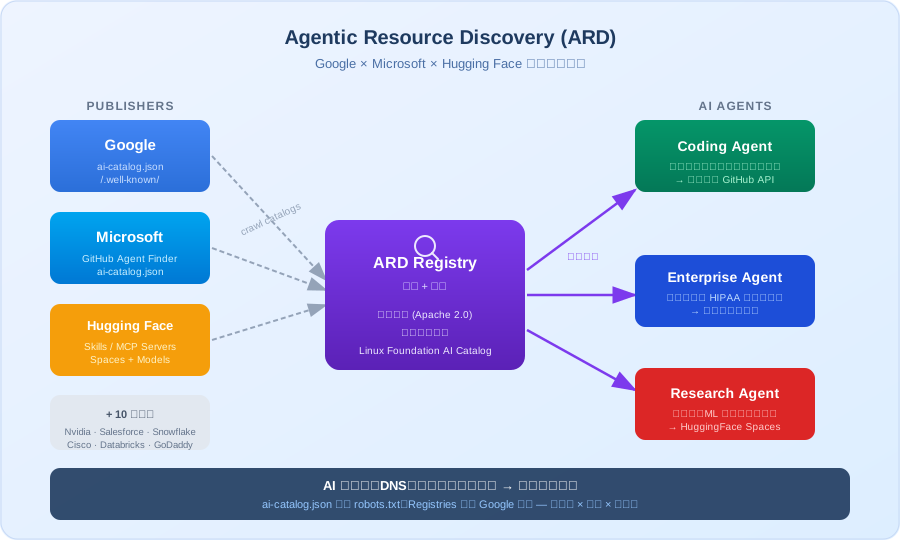
On June 17, 2026, Google published a specification document on the Developers Blog, co-signed by engineers from Microsoft and Hugging Face. The document is called Agentic Resource Discovery, or ARD.
Eleven companies participated in the standard: Google, Microsoft, Hugging Face, Cisco, Databricks, GitHub, GoDaddy, Nvidia, Salesforce, ServiceNow, and Snowflake. No single company’s name appears in the title. The spec builds on the Linux Foundation’s AI Catalog data model and is licensed under Apache 2.0.
The specification solves a problem that every AI agent engineer knows intimately: how does your agent know what tools are available to it right now?
How Today’s AI Agents Actually Work
Anyone who has built agents knows this workflow. You decide what tools the agent needs, manually install them, configure them, write their descriptions into the system prompt or tool list, and hand the whole package to the model.
This “install first, use later” pattern works when the tool count is small. As tools multiply, the cracks show: context windows fill with tool descriptions, agents’ understanding of tools freezes at install time, cross-organization tool calls require manual integration, and adding a new tool means reconfiguring the entire agent.
The deeper problem: agents have no way to discover tools they don’t already know about.
ARD’s Answer: Two Components
The ARD specification is built on two components.
The first is ai-catalog.json, hosted at a well-known path on an organization’s domain — analogous to the logic of robots.txt. Organizations describe in this JSON file what AI capabilities they’re publishing: what each capability does, inputs and outputs, authorization requirements, and invocation methods. Hugging Face has already deployed this at https://huggingface.co/.well-known/ai-catalog.json, indexing thousands of Skills, MCP Servers, and Spaces.
The second is a Registry, functioning like a search engine for capabilities. Registries continuously crawl ai-catalog.json files, build indexes, and return matching capabilities with verifiable trust metadata when an agent queries them.
An agent query might look like: “I need a HIPAA-compliant tool that can read Salesforce data.” The Registry returns a ranked list of matching capabilities. The agent verifies publisher identity and establishes a connection — all at runtime, without human intervention.
Identity Verification as the Moat
A critical detail in the ARD specification is that catalogs and registries are anchored in domain ownership. The ai-catalog.json must be hosted on a domain the organization actually controls, giving the identity verification process a cryptographic foundation.
This addresses not just tool discovery but agent security. When every tool an agent calls has a verifiable publisher, injecting malicious tools becomes significantly harder. Google Cloud’s Agent Registry in Gemini Enterprise Agent Platform already provides this governance layer, including namespaced URNs and HIPAA compliance management.
GitHub and Hugging Face Moved Simultaneously
On the same day the specification dropped, GitHub launched a feature called “Agent Finder” that lets GitHub Copilot dynamically discover GitHub platform APIs and capabilities at runtime. It’s one of the first large-scale production implementations of ARD.
Hugging Face released the “Discover Tool,” indexing Skills, ML applications, and MCP Servers across the Hub. It supports queries via CLI, REST API, or MCP server integration. Supported resource types include application/ai-skill, application/mcp-server+json, and application/vnd.huggingface.space+json.
Why Now
Before 2025, AI agents were mostly single-task, single-tool architectures where keeping tools manageable was feasible. By 2026, enterprise agents need to cross department boundaries, organizational boundaries, and system silos to fetch data and execute actions.
MCP (Model Context Protocol) solved “how does a model call a tool.” It didn’t solve “how does a model know what tools exist.” ARD fills that gap — the two specifications are designed to be complementary.
The timing also tracks directly with large-scale agent deployment. Eleven companies appearing together on a specification’s author list signals that this problem reached critical mass across multiple verticals simultaneously, and the industry chose cooperation over competing private standards.
Still a Draft, but Adoption Is Moving Fast
ARD is still a draft specification and continues to evolve. But GitHub and Hugging Face have already shipped production implementations, meaning developers can experiment today.
For engineers building AI agent systems, the lowest-cost starting point is publishing an ai-catalog.json on your organization’s domain describing your existing tool capabilities. Once registry infrastructure matures, that catalog becomes your agent-ecosystem entry point — discoverable automatically, with no manual integration required per consumer.
Resources are at agenticresourcediscovery.org, with quickstart guides and contribution instructions on GitHub.
If this was useful, subscribe to the newsletter for weekly AI PM insights and GenAI case studies.
Further Reading:
- Google Official Announcement — Developers Blog
- Hugging Face ARD Launch Post — Hugging Face Blog
- Full ARD Specification — agenticresourcediscovery.org
Related Articles
Copilot Unites Office and Persistent Agents: Can Work Continue Without Reconciliation?
Microsoft announces Home, Code and Autopilot, connecting shared Office files with Copilot. Integration could reduce version reconciliation, while persistent agents must recognize obsolete goals. Access remains phased rather than universal.
Google Launches Gemini 3.8 Live: Spoken Progress Needs to Help the User
Gemini 3.8 Live and its extended-thinking version reach general availability in the API with 97 languages. Background reasoning can reduce silence, but useful updates, task status and audio costs determine product value.