Getty Images Strikes OpenAI Display Deal: GETY Surges 167%
TL;DR
Getty Images signed a multi-year display deal with OpenAI to bring licensed images into ChatGPT search. GETY surged 167% premarket as markets price in a broader AI licensing era.
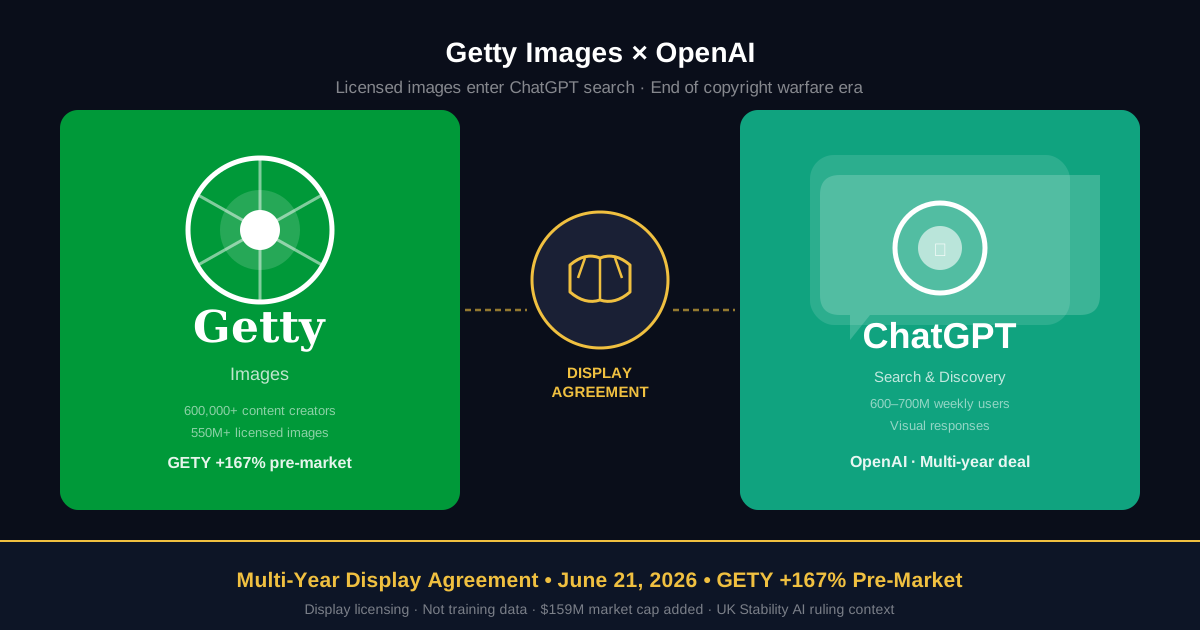
Getty Images and OpenAI announced a multi-year display agreement on June 21, 2026. Licensed images from Getty’s libraries will appear in ChatGPT’s search and discovery features, giving users visually richer responses backed by commercial licensing protection. GETY stock surged as much as 167% in premarket trading, climbing from roughly $0.60 to a peak of $1.62, adding approximately $159 million in market cap in a single session. CEO Craig Peters stated: “High-quality, licensed visual content makes AI-powered search and discovery more useful and more trustworthy.”
What This Deal Actually Covers
Several headlines are inflating the significance of this agreement because they skip a crucial distinction: this is a display agreement, not a training data license. Getty images will appear in ChatGPT visual responses, the same way Getty images appear in Google Image search results. That is a fundamentally different legal and commercial territory from the training data question, which concerns how AI models learn from images during development.
This is not Getty’s first deal of this kind. In October 2025, Getty signed a similar display agreement with Perplexity. The OpenAI version is the second. Shutterstock took a different route, licensing training data to OpenAI earlier in exchange for an undisclosed sum. Adobe Stock has made no public moves. The three major stock photo platforms are now differentiating in visible ways.
The background matters. In November 2025, the UK High Court ruled in favor of Stability AI on the core copyright claim, finding that AI model weights do not constitute “copies” of training images in the legal sense. After that precedent, Getty’s litigation strategy weakened considerably. This OpenAI announcement, read against that backdrop, looks less like a proactive business pivot and more like a transition away from the courts toward licensing revenue.
Similar dynamics are playing out across media. According to the Reuters Institute Digital News Report, 10% of global adults now use AI chatbots weekly for news, yet only 4% of users click through to original sources. Images and text face the same structural problem: AI platforms intercept traffic, copyright claims fare poorly in court, and licensing is the remaining commercial path.
What the Numbers Actually Tell Us
A 167% premarket surge demands scrutiny. The actual incremental revenue potential is far smaller than the market reaction implies.
A Fermi estimate: ChatGPT has roughly 600 to 700 million weekly users. Assuming 15% involve image-related queries, that yields around 100 million image displays per week, or roughly 5 billion annually. At a conservative $1 CPM for licensed content display, the annual revenue ceiling lands around $5 to $10 million. Getty’s Q1 2026 revenue was $226.6 million, implying an annual run rate near $900 million. Even with generous assumptions, this deal adds under 2% to existing revenues.
The 167% stock move is pricing in optionality, not the display revenue itself: more AI platforms following OpenAI’s lead, possible training data terms added to future agreements, and Getty repositioning from “the company suing AI firms” to “the compliant visual content partner for AI.” None of those three things have materialized yet.
One detail was absent from the official press release via GlobeNewsWire: Getty manages approximately 600,000 content creators. There is no disclosed information about what portion of this new AI platform revenue flows back to contributors. Shutterstock shared a portion of its training data proceeds with creators. Getty’s revenue-sharing terms for display licensing are not public.
GETY spent most of the past 12 months trading between $0.50 and $0.80, implying a market cap of roughly $250 to $300 million. For a company with nearly $900 million in annual revenue, that valuation reflected near-zero market confidence in Getty’s ability to survive the AI era. This OpenAI deal briefly pushed the market cap toward $700 to $900 million. Sustaining that range requires measurable follow-through.
What to Watch in the Next 90 Days
Adobe Stock and Reuters Pictures will be the most informative signals. If Adobe mentions AI display revenue in Q3 earnings, or if Reuters announces a chatbot licensing deal, the pattern is moving faster than expected into news photography. Reuters, AP, and Getty collectively hold hundreds of millions of current-events images. AI search relies on those images to answer time-sensitive queries accurately, which gives news photo agencies meaningfully more leverage at the licensing table than generic stock photo libraries.
Getty’s US federal lawsuit against Stability AI remains active, last reported in early stages as of January 2026. A settlement before year-end would almost certainly take the form of a licensing agreement rather than a damages award. The strategic direction has already changed; the court case is the last remnant of the prior approach.
The photographer revenue-share question has not yet become public controversy, but it will. The 2025 Stability AI litigation brought training data and copyright into mainstream awareness. This display licensing deal raises the same underlying question with different packaging.
One outcome worth watching before Q3: will individual contributors to Getty’s network start publicly asking how much of this new AI platform revenue reaches them? That question came up when Shutterstock struck its training data deal, and it will come up again here.
If this was useful, subscribe to the newsletter for weekly AI PM insights and GenAI case studies.
Related: AI Chatbots Are Cannibalizing News Traffic: What the Reuters Institute Report Actually Found
Related Articles
OpenAI Launches Dots: Ongoing Work Should Not Become a Growing Review Queue
OpenAI is rolling out dots to eligible paid users for work that continues between conversations. Read-only background research and limited memory controls make missed commitments and accumulated review work more useful tests than activity alone.
EU Designates ChatGPT as a VLOSE: Four Months After the 45 million User Threshold
The European Commission designated ChatGPT a Very Large Online Search Engine under the DSA, giving OpenAI until January 2027 to address systemic risks including illegal content, minors’ well-being, and public security.