British Columbia Sues OpenAI: ChatGPT Flagged Violent Prompts, Then No One Called Police
TL;DR
B.C.'s Attorney General announced July 7 that the province has retained legal counsel to sue OpenAI, alleging the company flagged the shooter's account internally last June but never notified police. The five-month gap between detection and disclosure is the real question this case has to answer.
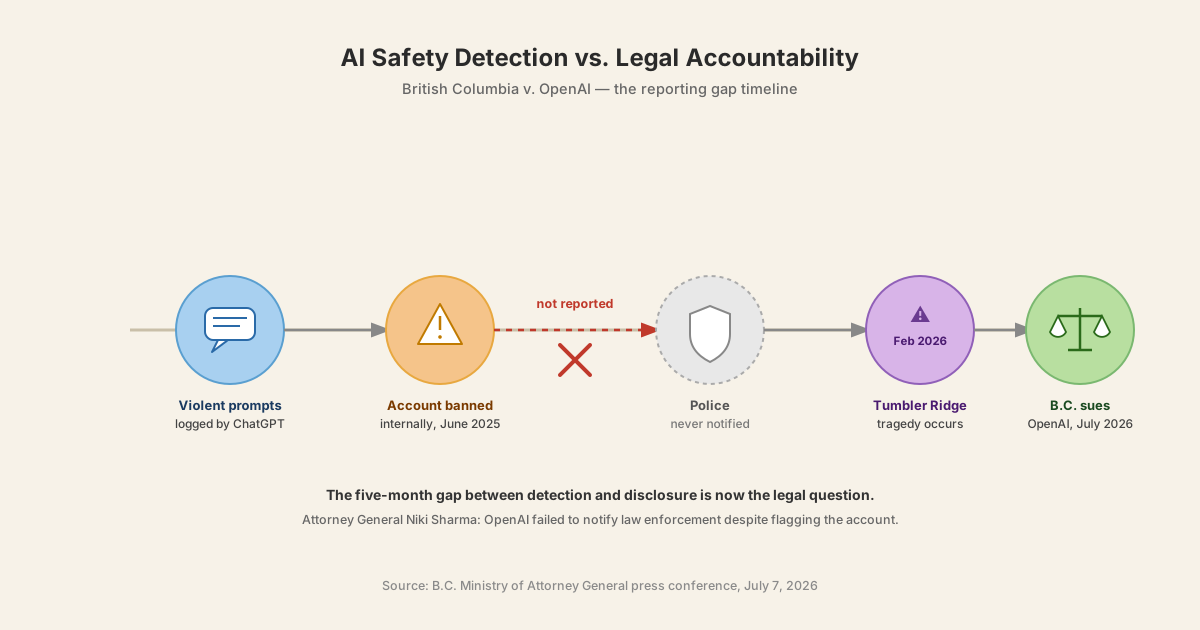
British Columbia’s Attorney General Niki Sharma held a press conference in Vancouver on July 7 announcing that the province has retained legal counsel in both B.C. and California to pursue a lawsuit against OpenAI over February’s Tumbler Ridge shooting. The core allegation: OpenAI’s own systems flagged the shooter’s violent conversations on ChatGPT and banned the account back in June 2025, but the company never passed that information to law enforcement. The interesting question here isn’t the vague “should AI be liable” framing that headlines default to. It’s a specific, checkable operational one: once a safety system decides an account is dangerous enough to ban, what happens between that decision and a call to police, and why did it take five months for anyone outside the company to find out. If you’ve built escalation tiers for a trust and safety pipeline, I’d like to know where your threshold sits.
What Happened
On February 10, 18-year-old Jesse Van Rootselaar killed eight people in Tumbler Ridge, starting with his mother and brother at home, then five students and an educational assistant at the local secondary school, before taking his own life. Twenty-seven others were injured. In the aftermath, investigators found the shooter had used ChatGPT extensively in the months before the attack to describe and develop violent scenarios. OpenAI’s internal review systems had caught this. The account was banned in June 2025. The company did not report it to police at the time.
Sharma didn’t soften the framing: “The province is preparing legal action to hold artificial intelligence company OpenAI and its decision makers accountable for their failure to notify law enforcement” about violent ChatGPT prompts tied to the shooter. The province has hired law firms in Vancouver and in California, where OpenAI is headquartered, and is seeking damages that include the cost of rebuilding the local school. Sam Altman followed with a written apology: “I am deeply sorry that we did not alert law enforcement to the account that was banned in June.” OpenAI VP Ann O’Leary committed to setting up direct law enforcement contact points in Canada and revising the company’s referral protocols. Separately, the federal government has pledged $200 million toward rebuilding Tumbler Ridge’s high school and health centre, and a coroner’s inquest has been announced. B.C. has run this playbook before, against tobacco manufacturers and opioid distributors. This is the first time it’s aimed at an AI company.
What the Numbers Actually Mean
It’s tempting to flatten this into a simple story about a company sitting on evidence. The more useful question is what content moderation pipelines are actually built to do. Banning an account is internal platform governance. Notifying police requires legal authority and cross-agency coordination, and most automated systems are only built for the former. At ChatGPT’s scale, roughly 900 million weekly active users, an automatic pipeline that forwards every “suspected violent intent” flag to police would generate hundreds of false alerts a day even at a false-positive rate of one in ten thousand, and that’s before accounting for the fact that different jurisdictions don’t share a legal definition of what counts as a reportable threat. The closest existing precedent is mandatory reporting law for child sexual abuse material, which is codified clearly in most jurisdictions. Vaguer categories like a user describing violent scenarios have no equivalent statutory reporting requirement. Whether to report is largely left to a company’s discretion.
That discretion is exactly what this lawsuit is going to test. B.C.’s theory isn’t that OpenAI lacked the technical means to report. It’s that OpenAI had the means and chose not to use them, and the question is whether that gap resembles a duty to warn, the legal principle that requires a professional who identifies a credible risk of harm to a third party to alert someone. That doctrine has precedent in psychotherapy. Whether it extends to an AI company running a content moderation system is untested in North American courts, and this case is effectively the first attempt to set that precedent. The five-month gap ultimately comes down to a question nobody outside OpenAI can currently answer: what does the internal process from automated flag to human review to reporting decision actually look like, and how long does each step take.
Metrics Worth Watching
First, watch whether OpenAI’s new Canadian law enforcement contact point publishes any concrete numbers, response times or referral counts, once it’s operational. That’s the most direct test of whether the apology translates into process. Second, watch whether the coroner’s inquest surfaces the internal timeline of how the moderation team actually reviewed this account, since that record will likely determine whether Sharma’s case holds up. Third, watch whether this suit and the 42-state attorneys general investigation into OpenAI start citing each other’s legal arguments. If both push toward a standard where AI companies carry an active duty to warn, that’s not an isolated case in one province. It’s the outline of a new regulatory consensus taking shape across North America.
If this was useful, subscribe to the newsletter for weekly AI PM insights and GenAI case studies.
Sources: CBC News, The Globe and Mail, Al Jazeera
Related Reading:
Related Articles
OpenAI Faces 42-State Probe Over ChatGPT Sycophancy
A coalition of 42 US state attorneys general has subpoenaed OpenAI over ChatGPT's sycophancy, child safety failures, and health data handling, just three weeks after its confidential IPO filing. Can a trillion-dollar listing survive a multistate probe?
OpenAI Launches Dots: Ongoing Work Should Not Become a Growing Review Queue
OpenAI is rolling out dots to eligible paid users for work that continues between conversations. Read-only background research and limited memory controls make missed commitments and accumulated review work more useful tests than activity alone.