US AI Models Crash Below 30% on OpenRouter: China Dominates Developer Traffic as OpenAI Faces IPO Pricing Dilemma
TL;DR
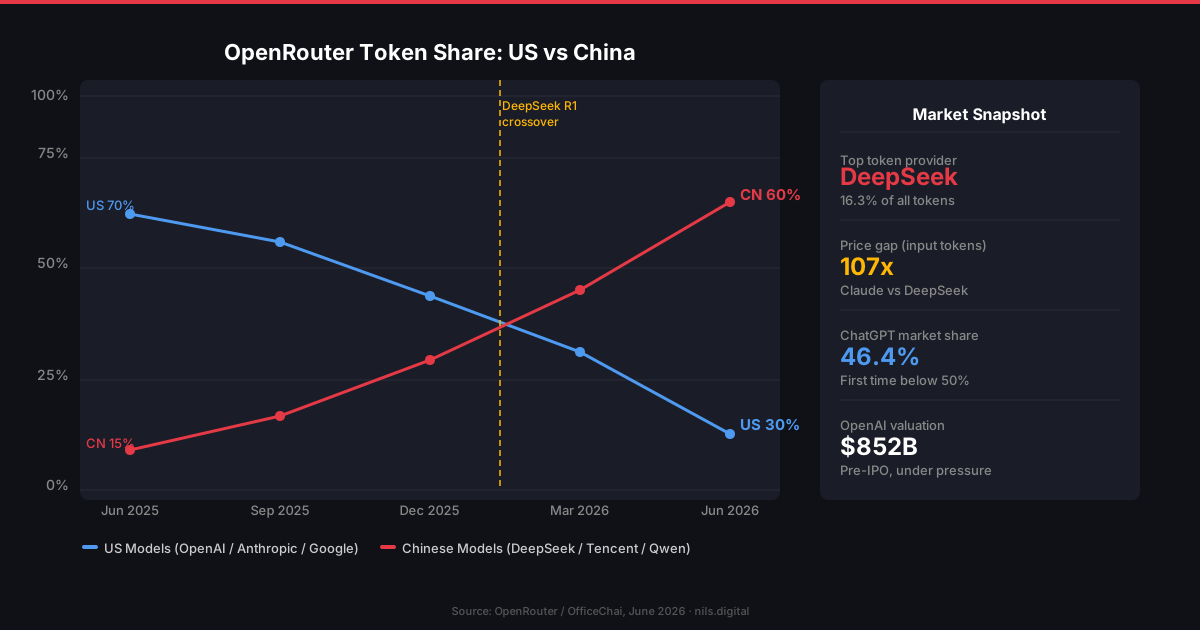
US AI models on OpenRouter fell from 70% to 30% token share in a year. DeepSeek alone holds 16.3%. ChatGPT global share dropped below 50% for the first time. OpenAI weighs deep price cuts heading into IPO. The compliance moat vs. the cost floor: which holds longer?
Here’s the specific question this article can’t answer on its own: how long does the compliance wall actually hold? If you’ve evaluated Chinese AI models for a regulated EU or US healthcare deployment, what was the real blocker — legal review, data residency, security audit? The gap between “technically prohibited” and “practically blocked” matters a lot for the timeline here.
What the Numbers Say
One year ago, OpenAI, Anthropic, and Google together held around 70% of token volume on OpenRouter. As of June 2026, that number sits at 30%.
Chinese models now fill the gap. Six of the top ten on OpenRouter by token volume are Chinese open-weight offerings — DeepSeek, Tencent, Xiaomi, MiniMax, and Qwen variants. DeepSeek alone commands 16.3% of all tokens processed, more than any single US provider. Anthropic’s Claude Opus 4.7 holds third place, the only Western closed-source model in the top three.
At the same time, ChatGPT’s share of the global AI assistant market fell to 46.4% — the first time it has held less than half. Google Gemini rose to 27.7%, Claude to 10.3%. OpenAI is reported to be weighing significant API price cuts. Both OpenAI and Anthropic filed confidential IPO documents in early June.
These developments share a timeline for a reason.
What the Numbers Are Actually Measuring
The token share figure deserves scrutiny before being taken at face value.
Token volume and revenue are not the same thing. DeepSeek V4 Flash costs roughly $0.14 per million input tokens. Claude Opus 4.7 costs $15 per million — a 107x gap. The same dollar budget buys 107 times more tokens from DeepSeek. Even if the number of paying customers using US models stayed flat, their token share would still decline mechanically as developers route high-volume, price-sensitive workloads to cheaper alternatives.
The more meaningful signals are paid request counts and enterprise contract value. OpenAI’s monthly revenue is still running at $2.6 billion. Anthropic posted its first profitable quarter in Q1. Those figures don’t support a “US models are losing” narrative — they support “US models are losing the cost-arbitrage layer of the developer market.”
The compliance layer compounds this: Tencent’s Hy3 Preview at $0.063/M input tokens is structurally inaccessible for most EU companies under GDPR, for any US government contract, and for healthcare organizations under HIPAA. Chinese models are winning the segment of the developer market that has no compliance constraints. That segment is real — indie developers, early-stage startups, prototype work — but it’s not where the bulk of enterprise AI spending flows.
OpenRouter’s user base skews toward technical builders and experimenters. It’s a useful leading indicator, not a mirror of enterprise procurement behavior.
The concern worth taking seriously is pipeline dynamics. Engineers who default to DeepSeek on OpenRouter bring that preference into enterprise purchasing conversations. The developer market is an upstream filter for B2B adoption, and the deterioration of that filter is a real medium-term risk for US providers.
If OpenAI cuts token prices aggressively to defend market share, it compresses margin going into an IPO that’s already priced at $852 billion. DeepSeek’s cost structure allows them to follow any US price cut — their training and inference economics are genuinely different. The race to the cost floor is one OpenAI’s current structure cannot win on price alone.
What to Watch Over the Next Two Quarters
The IPO prospectus revenue breakdown. If API token revenue accounts for less than 30% of OpenAI’s total, and consumer subscriptions exceed 60%, then the token price war hurts OpenAI less than current market narratives suggest. The opposite breakdown would mean the pressure is hitting the core business directly.
OpenAI’s announced price cut magnitude and timing. A cut above 50% announced before roadshows is a defensive market-share move at the expense of margin. A 20-30% cut tied to a new model launch is normal product cadence. The first scenario signals that token share loss is being treated as existential; the second signals confidence that capability differentiation is still the primary lever.
DeepSeek’s response speed. Every previous US model price cut has been followed by a DeepSeek response within two weeks. If OpenAI cuts by 50% and DeepSeek doesn’t follow, their cost floor has been reached. If they do follow, the race runs to a conclusion OpenAI’s current financial projections haven’t accounted for.
Claude’s OpenRouter ranking. If Claude Opus 4.7 holds top-three position through Q3, the capability moat is still functioning for specific use cases. If it slides, cost is beginning to outweigh quality even in segments where quality should command a premium.
If this was useful, subscribe to the newsletter for weekly AI PM insights and GenAI case studies.
Further reading:
Related Articles
The End of Tokenmaxxing: How Enterprise AI Overspending Created Its Own Crisis
Token consumption per developer surged 18.6× in nine months, bug rates climbed 54%, code churn hit 861%. Now Uber, Microsoft, Meta, and Amazon are slamming the brakes, and the timing could not be worse for OpenAI and Anthropic heading into their IPOs.
OpenAI IPO Prospectus Reveals Q1 2026: Revenue Tripled, Losses Widened
OpenAI's S-1 IPO financials are public: Q1 revenue tripled to $5.7 billion, but non-GAAP operating margin hit -122%. ChatGPT weekly users stalled near 905 million, Anthropic is only $900 million behind, and the IPO target remains $1 trillion.