LongCat-2.0: Meituan Trains a Trillion-Parameter Model on 50,000 Chinese Chips
TL;DR
Meituan open-sourced LongCat-2.0, a 1.6-trillion-parameter model claimed to be trained entirely on 50,000 domestic Chinese chips, priced at a tenth of GPT-5.5. Does the beats-GPT-5.5 claim actually hold up?
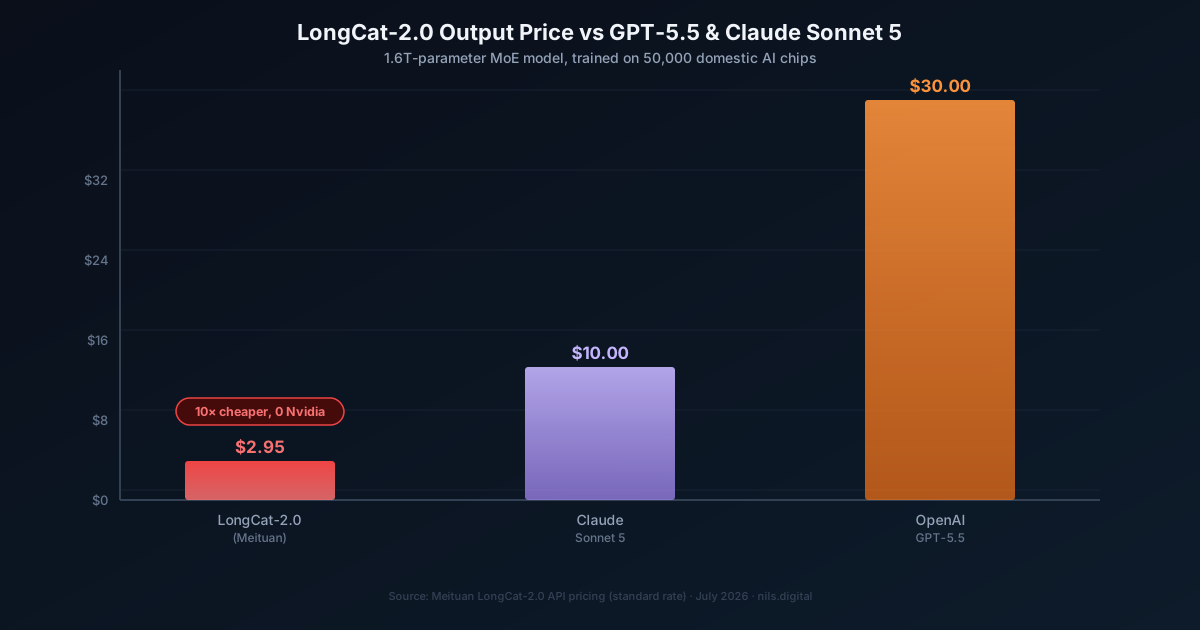
Meituan put LongCat-2.0 on GitHub and Hugging Face on June 30, a 1.6-trillion-parameter MoE model the company says was trained and served entirely on 50,000 domestic Chinese chips. It scored 59.5 on SWE-bench Pro, just ahead of GPT-5.5’s 58.6. My take is that the “beats GPT-5.5” framing doesn’t survive a closer look, a 0.9-point gap sits inside test-to-test noise, and on a separate agentic benchmark called FORTE, GPT-5.5 actually leads 77.8 to 73.2. If you’ve run other agentic benchmarks against LongCat-2.0 yourself, bring the numbers back, because right now it’s an open question whether this model genuinely closes the gap with Western frontier labs or just wins on one carefully chosen scoreboard.
What launched: a trillion-parameter model out of a food-delivery company
Meituan built its business on food delivery and local services in China, which makes LongCat-2.0 an odd product to come out of that company. It’s a mixture-of-experts model with 1.6 trillion total parameters, but only 33 to 56 billion activate per token, averaging around 48 billion. Context runs to one million tokens, pretraining covered more than 35 trillion tokens, and Meituan says the run finished with no rollbacks or unrecoverable loss spikes.
The more interesting part is what happened before the reveal. For two months, this model ran anonymously on OpenRouter under the codename Owl Alpha, with nobody outside Meituan aware of where it came from. During that stretch it averaged 559 billion tokens a day with 242% month-over-month growth, and developers picked it without knowing its lineage. That’s a stronger signal than any vendor-published benchmark, because it sidesteps the bias of a company choosing its own comparison set.
On the chips, multiple reports point to Huawei’s Ascend 910B series, though Meituan hasn’t confirmed this directly. If accurate, this is the first time a Huawei-trained model has reached frontier-adjacent performance on public benchmarks, which given China’s inability to import Nvidia hardware at scale since 2022 matters more than the SWE-bench score itself. On pricing, standard rates run $0.75 per million input tokens and $2.95 per million output tokens, roughly ten times cheaper than GPT-5.5’s $30 output rate and more than three times cheaper than Claude Sonnet 5’s $10.
What the numbers actually say
Start with the chip count. Each Ascend 910B is estimated at roughly 30-40% of an H100’s throughput, which puts this 50,000-chip cluster’s effective compute somewhere around 16,000-20,000 H100-equivalents, a scale that gets close to what GPT-4’s original training cluster was rumored to use. This isn’t a demo run. It’s China assembling a genuine frontier-scale training effort out of domestic silicon.
Now the pricing gap. A tenfold discount on output tokens is unlikely to come from chip efficiency alone. Cheaper electricity in China, no Nvidia margin or export tariff baked into the hardware cost, and Meituan’s evident urgency to grab share on platforms like OpenRouter are all more plausible explanations, and that last point lines up with what we’ve tracked before on Chinese models losing US market share on OpenRouter. Price is currently the only lever the Chinese camp can pull hard.
The word that deserves the most skepticism is “open.” Both the GitHub and Hugging Face pages still read “model weights coming soon, stay tuned,” meaning the only way to actually use this model right now is through Meituan’s own API. The MIT license exists on paper, not in a downloadable file.
Metrics worth watching next
Three things are verifiable within weeks to a few months. First, whether Meituan actually posts the weights, if a month passes with nothing, this release belongs in the marketing column rather than the open-source one. Second, whether an independent party confirms the training chips really are Ascend 910B, which decides whether this is a milestone in Chinese chip independence or an unverified claim riding on it. Third, whether Alibaba, ByteDance, or Tencent announce their own full-stack domestic-chip training runs within three to six months, if none of them do, Meituan’s run looks like an outlier rather than a trend.
If this was useful, subscribe to the newsletter for weekly AI PM insights and GenAI case studies.
Related reading: Chinese AI Models Lose US Market Share on OpenRouter, Zhipu’s GLM-5.2 Open-Weight Model Beats GPT-5.5
Related Articles
Kimi K3: Moonshot's 2.8 Trillion-Parameter Open Model Takes on Claude
Moonshot AI released Kimi K3 on July 16: a 2.8 trillion-parameter open model that ranks third on GDPval-AA, behind Claude Fable 5 and GPT-5.6 Sol, but priced like an Anthropic mid-tier model rather than a discount Chinese release. Open weights won't ship until July 27.
China's LineShine Tops TOP500 at 2.198 Exaflops: The AI Training Gap Remains Wide
China's LineShine hit No. 1 on the TOP500 list at 2.198 exaflops, with no Nvidia, Intel, or AMD chips anywhere. But Linpack measures FP64 dense algebra, not AI training. Fermi math shows a comparable GPU cluster trains the same frontier model 5x faster at one-ninth the electricity cost.