China's LineShine Tops TOP500 at 2.198 Exaflops: The AI Training Gap Remains Wide
TL;DR
China's LineShine hit No. 1 on the TOP500 list at 2.198 exaflops, with no Nvidia, Intel, or AMD chips anywhere. But Linpack measures FP64 dense algebra, not AI training. Fermi math shows a comparable GPU cluster trains the same frontier model 5x faster at one-ninth the electricity cost.
My read: the TOP500 crown matters politically and for scientific HPC, but it doesn’t move the needle on frontier AI training. The Fermi math puts the training-cost gap at 5x speed and 9x electricity versus an equivalent GPU cluster. If you work on HPC or AI infrastructure planning and have run similar cost-per-FLOP comparisons, I’d like to know where your numbers land differently from mine.
On June 23 at ISC 2026 in Hamburg, the TOP500 list released its latest rankings with a surprise: LineShine, a system installed at the National Supercomputing Center in Shenzhen, China, debuted at No. 1 with a sustained 2.198 exaflops on the HPL benchmark. No Nvidia, Intel, or AMD hardware anywhere in the system.
That puts LineShine roughly 20% ahead of the previous holder, the US Department of Energy’s El Capitan, and makes it the first CPU-only system in TOP500 history to break 2 exaflops.
What LineShine Is
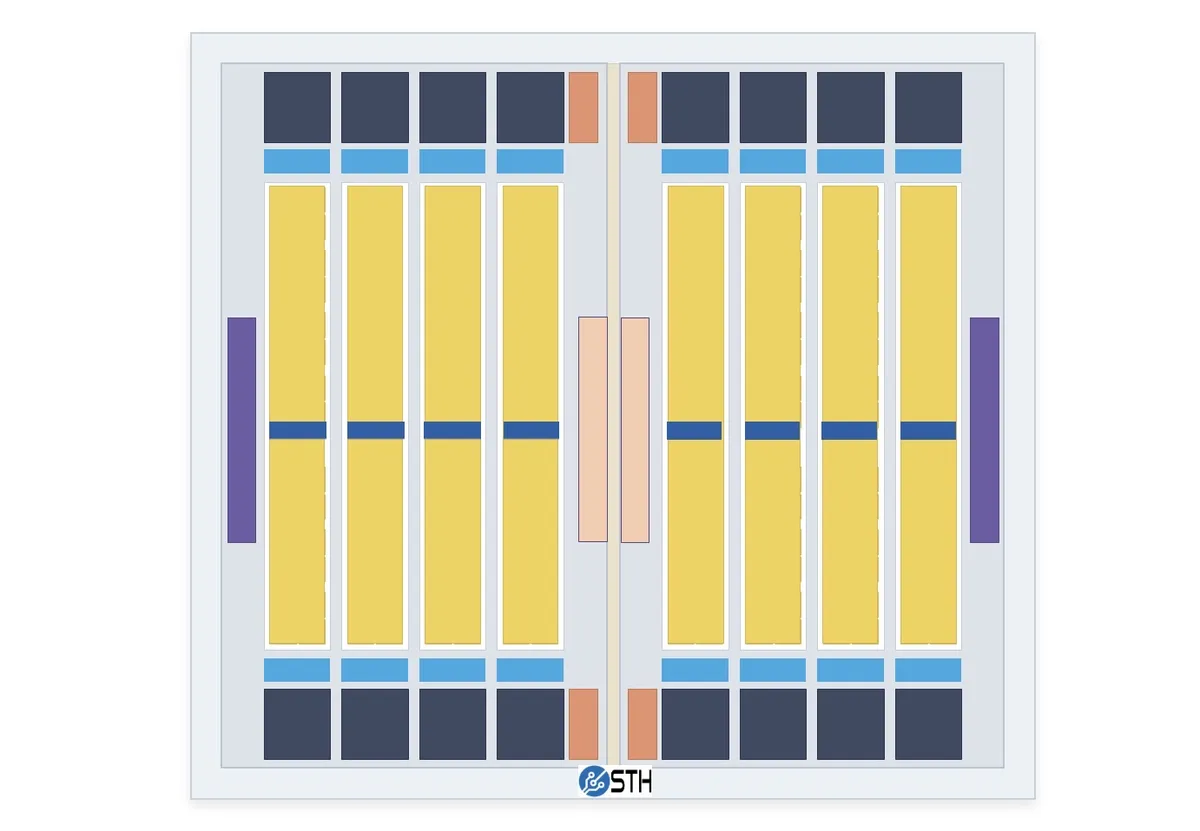
The system runs on China’s proprietary LX2 processors, an Armv9-compliant design with 304 cores per die running at 1.55 GHz. Each node pairs the LX2 with 8 stacked HBM modules totaling 32 GB and 4 TB/s of memory bandwidth, plus 256 GB of DDR5. Across 20,480 nodes, the full system fields approximately 13.79 million cores.
Interconnect is the self-developed LingQi network at 1.6 Tbps per node with a four-layer fat-tree topology. The operating system is KylinOS, a Linux derivative. Total power draw is 42.2 MW, delivering 52 GFlops/watt in efficiency.
From chip to interconnect to OS, LineShine demonstrates that China can build a No. 1 HPC system without touching a single piece of Western semiconductor infrastructure. That geopolitical signal is real and worth taking seriously.
The Numbers Behind the Numbers
The critical caveat is what HPL Linpack actually measures: FP64 double-precision dense matrix operations. This benchmark was designed for weather simulation, nuclear physics, and molecular dynamics workloads. It is not designed for AI training.
LLM training runs in FP16 or BF16. High-end GPUs push that further with FP8 tensor cores, where the performance ratios become extreme.
Concretely: each LX2 chip delivers approximately 120 TFLOPS in FP32. An Nvidia H100 SXM5 delivers 3,958 TFLOPS in FP8, about 33x more AI-relevant compute per chip.
Running the Fermi estimate for training a GPT-4-scale model (approximately 3×10²⁴ FLOPs):
LineShine at 30% effective AI utilization delivers roughly 740 petaflops/s of AI-equivalent compute. That training run takes about 47 days. At China’s industrial electricity rate of $0.05/kWh, electricity cost alone runs approximately $2.38 million.
The same job on 2,000 H100s at 50% utilization delivers roughly 3.95 exaflops of AI-equivalent compute. Training time: 8.8 days. Electricity cost: approximately $250,000.
Five times faster. Nine times cheaper on electricity.
This is not a criticism of LineShine’s engineering quality. The LX2’s 4 TB/s HBM bandwidth actually beats the H100’s 3.35 TB/s, which makes it genuinely competitive for memory-bandwidth-bound inference workloads, particularly very long context windows. But the current AI arms race is about training, not inference, and the physics of CPU vs. GPU tensor cores don’t favor LineShine in that workload.
HPCwire’s technical deep-dive and Digitimes’ market analysis both flag the same gap: No. 1 on TOP500 does not translate to No. 1 in AI training capability.
China’s major AI labs, including Baidu, ByteDance, and Alibaba, are running on Huawei Ascend 910B/910C clusters and pre-export-control Nvidia A100 inventory. LineShine doesn’t serve that stack. The actual AI compute bottleneck for Chinese frontier labs is Ascend performance relative to H100/B200, not Linpack rankings.
The Indicators Worth Watching
Three developments in the next three to six months will tell you what this announcement actually means for the AI compute race:
First, whether China submits LineShine results to MLPerf Training. MLPerf’s ResNet-50 and GPT-3 training benchmarks are the legitimate AI-workload comparison standard. Linpack is not. If a submission appears, the numbers will speak for themselves. If no submission appears, the TOP500 ranking has reached the limit of its AI relevance.
Second, whether Huawei updates its Ascend 910C submissions on MLPerf. The real China-US AI compute gap lives in the Ascend-versus-H100/B200 training throughput comparison, measured in tokens per second per dollar. That number, not the TOP500 list, is the indicator that matters for frontier model development.
Third, whether LX2 appears in any public GEMM or transformer-training benchmarks. ARM’s SME matrix extension has theoretical potential for matrix multiply workloads. Nobody has published real-world inference or training numbers on LX2 yet. That information gap is the actual unknown in this story.
If this was useful, subscribe to the newsletter for weekly AI PM insights and GenAI case studies.
Related Articles
LongCat-2.0: Meituan Trains a Trillion-Parameter Model on 50,000 Chinese Chips
Meituan open-sourced LongCat-2.0, a 1.6-trillion-parameter model claimed to be trained entirely on 50,000 domestic Chinese chips, priced at a tenth of GPT-5.5. Does the beats-GPT-5.5 claim actually hold up?
Goldman Sachs: $7.6 Trillion in AI Infrastructure by 2031 — Nvidia to Capture 75% of Compute
Goldman Sachs projects $7.6 trillion in cumulative AI infrastructure capex through 2031. Nvidia is set to capture 75% of the $5.1 trillion compute layer — but power availability, not capital, is the binding constraint.