Goldman Sachs: $7.6 Trillion in AI Infrastructure by 2031 — Nvidia to Capture 75% of Compute
TL;DR
Goldman Sachs projects $7.6 trillion in cumulative AI infrastructure capex through 2031. Nvidia is set to capture 75% of the $5.1 trillion compute layer — but power availability, not capital, is the binding constraint.
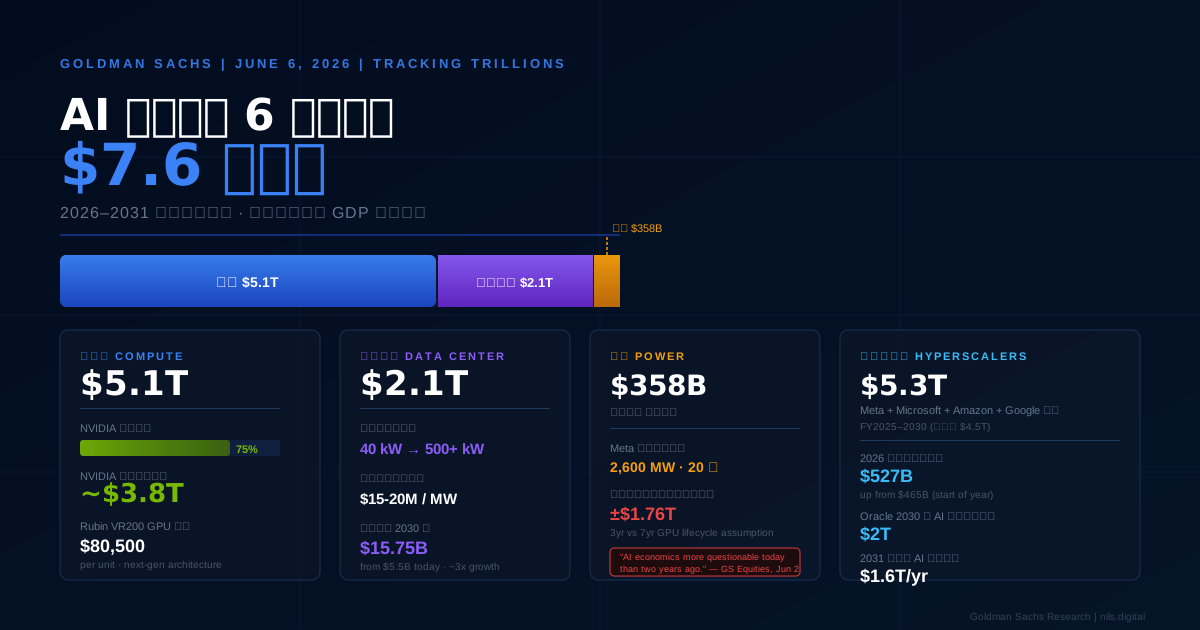
On June 6, Goldman Sachs published a research report titled “Tracking Trillions.” The opening figure: $7.6 trillion in cumulative AI infrastructure capital expenditure between 2026 and 2031, roughly one-quarter of the entire US annual GDP.
The baseline model puts 2026 annual spending at $765 billion, scaling to $1.6 trillion per year by 2031. The report details its assumptions explicitly, so readers can trace exactly how sensitive each projection is to changes in hardware pricing, depreciation cycles, and power availability.
Three Layers: Compute, Data Centers, and Power
Goldman breaks the AI buildout into three spending categories.
Compute takes the largest slice at $5.1 trillion, covering AI chips, servers, and supporting hardware for training and inference workloads. The baseline uses Nvidia’s next-generation Rubin VR200 GPU at a unit price of $80,500, roughly double what the H100 cost at launch.
Data centers account for $2.1 trillion, including construction, cooling upgrades, electrical infrastructure, and connectivity. Build pace is accelerating globally, but power access is the bottleneck.
Power and energy infrastructure is the smallest line item at $358 billion — yet analysts identify it as the single most binding constraint on deployment timelines.
Nvidia’s Structural Position
Of the $5.1 trillion compute layer, Goldman estimates Nvidia will capture approximately 75%, translating to roughly $3.8 trillion in cumulative revenue through 2031.
Combined capex from Meta, Microsoft, Amazon, and Alphabet for fiscal 2025–2030 has been raised to $5.3 trillion, up from a prior estimate of $4.5 trillion — an $800 billion upward revision. Oracle separately targets approximately $2 trillion in AI-related asset additions by 2030. Consensus hyperscaler AI capex for 2026 now sits at $527 billion, up from $465 billion at the start of the year.
AMD, Intel, Google’s TPUs, and domestic Chinese alternatives are all competing for share. Goldman’s view is that Nvidia’s software ecosystem cannot be replicated quickly. That assessment has been made before, but purchasing data so far has provided no serious rebuttal.
Power: The Hardest Constraint
The $358 billion power figure is the smallest share of the $7.6 trillion, but it represents confirmed contracts and planned spending — the actual gap is wider.
AI data centers have already undergone a step-change in power density. Traditional hyperscale racks run at roughly 40 kilowatts. Next-generation AI facilities are designing for 500+ kilowatts per rack, a tenfold increase. Construction costs have risen from $10 million per megawatt to $15–20 million per megawatt for next-generation facilities.
Liquid cooling is moving from optional to standard. The liquid cooling market is projected to grow from $5.5 billion today to $15.75 billion by 2030. Amazon CEO Andy Jassy stated plainly: “Our single biggest constraint is power.” Goldman quotes this directly.
Nuclear energy is back in serious corporate conversations. Vistra Energy signed a 20-year contract with Meta covering over 2,600 megawatts — one of the largest corporate nuclear energy agreements in history. Grid connection queues now extend years into the future, pushing large players toward direct power agreements with nuclear operators and renewable developers.
Goldman’s Own Caveat
The report carries an internal tension worth noting. On June 2, a Goldman equities official advising institutional clients stated: “The economics of artificial intelligence are more questionable today than two years ago.”
The timing is deliberate. Goldman quantifies the scale of spending while its equity research division flags that scale does not guarantee returns.
The uncertainty is concentrated in hardware depreciation assumptions. A three-year GPU lifecycle versus a seven-year assumption creates a $1.76 trillion variance in the cumulative spending forecast. AI model architectures are evolving fast enough that early-vintage chips may be obsoleted before they are fully written down. The buying cycle has to be planned under that uncertainty.
Pricing Will Keep Rising
For enterprise buyers, the most actionable implication from this report is pricing direction.
In March 2026, Alibaba Cloud raised AI computing prices by up to 34% and storage by 30%, citing hardware procurement costs. Baidu followed that same month. Within Goldman’s framework, this sequence is straightforward: pricing power sits with Nvidia and a handful of hyperscalers, and when their costs rise, those costs flow downstream to cloud customers.
Cloud AI compute pricing will likely trend upward for the next several years unless GPU energy efficiency improves materially or a credible Nvidia alternative emerges at scale. Organizations modeling AI infrastructure budgets should treat compute costs as a dynamic variable rather than a fixed line item.
If this was useful, subscribe to the newsletter for weekly AI PM insights and GenAI case studies.
Related reading
Related Articles
NVIDIA Expands Agent Safety: Runtime Permissions Do Not Guarantee Correct Work
NVIDIA launches its Open Agent Safety Platform, with OpenShell 0.1.0 enforcing file, network and tool permissions outside the model. That can contain mistakes, but more than 100 participating organizations do not establish deployment results or correct work.
Salesforce Introduces Koa: Training on CRM Workflows Leaves Exceptions to Be Tested
Built on NVIDIA Nemotron, Koa enters Agentforce customer pilots. Workflow specifications become training material, but internal benchmarks, real exceptions and general availability remain distinct.