Nvidia's Japan Physical AI Factory: What 27,500 Rubin GPUs Actually Buy
TL;DR
Nvidia unveiled a Vera Rubin AI factory with Japan's Noetra consortium on July 16, backed by $6.2B in subsidies and 27,500 Rubin GPUs, billed as the world's first national AI infrastructure. Here is what the math actually says about Japan's 2040 robotics ambitions.
Rubin GPUs are not yet in mass production, so the real open question behind this announcement is whether a 140-megawatt cluster actually ships on the timeline Nvidia implied. If you track Nvidia’s supply chain, or have visibility into Rubin’s tape-out and packaging schedule, I would like to compare notes on whether the second year of this program is realistic or just a placeholder in a press release.
What happened: four announcements in one Tokyo press day
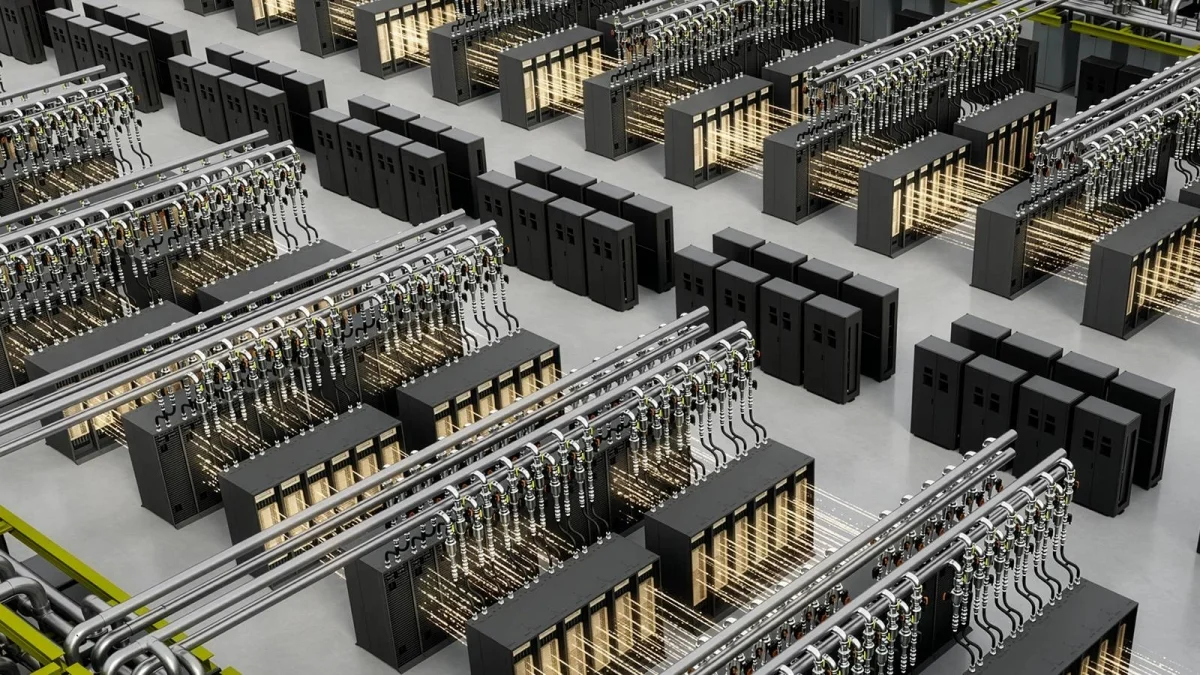
On July 16, Nvidia CEO Jensen Huang announced in Tokyo that the company is working with Japan’s Noetra consortium to build a Vera Rubin AI factory: 27,500 Nvidia Rubin GPUs and 13,750 Vera CPUs, delivering 140 megawatts of data center capacity on Nvidia’s DSX platform with Spectrum-X Ethernet and BlueField DPUs. Noetra, a group formed by SoftBank, Sony, NEC, Honda and Japan’s National Institute of Advanced Industrial Science and Technology, will run the facility under Japan’s METI-backed FRONTia Project, aiming to train an open multimodal foundation model for physical AI, the class of systems behind robots, digital twins and smart manufacturing. Model weights are supposed to be shared with domestic developers alongside Nvidia’s Nemotron, Cosmos and Isaac GR00T stack.
The same day, Huang appeared alongside the CEOs of Fujitsu, Fanuc, Yaskawa and Kawasaki Heavy Industries to announce a separate physical-AI robotics alliance, with a first phase launching this year and a possible joint venture down the line. Nvidia also expanded its existing partnership with Toyota, bringing Omniverse digital twins into factory lines and its AI stack into Toyota’s experimental Woven City. Together, the three threads made up Huang’s first Japan trip in roughly nine months, after weeks of chatter that Japan had been sidelined in Nvidia’s global rollout.
What the numbers actually say
Put 27,500 GPUs and 140 megawatts next to the scale hyperscalers are already building. US cloud providers are planning campuses in the gigawatt range, and a single hyperscaler’s quarterly data center capex regularly tops $20 billion. Noetra’s five-year budget is roughly ¥1 trillion, about $6.2 billion, or $1.2 billion a year. That means Japan’s entire national physical-AI push, spread over five years, adds up to less than two months of one American cloud company’s capex. Calling this “the world’s first national AI infrastructure” is accurate as a policy first, not as a claim about compute scale.
The chip itself is not the interesting part either. Rubin succeeds Blackwell as Nvidia’s next architecture, and as of this announcement it has not shipped in volume, so the factory is being sold on a spec sheet and a timeline rather than running hardware. The asset money genuinely cannot buy is Japan’s roughly 70% share of the global industrial robot market and the decades of sensor and actuation data that come with it, which is exactly the training data physical AI models need and competitors cannot replicate by buying the same GPUs. That is also the subtext of Huang standing next to Fujitsu’s, Fanuc’s, Yaskawa’s and Kawasaki’s CEOs and framing Japanese manufacturing discipline (kaizen) as the right culture for training robots that work safely next to people.
Japan’s government has attached a 2040 target of capturing over 30% of the global AI robotics market, a $133 billion opportunity by its own estimate. That is a fourteen-year forecast with no interim numbers to check it against yet. If the underlying commitment is real, the next three to six months should produce a concrete Rubin GPU delivery schedule, and Noetra’s program should clear its year-two milestone review rather than quietly slipping it.
What to watch next
The clearest signal is Nvidia’s actual Rubin GPU shipment schedule, since that determines whether the Noetra factory goes live anywhere near the announced specs. Second is METI’s annual milestone review of the Noetra program, particularly whether the ¥1 trillion funding envelope survives past year two intact. Third, and probably the most telling test of whether this is substance or stagecraft, is whether Fujitsu, Fanuc, Yaskawa and Kawasaki actually form a joint venture with named products by year end, rather than leaving the alliance as a memorandum of understanding. Fourth is whether Toyota’s Woven City Omniverse pilot produces any publishable factory-efficiency numbers. Finally, if FRONTia’s open multimodal model actually ships weights, the number worth checking is how it performs on robotic control and multimodal benchmarks against Nvidia’s own existing Isaac GR00T and Cosmos stack, not against a marketing slide.
If this was useful, subscribe to the newsletter for weekly AI PM insights and GenAI case studies.
Sources: NVIDIA Newsroom / GlobeNewswire, The Japan Times, Asia Times, Nikkei Asia
Related reading:
Related Articles
NVIDIA Pledges $20B for European AI Infrastructure as VivaTech 2026 Opens in Paris
Jensen Huang opened VivaTech 2026 in Paris with a $20B pledge for European AI infrastructure and over 3,000 exaflops of Blackwell compute across eight countries, days after US export controls on Anthropic's Fable 5 exposed Europe's AI dependency.
AMD Plans to Buy World Labs for $8.2 Billion: What World Models Change for Compute
AMD announces an all-stock agreement to buy Fei-Fei Li’s World Labs, targeting completion by year-end. Model research can inform hardware design earlier, but simulation costs, transfer to robots and customer adoption remain separate questions.