NVIDIA Pledges $20B for European AI Infrastructure as VivaTech 2026 Opens in Paris
TL;DR
Jensen Huang opened VivaTech 2026 in Paris with a $20B pledge for European AI infrastructure and over 3,000 exaflops of Blackwell compute across eight countries, days after US export controls on Anthropic's Fable 5 exposed Europe's AI dependency.
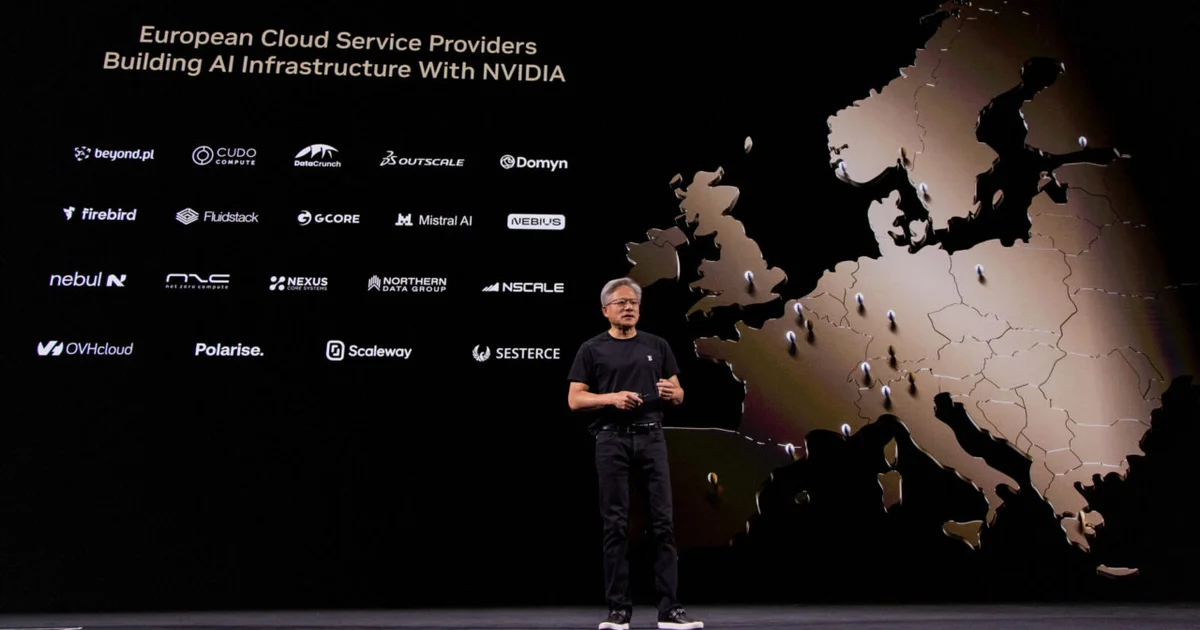
VivaTech 2026 opened June 17 in Paris, and NVIDIA CEO Jensen Huang led with the conference’s heaviest number on day one: $20 billion committed to European AI infrastructure across France, Italy, Germany, Spain, Poland, the UK, Sweden, and Finland.
The timing was deliberate. Five days earlier, the US government ordered Anthropic to suspend access to Fable 5 and Mythos 5 for any foreign national, and Anthropic complied by taking both models offline globally within 90 minutes. A single export-control directive turned “European AI sovereignty” from a policy document talking point into an operational emergency for CTOs across the continent.
What $20 Billion Looks Like on the Ground
Huang’s commitment maps to more than 3,000 exaflops of Blackwell computing power being deployed across Europe. One German facility alone will house over 10,000 DGX B200 GPU systems. Norway’s Telenor and Spain’s Telefónica have signed agreements to deploy NVIDIA GPUs for edge AI deployments. Pharmaceutical company Sanofi demoed its drug development collaboration with NVIDIA on the VivaTech floor.
Huang framed it in infrastructure terms: “We now have a new industry, an AI industry, and it’s now part of the new infrastructure, called intelligence infrastructure, that will be used by every country, every society.” Speaking those words in Paris, with the G7 summit wrapping up 90 kilometers away in Évian, the symbolism was hard to miss.
Isaac Gr00T N1.5 and Three Core Platforms
Beyond the hardware commitment, Huang announced Isaac Gr00T N1.5, an updated foundation model for humanoid robots, alongside three platforms that anchored NVIDIA’s VivaTech showcase.
Nemotron is an open large language model optimized for enterprise and sovereign AI deployments, built to be fine-tuned on local data by governments and corporations. It is NVIDIA’s most direct product answer to the sovereignty question. Cosmos is a world foundation model that generates synthetic training data and simulated environments for robotics and autonomous vehicles. Isaac and Omniverse together provide the full development and simulation stack for industrial robotics.
The three platforms combined point at the same thesis: NVIDIA is selling a complete stack from training data to deployment, not just chips. The compute is the entry ticket.
The Real Cost of Sovereign AI
Europe’s structural problem is visible in the numbers. The EU has planned over 20 AI factories across member states, with five gigawatt-class gigafactories in the pipeline, but rollout spans years. More than 700 NVIDIA Inception member startups operate in France alone. Most of them still run model training and inference on American cloud infrastructure.
The Fable 5 incident exposed something concrete: European AI dependency is not hypothetical. Mistral, Europe’s most prominent domestic AI company, has already announced debt financing to purchase NVIDIA chips and is committing to new data centers. Whether one French company can carry the weight of continental sovereignty ambitions is a reasonable question with no clean answer yet.
At the G7 summit in Évian, representatives were negotiating a potential “trusted partners” arrangement for allied access to restricted American models. That negotiation is itself an acknowledgment that building alternatives and maintaining American access are not mutually exclusive strategies — Europe is currently running both tracks simultaneously.
NVIDIA’s Position on the Board
Huang’s presence at VivaTech represents more than a hardware sales pitch. NVIDIA is the unavoidable supplier in every European sovereign AI roadmap: France’s AI factories, Germany’s industrial AI buildout, Mistral’s training infrastructure. They all run on NVIDIA GPUs.
Whether the $20 billion commitment translates into actual deployments depends on government procurement cycles and data center permitting timelines. What today’s announcement did accomplish is to give VivaTech 2026 a concrete number to anchor the European AI infrastructure conversation, one that had been long on ambition and short on specifics. Sovereign AI either shows up in warehouses and power bills, or it stays in press releases.
If this was useful, subscribe to the newsletter for weekly AI PM insights and GenAI case studies.
Sources: NVIDIA Blog – GTC Paris, TechCrunch – Why VivaTech 2026 is the place to see Europe’s AI strategy take shape, The Next Web – Europe frets over American AI as the tech world descends on France
Further Reading:
Related Articles
Nvidia's Japan Physical AI Factory: What 27,500 Rubin GPUs Actually Buy
Nvidia unveiled a Vera Rubin AI factory with Japan's Noetra consortium on July 16, backed by $6.2B in subsidies and 27,500 Rubin GPUs, billed as the world's first national AI infrastructure. Here is what the math actually says about Japan's 2040 robotics ambitions.
NVIDIA Expands Agent Safety: Runtime Permissions Do Not Guarantee Correct Work
NVIDIA launches its Open Agent Safety Platform, with OpenShell 0.1.0 enforcing file, network and tool permissions outside the model. That can contain mistakes, but more than 100 participating organizations do not establish deployment results or correct work.