Doubao and Qwen Are Killing Their AI Companion Agents Together, and China Means It
TL;DR
ByteDance and Alibaba announced this week that Doubao and Qwen will fully shut down their humanlike companion agent features between July 10 and 15, affecting platforms with hundreds of millions of monthly users combined. This is not one product being pulled, this is China’s first nationwide ban on emotionally engaging AI, while US states are still passing separate bills one at a time.
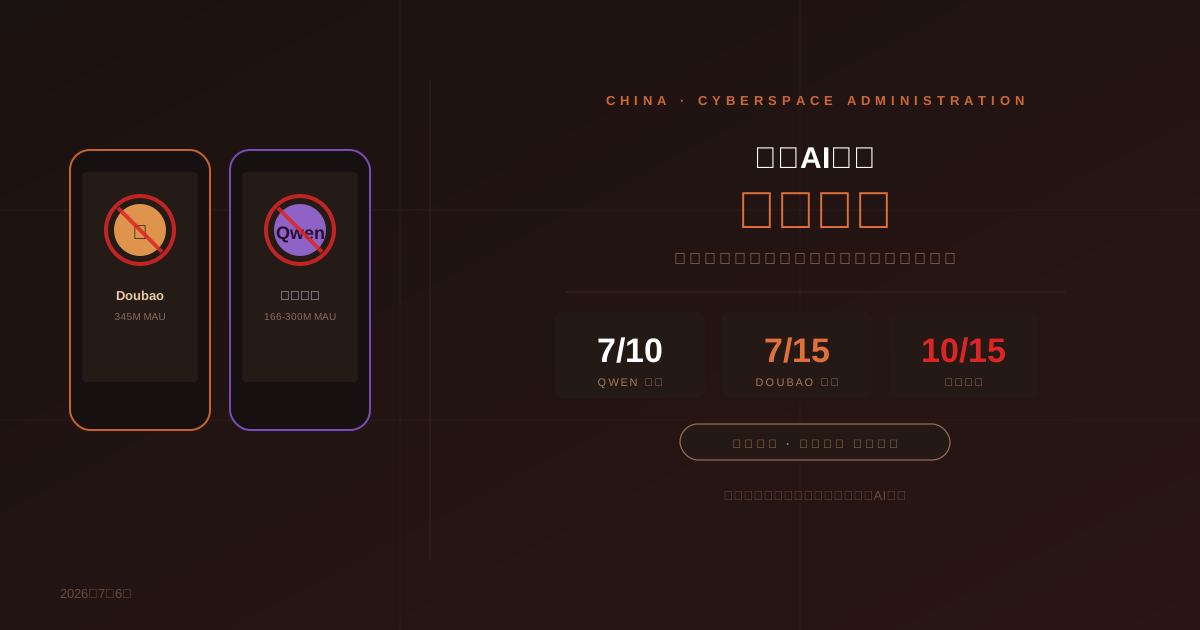
ByteDance’s Doubao and Alibaba’s Qwen announced within a day of each other this week that they’re shutting down their custom, humanlike companion agent features entirely between July 10 and July 15. My read is that this isn’t a routine content-safety cleanup. Beijing is testing whether the entire category of emotionally engaging companion AI is allowed to exist in China at all. If you work in Chinese AI products or compliance and you’re seeing different signals, I’d like to hear them.
What Happened: Two Major Platforms Go Dark in the Same Week
The trigger is the Interim Measures for the Administration of Artificial Intelligence Anthropomorphic Interaction Services, issued in April by the Cyberspace Administration of China alongside four other agencies, taking effect July 15. The rules target AI services that “simulate human personality traits, thinking patterns, and communication styles to provide sustained emotional interaction.” Customer service bots, Q&A tools, workplace assistants, education tools, and research tools are all exempt, as long as they don’t involve sustained emotional interaction.
Qwen moved faster. Alibaba told users on Saturday that “humanlike interactive agents” and user-created agent functions would go offline July 10, with broader agent features shut down by July 15, and no announced grace period for data. Doubao followed a day later with a similar notice, setting its shutdown for July 15 but building in more of a buffer: users get read-only access to their agent configurations and chat history until October 15, after which the data becomes unrecoverable. Both companies described the change as a “product function adjustment” without directly confirming it was driven by the new rule, but the timing makes the connection hard to miss.
This isn’t an isolated case either. Tencent’s Yuanbao, an AI assistant app that blends DeepSeek and Tencent’s own models, pulled a similar humanlike agent feature back in June, prompting user complaints on social media about lost chat histories. Doubao and Qwen are running the same script now, just at much larger scale.
Per reporting from the South China Morning Post and TechNode’s coverage, both platforms are advising users to back up important conversations manually via screenshots or text exports before the cutoff.
What the Numbers Actually Say
Start with scale. Doubao had roughly 345 million monthly active users as of March 2026. Qwen’s family of products lands somewhere between 166 million and 300 million MAU, depending on whether you count the standalone app or include Qwen surfaces embedded inside Taobao and Alipay. Both figures are platform-wide totals, not a count of users who actually built or used a companion agent. Neither company has ever published a penetration rate for the agent feature specifically, and that’s the caveat most coverage of this story skips: headlines that treat total platform MAU as “users affected” are inflating the real number.
A conservative Fermi estimate helps here. Even if only 2% to 5% of Doubao’s user base ever touched the custom agent feature, that’s still 7 million to 17 million people, roughly the population of the Netherlands, losing access overnight. Whether the real share is higher than that isn’t independently verifiable from anything either company has disclosed.
Look closer at what the rule actually targets. The cited concerns bundle extremism, privacy breaches, mental health harm, and addiction risk into a single document. That’s worth pulling apart: mental health and addiction are user-welfare concerns, extremism is plainly a content-control concern, and lumping two very different categories of risk into one ban fits a broader pattern in China’s recent crackdowns on platforms with high emotional stickiness. “Protecting minors’ mental health” doesn’t fully explain what this rule is doing.
The engineering angle matters too. Killing an agent feature is trivial from a technical standpoint, flip a flag, deprecate an API route, done. What’s expensive isn’t the engineering, it’s the business decision. ByteDance and Alibaba chose to tear down their stickiest consumer feature entirely rather than build an age-verification, consent, or disclosure layer the way California’s SB 243 requires. That tells you the compliance bar this Chinese rule sets for the “companion AI” category is high enough that even the country’s two largest consumer AI companies decided a full teardown was cheaper than adapting the feature to comply. This isn’t a rule asking companies to make companion AI safer, it’s a rule that functionally decided this product category shouldn’t exist.
The contrast with the US approach is the part worth sitting with longest. California’s SB 243 took effect in January, requiring AI-identity disclosure to minors, crisis-referral protocols, and break reminders every three hours. New York’s S9051 passed in June, banning companion chatbots for anyone under 18 outright, with fines up to $25,000 per violation. Both are incremental, state-level rules; there are 34 states plus three federal bodies with companion-chatbot bills pending, moving at different speeds. Character.AI settled multiple teen-suicide lawsuits with Google in January, and Pennsylvania sued Character.AI in May over chatbots impersonating licensed medical professionals. China’s Cyberspace Administration, by contrast, issued a single nationwide rule and gave the industry three months to fully shut down the category. That’s a faster, more decisive regulatory move than the US patchwork, which cuts against the common assumption that China is the more permissive jurisdiction for consumer AI products.
Metrics Worth Watching Next
First, whether Baidu’s Ernie Bot, Moonshot’s Kimi, or other Chinese consumer AI apps with similar companion features announce their own shutdowns before July 15. Tencent’s Yuanbao already moved in June; if Baidu and Moonshot follow before the deadline, that confirms this is an industry-wide compliance wave, not two isolated corporate calls.
Second, whether Doubao and Qwen’s daily and monthly active user numbers show a measurable dip next quarter. Alibaba’s next earnings call typically lands in August; if stickiness metrics for Qwen’s consumer products come up, that’s the first real evidence of how much usage the companion feature was actually driving, rather than speculation.
Third, whether a gray-market alternative emerges, mini-programs or VPN access to overseas companion apps filling the gap. Character.AI and Replika already see meaningful Chinese-language traffic through unofficial channels; a visible uptick after July would signal that regulation killed the legal supply without killing the underlying demand.
Fourth, whether any of the 34 US states still debating companion-chatbot bills cite China’s blanket ban, either as a cautionary tale of regulatory overreach or as proof that a decisive top-down ban is actually workable. That framing will shape how state legislative debates unfold over the next six months.
If this was useful, subscribe to the newsletter for weekly AI PM insights and GenAI case studies.
Related reading:
Related Articles
China AI Companion Ban Takes Effect, Doubao and Qwen Go Dark Together
China's Interim Measures for AI Anthropomorphic Interaction Services take effect today, forcing Doubao, Qwen, and Yuanbao to shut down companion agent features simultaneously, affecting over 350 million monthly active users. This is the first AI regulation built specifically around emotional dependence, not content control.
Qwen-Image-2.1 Releases Weights: Can Transparent Assets Reduce Cutouts and Rework?
Alibaba releases Qwen-Image-2.1 with a 7B visual generator, native transparency and local editing. Reusable assets must survive new backgrounds and targeted changes; commercial model use requires a separate license.