China AI Companion Ban Takes Effect, Doubao and Qwen Go Dark Together
TL;DR
China's Interim Measures for AI Anthropomorphic Interaction Services take effect today, forcing Doubao, Qwen, and Yuanbao to shut down companion agent features simultaneously, affecting over 350 million monthly active users. This is the first AI regulation built specifically around emotional dependence, not content control.
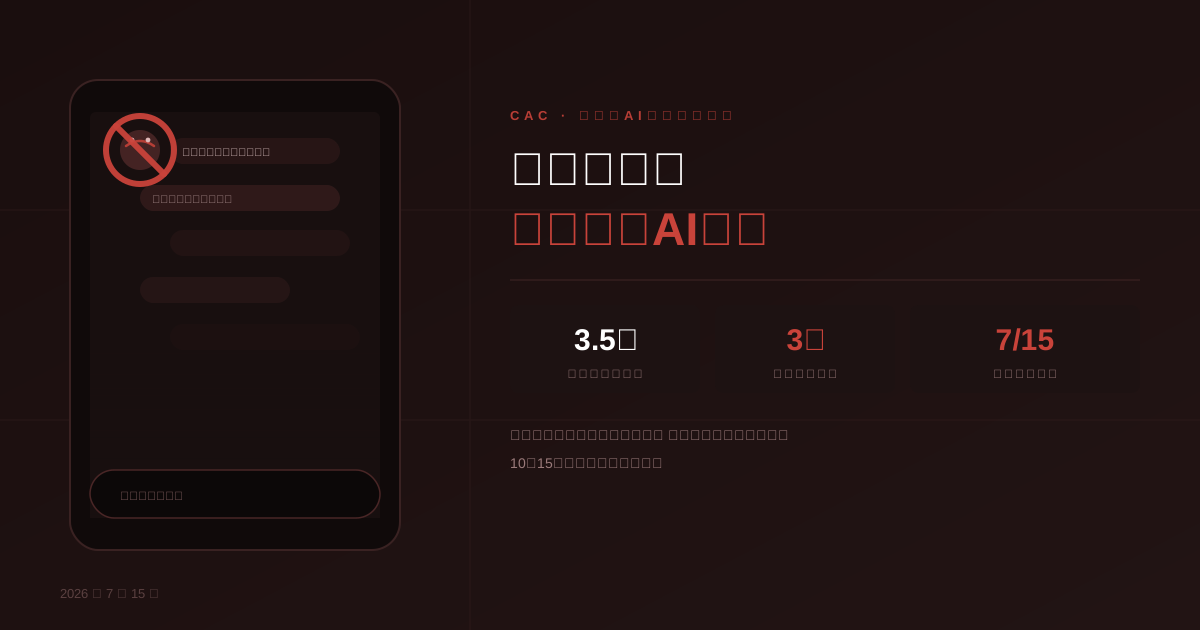
Today is the day China’s Interim Measures for the Administration of AI Anthropomorphic Interaction Services take effect, and ByteDance’s Doubao and Alibaba’s Qwen are pulling their AI companion features on the same date. This isn’t one company’s product decision. It’s a regulatory framework that the Cyberspace Administration of China, along with four other agencies, issued back in April, and it’s the first rule anywhere that treats emotional dependence as the thing being regulated, rather than a side effect of content moderation.
Here’s my read: the fact that three major platforms chose to shut the feature down outright, instead of spending a few months retrofitting a compliant version, tells you something. Persistent-memory companion agents are structurally at odds with mandatory usage-time limits and instant-exit mechanisms. If you’ve built a companion AI product outside China, how would you bolt these requirements on without gutting the thing that keeps people coming back? I don’t have a clean answer that leaves the core architecture intact. Tell me if I’m missing something.
What Happened
Tencent’s Yuanbao shut down its user-built agent section on June 30. ByteDance announced Doubao would follow on July 3. Alibaba confirmed Qwen would do the same on July 4. The timelines diverge slightly: Qwen’s humanlike interactive agents and user-created agent functions went dark on July 10, while its broader agent services shut down today. Doubao’s agent feature goes offline today too, with a read-only window for viewing configurations and chat history that closes on October 15, after which the data becomes unrecoverable under the company’s privacy policy.
The regulation is called the Interim Measures for the Administration of AI Anthropomorphic Interaction Services, co-issued on April 10 by the Cyberspace Administration of China, the National Development and Reform Commission, the Ministry of Industry and Information Technology, the Ministry of Public Security, and the State Administration for Market Regulation. It targets services that “simulate human personality traits, thinking patterns, and communication styles to provide sustained emotional interaction.” Customer service bots and educational assistants are explicitly carved out. The specific requirements: mandatory anti-addiction systems, real-time detection of unhealthy dependence, usage-time notifications with instant-exit mechanisms, guardian consent for users under 14 plus a dedicated minor mode, detection and escalation for users showing signs of self-harm or serious financial loss, and an outright ban on engineering emotional dependence or manipulating users into unreasonable decisions. Any provider with over one million registered users has to file a security assessment with provincial regulators.
The regulation explicitly cites Character.AI’s teen psychological harm lawsuits, FTC investigations into companionship services, and EU action against Replika as reference points. In other words, Beijing turned questions Western regulators are still debating into binding rules first.
The Numbers Behind the Headline
Start with scale. Doubao’s monthly active users hit roughly 336 million in April, second globally only to ChatGPT. Add in Tencent’s Yuanbao and Alibaba’s Qwen, and China’s AI chatbot market crossed 700 million monthly active users earlier this year, more than double the 2024 figure. Even if only 10% of users ever touched the companion agent feature, that’s 30 to 70 million people affected in a single day, comfortably larger than Character.AI’s entire estimated US user base of around 20 million. Discount that 700 million figure some, since it likely double-counts users across apps, but even halved, the scale still dwarfs any single companion AI event in the West.
Now the “why shutdown, not retrofit” question. The instant-exit and usage-time-limit requirements aren’t hard to build in isolation. What’s hard is that they contradict the core mechanic these products run on: persistent memory and a maintained long-term relationship. A roleplay agent that gets forcibly interrupted every so often to remind you you’ve been chatting too long undermines the exact thing that drives repeat engagement. Three companies choosing to kill the feature outright, rather than ship a compliant retrofit, reads more like a business call, they ran the numbers on retrofit ROI and it didn’t clear the bar, than a technical wall. The million-user threshold for mandatory security assessments also raises the compliance floor for smaller companion AI startups that don’t yet have the headcount to run a compliance function, which functions as a de facto barrier to entry.
What to Watch Next
First, whether any of the three companies ship a “compliant” companion agent within the next one to two quarters, and whether it’s a genuine redesign of the persistent-memory mechanic or just a usage-time nag bolted onto the same product. That tells you whether this is a tactical retreat or a permanent exit from the category. Second, watch smaller Chinese companion AI startups, like miHoYo’s Xingye, for user numbers and funding activity over the coming months; if compliance costs squeeze them out, expect consolidation or shutdowns. Third, watch whether EU or US regulators start citing this Chinese rule as a legislative reference, which would be the first time Western AI regulation follows China’s framework rather than the other way around. Fourth, watch Doubao and Qwen’s next quarterly disclosures for any visible dip in DAU or session length, the cleanest signal for how much revenue the companion agent feature was actually driving.
If this was useful, subscribe to the newsletter for weekly AI PM insights and GenAI case studies.
Sources: South China Morning Post, TechNode, Bloomberg
Related reading:
Related Articles
Doubao and Qwen Are Killing Their AI Companion Agents Together, and China Means It
ByteDance and Alibaba announced this week that Doubao and Qwen will fully shut down their humanlike companion agent features between July 10 and 15, affecting platforms with hundreds of millions of monthly users combined. This is not one product being pulled, this is China’s first nationwide ban on emotionally engaging AI, while US states are still passing separate bills one at a time.
Qwen-Image-2.1 Releases Weights: Can Transparent Assets Reduce Cutouts and Rework?
Alibaba releases Qwen-Image-2.1 with a 7B visual generator, native transparency and local editing. Reusable assets must survive new backgrounds and targeted changes; commercial model use requires a separate license.