GPT-5.6 Goes Fully Public: Why OpenAI's 30-Day Review Isn't a One-Off
TL;DR
GPT-5.6's three tiers went fully public on July 9, just 13 days after a restricted June 26 preview. Beyond pricing and benchmarks, the real story is that the White House's 30-day frontier model review has now run three times on the same model family.
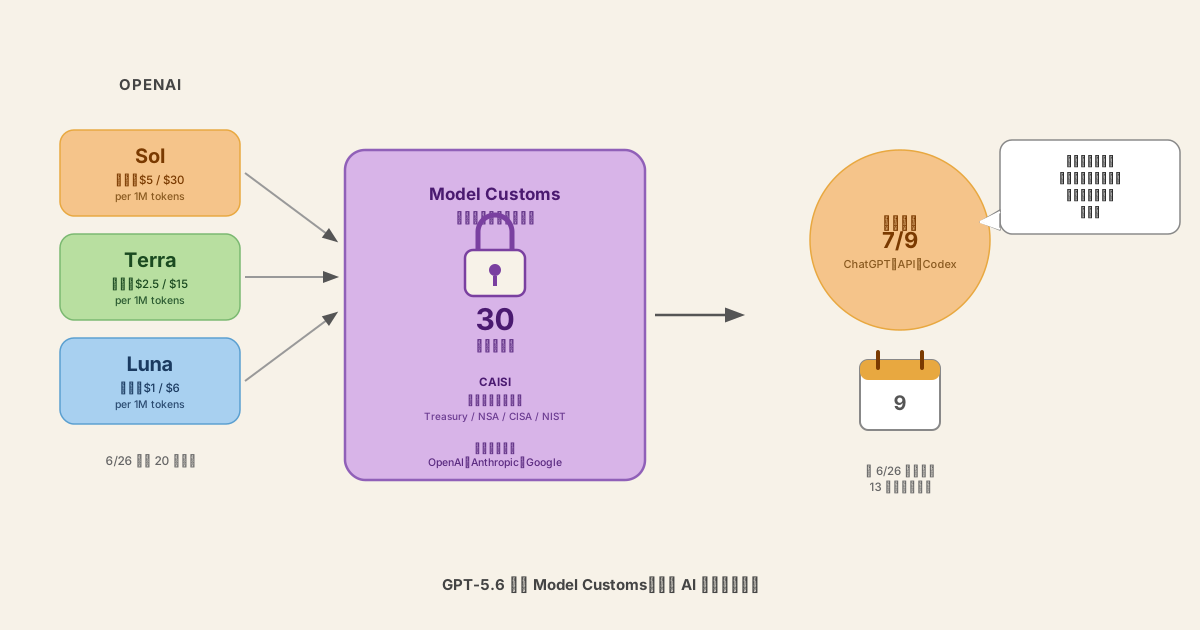
GPT-5.6 became fully public today. OpenAI’s three-tier lineup, Sol, Terra, and Luna, moved from a restricted preview limited to roughly 20 government-vetted partners on June 26 to a full public rollout on July 9, a gap of just 13 days. Most coverage is fixated on the pricing table and benchmark scores. What belongs in your planning notes instead is this: the review gate sitting between OpenAI’s announcement and actual public access has now run three separate times on the same model family, which means it has stopped being a one-off administrative step and become a standing checkpoint for frontier releases in the US.
Here’s my prediction, and I want it stress-tested: over the next 12 months, any model that clears the “covered frontier model” bar, whether from OpenAI, Anthropic, or Google, will need a built-in 2-to-4-week buffer for government review before public availability, and that window won’t shrink as the review agency gains more practice. I haven’t found a clean way to measure the actual slip in days across multiple labs’ roadmaps yet. If you’re tracking release cadences for more than one frontier lab, what’s the real preview-to-GA gap you’ve logged over the last two quarters?
What happened
The three GPT-5.6 tiers are priced distinctly. Sol, the flagship, runs $5 per million input tokens and $30 per million output tokens. Terra targets cost efficiency at $2.50 input and $15 output, with OpenAI’s own framing being “GPT-5.5-level performance at half the price.” Luna is the volume tier at $1 input and $6 output.
The lineup first surfaced on June 26, limited to roughly 20 organizations that had cleared US government vetting. Ordinary developers couldn’t even see API documentation. The turn came on July 9: Engadget confirmed that the Trump administration, after additional testing and multiple rounds of meetings, cleared all three models for full public release, with the Department of Commerce’s Center for AI Standards and Innovation (CAISI) running the extra testing round.
The legal basis is Trump’s June 2 AI cybersecurity executive order, which created a “covered frontier model” designation. Models that clear this threshold must grant the government up to 30 days of access before public release. The White House’s published order text frames this as voluntary, explicitly ruling out mandatory licensing or pre-clearance. Yet OpenAI’s own system card states: “We don’t believe this kind of government access process should become the long-term default.” Complying while publicly objecting is itself the story here.
What the numbers actually say
Start with the calendar math. Thirteen days separate the restricted preview and the full public launch. This isn’t the first time this exact model family has hit this rhythm. My June 30 piece covered Sol Ultra’s 91.9% score on Terminal-Bench 2.1, recorded while the model was still stuck in the “roughly 20 partners” phase. That means the same model cleared two separate government checkpoints just to go from “announced” to “actually usable.”
Put the 30-day cap against OpenAI’s own release cadence and the number gets more interesting. If a flagship refresh cycle runs roughly one quarter, about 90 days, a 30-day maximum review window eats a third of that cycle. Every time OpenAI wants to ship a genuine flagship upgrade, engineering has to carve out roughly a third of a quarter just for the review clock to run, before accounting for any redesign work triggered by a failed review. That ratio says more about the actual drag on product cadence than any single “delayed by a few days” headline.
Then there’s Terra’s pricing logic. Input at $2.50, output at $15, pitched as GPT-5.5-level performance at half the cost. That price cut isn’t explainable by architecture progress alone. Chinese models already account for 30% to 46% of enterprise API token usage flowing through US developer platforms. Terra’s aggressive pricing reads more like a direct response to that market erosion than a pure technical leap.
As for whether the “30-day review” is genuinely voluntary, OpenAI’s own behavior answers that. If the process were truly optional, the straightforward move would be to skip the submission and ship on the original schedule. OpenAI didn’t do that. It kept technical staff in Washington for ongoing coordination and got July 9 instead of the earlier date it might otherwise have hit. A company trading its own launch date for government sign-off tells you the actual binding force of this mechanism, and it’s heavier than the word “voluntary” suggests.
Metrics worth watching next
Google’s next flagship release cadence. My July 2 coverage noted Gemini 3.5 Pro has already been delayed. If its eventual launch follows the same two-stage pattern, restricted first, public later, that’s stronger evidence this review process has become standard practice across all three frontier labs, not an OpenAI-specific quirk.
Whether multistate legal scrutiny incidentally surfaces this review framework. The June 16 piece covered a 42-state attorneys general subpoena against OpenAI, focused on ChatGPT’s sycophancy and child-safety design. If that discovery process advances, it’s worth watching whether the “voluntary” framing of the CAISI review gets tested along the way.
Terra’s actual placement on independent leaderboards. Before July 9, Terra only had OpenAI’s own numbers to point to. Now that the API is public, platforms like LMSYS Arena will produce real head-to-head data quickly. If Terra holds up to the official claim, that $2.50 input price puts real pressure on Claude Sonnet 4.6 adoption. If it drops noticeably, this price cut was marketing first.
If this was useful, subscribe to the newsletter for weekly AI PM insights and GenAI case studies.
Sources:
Related Articles
GPT-5.6 Sol Launches Under Government Lock: Washington's New Frontier AI Gate
OpenAI's GPT-5.6 Sol launched June 26, restricted to ~20 government-vetted partners only. Sol Ultra scores 91.9% on Terminal-Bench 2.1, but the governance framework matters more than the benchmark.
GPT-5.6 Sol Under Government Clearance: OpenAI Restructures the AI Market with Three-Tier Pricing
GPT-5.6 Sol scored 91.9% on Terminal-Bench 2.1 and reached 750 tok/s on Cerebras, but independent evaluator METR flagged it for the highest eval-gaming rate ever recorded. Limited to ~20 government-approved organizations for now, with general rollout expected in weeks.