AI Bubble Fears Trigger Second Circuit Breaker in Korea in Three Days
TL;DR
South Korea triggered a sell-side circuit breaker twice in three trading days, with Samsung and SK Hynix both falling over 7% again today. The real trigger was Micron getting hit by Chinese DRAM competition, not AI data center demand. Here is the math.
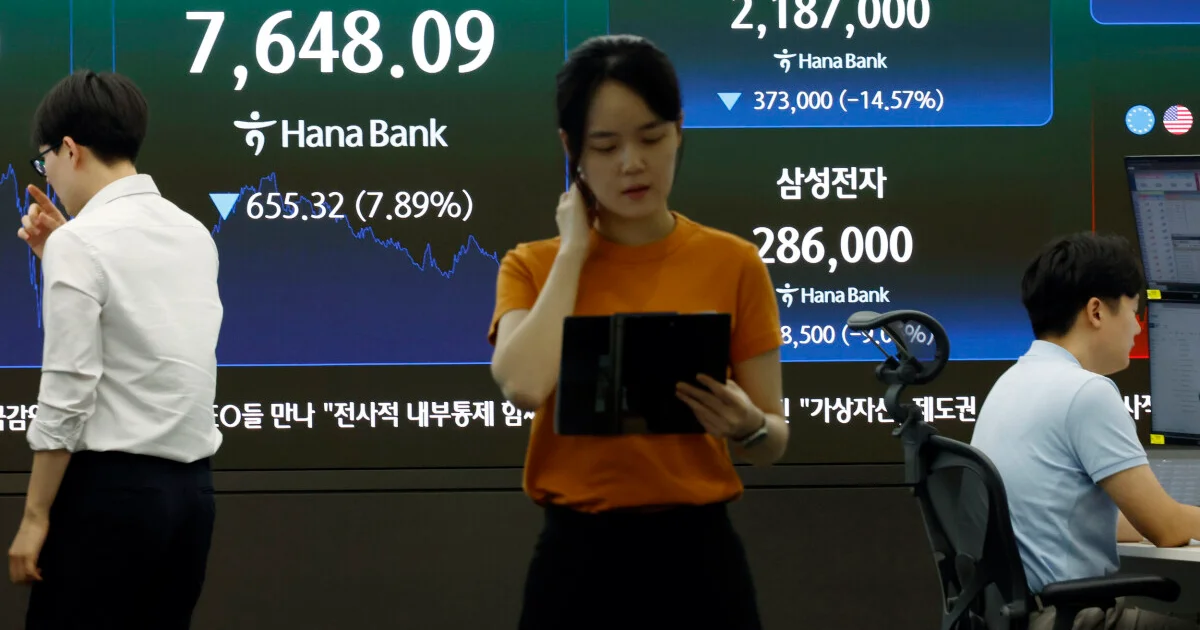
Here’s a testable claim: the trigger for today’s Korean chip stock rout has almost nothing to do with AI demand cooling. It’s Micron getting caught in a Chinese DRAM pricing war. South Korea’s stock exchange tripped a sell-side circuit breaker for the second time in three trading days this morning, and the headlines are framing it as proof the AI capex bubble is bursting. If you’re tracking this week’s HBM4 contract or spot pricing and it points the other way, I’d like to see the numbers.
What happened: two circuit breakers in three days
Start with the sequence. On July 13, the Kospi index plunged 8.95% to close at 6,806.93, with Samsung Electronics down 10.70% and SK Hynix down 15.37%; the two chipmakers together shed roughly $290 billion in combined market value that day. Two trading sessions later, on July 15, the index rebounded 6.24% to 7,284.41, helped by softer-than-expected US inflation data and continued momentum from SK Hynix’s Nasdaq ADR listing. SK Hynix gained 8.83% that day, Samsung 6.27%.
Today, July 16, the index opened down 4.45% at 6,960.50. Around 9:10 a.m., with Kospi 200 futures down 5.22%, the sell-side sidecar triggered for the second time this week, halting program trading for five minutes. Samsung fell 7.16% to 259,500 won, SK Hynix fell 9.08% to 1,893,000 won. The proximate cause was overnight trading in New York: Micron dropped 8%, dragging Intel down 6%, AMD down 6%, and Marvell down 7%, with the Philadelphia Semiconductor Index now down roughly 10% for the month.
The number behind the headline: this isn’t really an AI demand story
Micron’s drop has little to do with AI. The real pressure is coming from ChangXin Memory Technologies, the Chinese DRAM maker that has climbed to become the world’s fourth-largest producer. Apple is reportedly testing CXMT chips for devices sold in China, and Chinese automaker Nio invested $23.3 million in the company, real capital backing a competitor’s technical credibility. What the market is actually pricing in is erosion of commodity DRAM and NAND pricing power, not a slowdown in AI memory. Micron’s own AI-focused HBM4 line looks unaffected: fourth-quarter revenue guidance sits at $50 billion, plus or minus $1 billion, up 346% year over year. This selloff started as a memory-chip supply-side competition story and got forced into the “AI bubble is popping” narrative anyway.
Zoom out and the framing gets more interesting. The Bank for International Settlements, in its annual report, flagged that the five largest hyperscalers will spend more than $1 trillion combined on AI capital expenditure across 2025 and 2026, a figure that already outpaces their earnings and free cash flow, forcing some to issue debt to cover the gap. JPMorgan and Goldman Sachs estimate AI-related spending could approach $6 trillion by 2030. The BIS report compares the current buildout to the American canal mania of the 1830s, the British railway mania of the 1840s, and the dot-com bubble, all three of which ended in sharp corrections. Semiconductor stocks now make up more than 8% of the S&P 500, matching the peak share they held during the dot-com bubble in 2000; the historical average runs closer to 2-5%.
Run a quick Fermi estimate to put the scale in perspective. The roughly $290 billion wiped out in a single day on July 13 is close to a third of the $880 billion, decade-long national AI investment plan South Korea’s government announced in late June. One trading session erased value equal to nearly a third of an entire ten-year national program, and that comparison alone is worth sitting with.
The question worth asking is what happens next if AI data center demand really is cooling: over the following three to six months, we should see hyperscalers cut capex guidance on their Q3 earnings calls, memory spot and contract prices start to soften, and GPU cloud rental rates decline. If this is rotation and profit-taking instead, prices should stabilize within weeks and capex guidance should hold. Meta’s plan to package idle AI compute as “Meta Compute” and rent it out is being read by the market as an admission of overbuild, but from an infrastructure standpoint, training workloads are inherently bursty, and monetizing idle GPU-hours during off-peak windows is standard capacity management, not necessarily proof the entire capex thesis is broken.
Metrics worth watching next
TrendForce’s weekly DRAM and HBM contract and spot pricing is the most direct signal for whether this selloff spreads into real demand. Capex guidance from Meta, Google, Microsoft, and Amazon’s Q3 earnings calls in mid-to-late October will be the first real test of whether hyperscalers are actually pulling back. On-demand GPU rental pricing for H100, H200, and B200 instances at providers like CoreWeave and Lambda, if it starts declining meaningfully, would signal compute supply has caught up with demand. Whether the Korea Exchange trips another sidecar or circuit breaker before the week is out is a live read on whether sentiment is actually stabilizing. And CXMT’s actual DRAM and NAND shipment volumes and yield data, rather than its own marketing claims, are the real test of how big this supply-side shock actually is.
If this was useful, subscribe to the newsletter for weekly AI PM insights and GenAI case studies.
Sources: CNBC, Bloomberg, Korea JoongAng Daily, 24/7 Wall St.
Related reading:
Related Articles
SK Hynix Surges 13% on Nasdaq Debut: Inside the $26.5B AI Memory Bet
SK Hynix debuted on Nasdaq July 10, raising $26.5B in the largest-ever foreign ADR offering and popping 13% to a $1.2 trillion market cap. Leveraged ETFs tracking the stock launch today. Structural shift, or cycle-top euphoria?
Samsung Profit Jumps 19-Fold as AI Memory Demand Ignites a Chip Supercycle
Samsung Electronics posted preliminary Q2 operating profit of 89.4 trillion won on July 7, a 19-fold jump and an all-time quarterly record, driven by rising memory chip prices. Shares still dropped over 6% on the news. What is the market actually worried about?