AWS has announced the TorchNeuron native backend and public-beta arrangements to make moving PyTorch models to Trainium easier. The available evidence helps identify which models can run more readily, but not how much every workload will save. If retaining the original code still requires extensive customization to reach equivalent quality and speed, lower migration barriers may not reduce total costs.Architecture
The announcement date is 2026-10-19. This article uses an October 20, 08:55 Taipei cutoff and the previous day’s event within the 48-hour window. The Reuters republication on Moneycontrol is timestamped October 19 at 18:48 IST, or 21:18 in Taipei. Hugging Face schedules the public beta for October 20 without a time, which does not establish universal download availability at the cutoff.Announcement Reporting Schedule
AWS release notes instead date the public beta to October 19. Neither official source provides a launch time that reconciles the dates. This article retains that discrepancy rather than treating a schedule as evidence of universal access.Release date
TorchNeuron is a native PyTorch backend that routes operations to Trainium through a standard device mechanism. It supports eager execution and compilation-based optimization, allowing more familiar development workflows. This changes software integration; it does not automatically make existing CUDA-specific code portable.Mechanism Scope
Hugging Face reports out-of-the-box support for 89% of the 100 most-used text-generation model architectures, compared with 46% for Optimum Neuron v0.4.5. This measures architecture coverage, not faster execution or lower costs. It does not establish validation of every checkpoint, precision setting or workload.Coverage
Amazon cites Cartesia running its standard inference pipeline with minimal PyTorch changes. Reuters quotes an Amazon executive saying more than 30 early customers use the software. These accounts support actual adoption, but remain supplier-provided cases and counts, not a generally applicable savings estimate.Case Customers
Compare hardware without first rebuilding the product
The option to preserve model code matters most to me. Suppose a team has already brought a model to an acceptable quality level. If evaluating another chip requires rewriting that code first, it must spend engineering effort before learning whether the hardware fits. Reusing code can reverse that sequence: compare the same task, then decide whether further optimization deserves investment. That is particularly useful for teams unable to maintain several implementations simultaneously.
Successful execution is still different from efficient hardware use. AWS documents CPU fallback with a warning for unsupported operators in eager mode; tuning can require compilation or custom kernels.Execution limits A run without an error can therefore conceal waiting caused by data movement or slower operations.
I would preserve shared model logic and separate the parts that genuinely require hardware-specific adjustment. This is a product choice inferred from the backend design: access another compute option without repeating an entire port whenever the model changes. If most of the workload ultimately depends on specialized kernels, the expected maintenance benefit should be revised downward.
Open-source licensing does not remove cloud-access conditions. Amazon lists Trainium2 and Trainium3 support and a planned Apache 2.0 release; using it still requires the corresponding compute capacity.Availability Free software alone cannot establish inexpensive deployment, and architecture coverage should not be treated as market adoption.
The announcement makes more models candidates for hardware comparison, without proving Trainium economical for every workload. I would compare total migration, execution and maintenance costs using equivalent inputs, quality requirements and completed work. When extra optimization consumes the compute savings, retaining the existing platform is reasonable. Easier migration becomes a reason for sustained adoption only when those costs decline together.
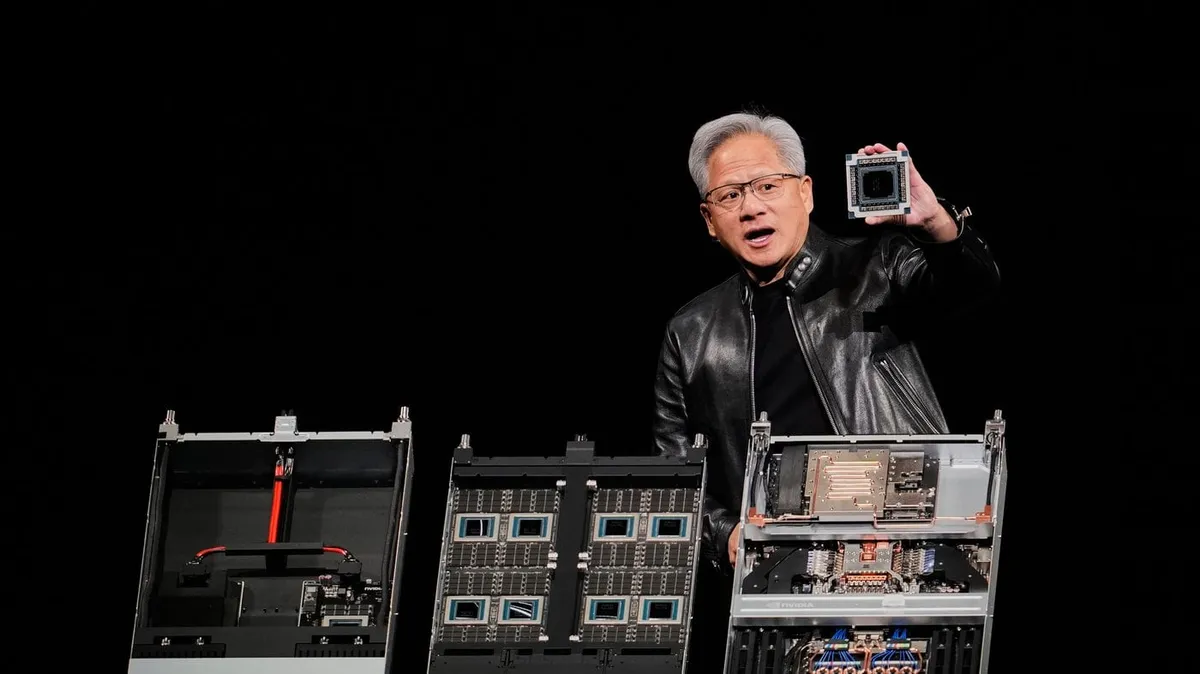
The cover reuses a historical NVIDIA hardware presentation photo from this site to illustrate the competing platform. It does not depict TorchNeuron or Trainium. The official event image could not be downloaded.
Sources:
- PyTorch: Native backend announcement
- Hugging Face: Integration, architecture coverage and beta schedule
- AWS Neuron: Backend, execution modes and operator limitations
- Amazon: Customer cases, hardware support and open-source plans
- Reuters / Moneycontrol: Announcement and early customers
- AWS Neuron: Public-beta release notes