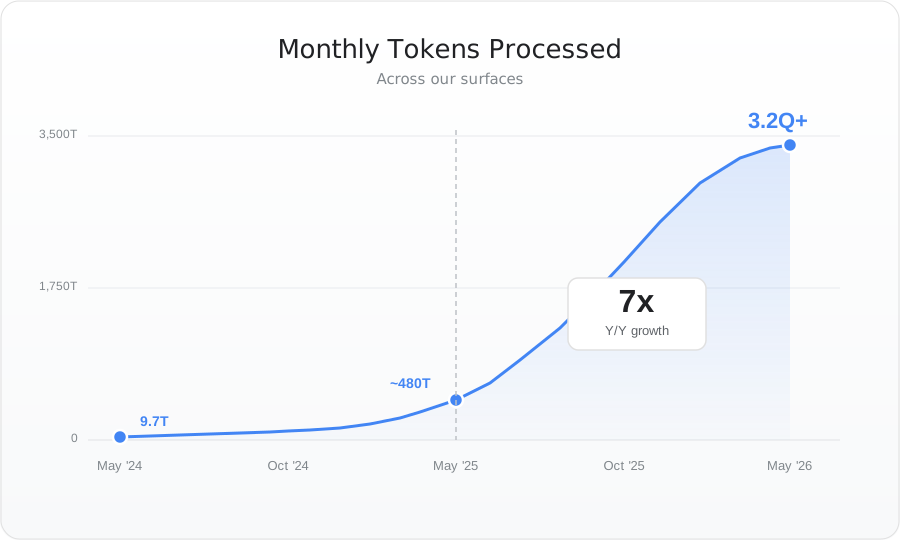
At Google I/O 2026, Sundar Pichai showed a chart of token usage.
It listed 9.7 trillion tokens per month for May 2024, 480 billion for May 2025 and 3.2 quadrillion for May 2026, alongside sevenfold annual growth. These are the figures quoted in the original article; the 2024 and 2025 values do not form a continuous growth series and should not be read as one.
My first reaction to the steep curve was that people could not have typed all of it themselves.
Even hundreds of millions of people using ChatGPT, Gemini and Claude would face a limit on manual input. I read the growth as a sign of automation: systems talking to systems, pipelines feeding pipelines and agents consuming tokens continuously. That interpretation is an argument about the chart, rather than a measured breakdown of its traffic.
Tokens as a unit of computing work
In the 2010s, GPU hours and TPU capacity helped describe what a cloud platform could do. Tokens offer another unit for discussing work done with language models.
Input tokens provide context; output tokens represent generated work. The original argument treats token consumption as a proxy for the intellectual effort applied by AI. That is a useful framing for workload planning, though token volume alone cannot establish answer quality.
Consider the article’s illustrative contract-review example: two hours for a person, versus 50,000 tokens and 30 seconds for an AI workflow. At 10,000 contracts a year, that becomes 20,000 human hours or 500 million tokens. The original estimates a few hundred dollars in API fees. These are scenario assumptions, not a quoted price or a verified end-to-end review benchmark.
The practical question is whether a suitable workflow is actually running.
Manual use has a ceiling
Opening a chat window, asking a question, reading the answer and closing it consumes human time. An eight-hour workday cannot expand indefinitely. The article compares that limit with Google’s stated rate of 19 billion tokens per minute.
An automated pipeline does not need continuous typing. Over three months, an agent could consume more tokens than an employee uses manually in a year, depending on its workload.
The Token Maxi proposition is to build systems that use AI on your behalf, instead of relying only on more individual chat sessions.
Three levels of automation
The first level is a prompt pipeline: package repeated prompts in code, trigger them on a schedule and save the output or send a notification. Examples include a morning news summary, a welcome email for a new customer and an explanation of a monthly report. A small Python workflow can provide a starting point.
The next level gives an agent tools for search, database queries, API calls and code execution. It can act as well as answer. Reliability becomes the central engineering problem: tool calls fail, agents make mistakes and context grows too large. The harness, error handling and retry logic matter.
The third level orchestrates several agents across research, writing, review and formatting, then combines the results. My interpretation is that enterprise deployments with many concurrent pipelines could explain a substantial part of the chart’s growth. The chart itself does not establish that allocation.
Calculate token ROI from outcomes
Instead of starting with “How can I spend fewer tokens?”, ask what the tokens produced.
The original examples compare 100,000 tokens for a loan-document review with three hours of a lawyer’s time, 10,000 tokens for marketing copy that wins a customer, and 5,000 tokens for a weather question. Their value depends on the actual outcome and the work displaced; the article’s suggestion of a return of hundreds of times is illustrative.
Token use is a means. The aim is to automate repetitive cognitive work while people retain judgment, relationships, creativity and ethical decisions.
Operating history can compound
An early automation user accumulates records of inputs, outputs, errors and successes. Those records can support improvements after three months or a year. Improvement requires using the evidence; consumption does not automatically train or correct a system.
The original compares that accumulation with Google’s reported token growth over two years. The defensible operational point is that a running system creates a history that a newly built one lacks.
If a cognitive task repeats more than three times a week and has stable inputs and outputs, it is worth considering automation. Start with a bounded workflow and measure its results. The opportunity comes from useful systems running repeatedly, rather than token consumption by itself.